



Chess Culture, Non classé
Dark chess tales: legends, mysteries and films for Halloween night

22
Oct
Oct
Halloween and chess share more than just the mood: the history of the game is full of genuinely dark legends. A rigged automaton that bluffed all of Europe, a medieval fresco where Death faces a knight at chess, the mysterious end of a world champion, two literary works that plunge into madness… Five verified stories to (re)discover tonight, each linked to a chess board or piece style to carry on the evening.
Published 22 October 2026 · By Delphine D., Le Palais des Échecs editorial team
In brief
• The Mechanical Turk: a chess-playing automaton created in 1770 by Wolfgang von Kempelen, in fact operated by a hidden player.
• Death playing chess: a 15th-century Swedish fresco, taken up by Ingmar Bergman in The Seventh Seal in 1957.
• Alexander Alekhine: world champion found dead in his hotel room in Estoril in 1946, in circumstances never fully explained.
• The Luzhin Defence: a novel by Vladimir Nabokov (1930) about the unravelling of a chess genius, adapted for film in 2000.
• Chess (The Royal Game): a novella by Stefan Zweig, published after his death in 1942, about an obsession born in captivity.
The Mechanical Turk: the chess-playing automaton that terrified Europe
In 1770, the Austrian engineer Wolfgang von Kempelen presented Empress Maria Theresa with an automaton capable of playing chess and beating human opponents: the Mechanical Turk. The automaton took the form of a mannequin in oriental costume, seated behind a wooden cabinet whose doors opened onto a visible clockwork mechanism, supposedly proving there was no trickery involved. For more than eighty years, this figure travelled across Europe and then the United States, beating well-known players.
The mystery came down to a single question: how could an 18th-century machine think? The answer, already suspected during its lifetime, was simpler and more unsettling: a flesh-and-blood chess player was hidden inside the cabinet, operating the automaton’s arms using a system of levers and mirrors. The writer Edgar Allan Poe devoted an entire essay to unpicking the trick in 1836. The Mechanical Turk eventually disappeared in the fire that destroyed the Peale Museum in Philadelphia in 1854, taking some of its secrets with it.
Almost two centuries later, the question of the thinking machine has never truly left chess: it resurfaces every time a program faces a champion, as in the famous duel between Garry Kasparov and the computer Deep Blue in 1997. To continue this journey, take a look at our historical and themed chess sets, before another enigma, this time a pictorial one.
Death playing chess: Albertus Pictor’s fresco and The Seventh Seal
In the church of Täby, near Stockholm, the Swedish painter Albertus Pictor created a now-famous fresco at the end of the 15th century: «Döden spelar schack», Death playing chess against a man for his own life. The image, striking in its simplicity, has endured for centuries without losing its power.
In 1957, the film-maker Ingmar Bergman drew direct inspiration from it for The Seventh Seal: the knight Antonius Block, returning from the Crusades, challenges Death to a game of chess on a board set on the sand, hoping to buy himself time. The scene has become one of the most quoted in cinema history, and it has firmly fixed the image of a chess board as a place of bargaining between life and death.
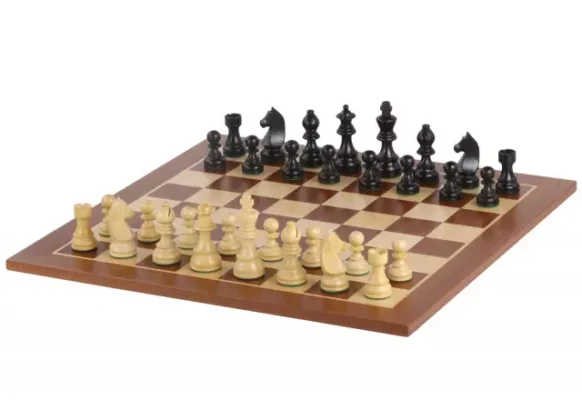
To recreate this scene at home, a chess board with sharp contrast stays truest to the spirit of the fresco: dark and light pieces clearly distinct, set on a sober board. The Classic Staunton Set in ebony and boxwood captures this, on a wooden chess board with timeless appeal.

The mysterious death of Alexander Alekhine in Estoril, 1946
Alexander Alekhine was world chess champion when he was found dead in his room at the Hotel do Parque in Estoril, Portugal, in March 1946. To this day, he remains the only world champion to have died while still holding the title. The exact circumstances of his death have never been fully explained, and they continue to fuel speculation nearly eighty years on.
Alekhine belongs to the lineage of classic Staunton masters, an era when ebony and boxwood pieces dominated international tournaments. To (re)discover the great names who shaped this history, our article on the 11 best chess players of all time places his career in context.
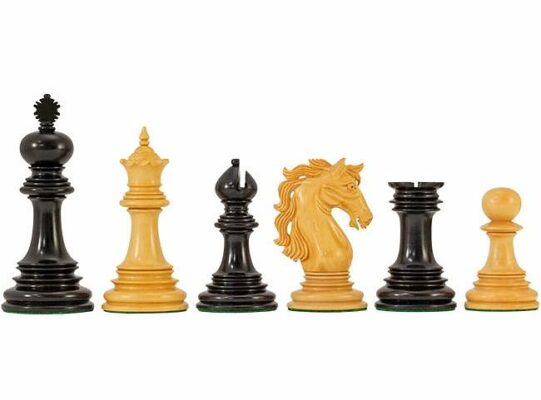
A chess set entirely in ebony wood, with no embellishment, captures well the austerity of tournaments from that era. The Constantine Chess Set in ebony wood is part of our fine wood chess sets.
Nabokov’s The Luzhin Defence: the madness of a chess genius
Published in 1930, Vladimir Nabokov’s novel follows Luzhin, a grandmaster overtaken by his own genius: by seeing the entire world as an extension of the chess board, he loses his grip on reality. The novel closes on a fall, that of a man who believes he can escape a game that pursues him everywhere.
The story was brought to the screen in 2000, with John Turturro in the role of Luzhin. This film features among the references in our selection of the best chess films.
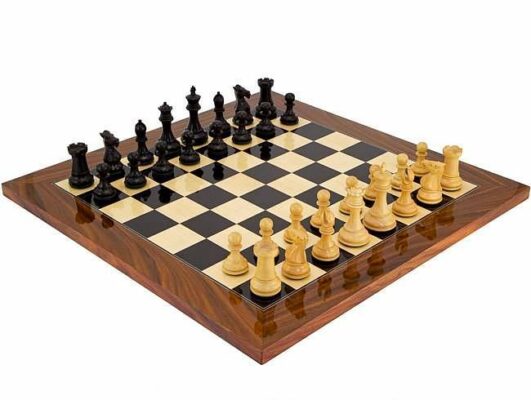
The tormented grain of rosewood burl evokes rather well the tortured spirit of the character. The Elegant Set, chess board in rosewood burl and chess set in ebony wood, captivates with this contrast between refinement and darkness.
Stefan Zweig’s Chess: obsession to the point of madness
Stefan Zweig wrote Chess (The Royal Game) in 1941; the novella was published after his death, in 1942. The narrator meets a man who taught himself chess alone, in captivity, by memorising the games in a stolen manual. Deprived of a real opponent, he ends up playing against himself, until a monomania resurfaces years later, aboard an ocean liner, facing a world champion.
Zweig’s text remains one of the most accurate explorations of what chess can do to an isolated mind. To carry on this evening with other unsettling tales, our article on the darkest chess sets offers further ideas for reading and playing.
For an equally unsettling but older atmosphere, the pieces of the Isle of Lewis, with their frozen faces and empty stares, evoke a mysterious Middle Ages quite different from Zweig’s modern isolation.
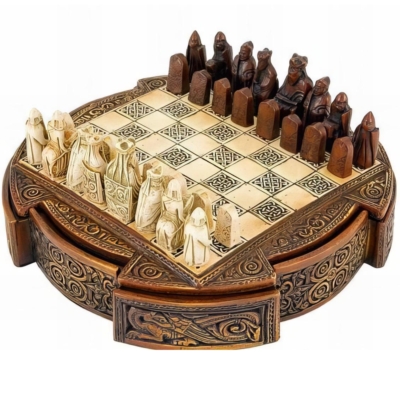
These reproductions of the famous medieval pieces discovered in Scotland bring a touch of strangeness to any collection. The Isle of Lewis Travel Set is our most sought-after version.
Five dark chess tales, at a glance
| Story | Period | Place | Nature |
|---|---|---|---|
| The Mechanical Turk | 1770 to 1854 | Vienna, then Europe and the United States | Historical fact |
| Death playing chess | Fresco: late 15th century; film: 1957 | Täby (Sweden) | Fact (fresco) and fiction (film) |
| Alekhine’s death | 1946 | Estoril (Portugal) | Historical fact |
| The Luzhin Defence | Novel: 1930; film: 2000 | Fiction | Literary work |
| Chess (The Royal Game) | Written 1941, published 1942 | Fiction | Literary work |
For a successful chess-themed Halloween evening: films, reading and the right chess board
Three ingredients are enough for a memorable evening: a film, a book, and a chess board to match the mood.
On screen
The Seventh Seal (1957) for its iconic scene, and The Luzhin Defence (2000) for the unravelling of a genius. Our selection of the best chess films lists several more.
For reading
Zweig’s Chess can be read in a single evening; Nabokov’s The Luzhin Defence takes a little longer, for an equally striking effect.
For a lighter touch if the evening also includes children, the wizard-themed chess set inspired by Harry Potter changes the mood entirely.
As for the chess board, dark woods remain the most fitting for the atmosphere: solid ebony, in particular, echoes the darkness of these evening tales.
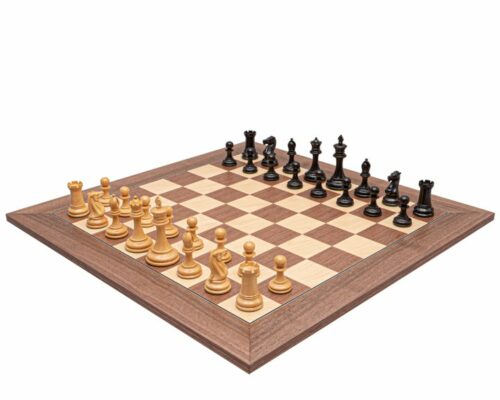
Pieces in boxwood and ebony on a walnut and maple board: the Rochester Set combines striking contrast with careful finishing, part of our fine wood chess sets.
For a more intimate piece, to display year-round on a shelf, the Collector’s Chess Pieces in boxwood and ebony wood play on the same contrast, without a board.
Frequently asked questions
Why are Halloween and chess associated?
Because the history of the game includes several genuinely unsettling episodes: a rigged automaton, the mysterious death of a world champion, a medieval fresco where Death faces a man across a chess board, and literary works that explore madness. These are not legends invented for the occasion, but real facts and real works.
Who built the Mechanical Turk?
The Austrian engineer Wolfgang von Kempelen, in 1770, for the court of Empress Maria Theresa. The automaton actually concealed a hidden chess player inside the cabinet, and it was destroyed in a fire in Philadelphia in 1854.
How did Alexander Alekhine die?
The world champion was found dead in his hotel room in Estoril, Portugal, in March 1946. The exact circumstances of his death have never been fully explained, making it one of the most discussed mysteries in chess history.
Is The Luzhin Defence a true story?
No, it is a work of fiction written by Vladimir Nabokov in 1930. It tells of the unravelling of a grandmaster overwhelmed by his own genius, to the point of no longer distinguishing the game from reality.
What is Stefan Zweig’s Chess about?
This novella, published in 1942 after the author’s death, follows a man who taught himself chess alone, in captivity, and develops an obsession so intense that it resurfaces years later, during a game against a world champion.
Which chess board suits a Halloween atmosphere?
A chess board in dark, contrasting woods, such as ebony paired with boxwood or walnut, best suits the mood. Our fine wood chess sets and wooden chess boards include several suitable models.
Fancy carrying on the evening?
From ebony wood pieces to Isle of Lewis reproductions, discover the chess sets that best suit these dark tales.
Historical & themed chess setsIsle of Lewis setsFine wood chess pieces
Random chess: a breath of fresh air in the chess world!
Today, we’re going to explore a variant of chess that’s growing in popularity and promises [...]
Chess Puzzle No. 275: Can White win it all with a forcing sequence?
An interactive chessboard awaits: can you find the winning move in this intermediate-level endgame? Play [...]
Electronic Chess Board: Comparison and Buying Guide 2026
Discover the best electronic chess sets, from the most popular to the most technical