Chess rules: moves, captures and special moves
This guide answers the most frequently asked questions about the rules of chess. Whether you’re a complete beginner or want to brush up on your knowledge, each answer below is self-contained and complete: you can read any question independently of the others. From the basics of how pieces move to strategies for improving, as well as special moves and endgame situations, it’s all here. Happy reading, and enjoy your games!
The basics of chess
How do you play chess?
Chess is played on a chessboard of 64 squares (8 rows × 8 columns), alternating between light and dark colours, between two players. Each player has 16 pieces: a king, a queen, two rooks, two bishops, two knights and eight pawns. White always makes the first move, then the players alternate. On each turn, a player moves a single piece according to the movement rules specific to that piece. You can capture an opponent’s piece by moving onto the square it occupies. The aim is to put the opponent’s king in checkmate, meaning to attack it without any way for it to defend itself. The game can also end by resignation, by a draw (stalemate, repetition, insufficient material) or by running out of time in timed games.
What is the aim of chess?
The aim of chess is to put the opponent’s king in checkmate. This means the king is under attack (in check) and there is no legal move to escape this threat: it cannot flee, be protected by another piece, or have the attacking piece captured. Contrary to popular belief, the aim is not to capture the king (it is never actually taken) nor to eliminate all the opponent’s pieces. As soon as checkmate is declared, the game ends immediately, regardless of what pieces remain on the board.
What are the pieces in chess?
Each player begins the game with 16 pieces, making 32 pieces in total on the chessboard. There are six types of pieces, each with distinct movement and strategic value:
| Piece | Symbol | Quantity | Value |
|---|---|---|---|
| King | ♚ / ♔ | 1 | Priceless |
| Queen | ♛ / ♕ | 1 | 9 points |
| Rook | ♜ / ♖ | 2 | 5 points |
| Bishop | ♝ / ♗ | 2 | 3 points |
| Knight | ♞ / ♘ | 2 | 3 points |
| Pawn | ♟ / ♙ | 8 | 1 point |
The king is the most important piece (its loss ends the game), while the queen is the most powerful thanks to its freedom of movement. Point values serve as a guide for evaluating exchanges.
How many pieces are there in a chess set?
A complete chess set has 32 pieces: 16 white and 16 black. Each side has exactly: 8 pawns, 2 rooks, 2 knights, 2 bishops, 1 queen and 1 king. At the start of the game, all the pieces are placed on the board: the major and minor pieces on the first rank and the pawns on the second. If you’re looking for a complete set with matching pieces and board, discover our complete chess sets.
What are chess pieces called?
Chess has six types of pieces, each with a specific name. The King is the central piece of the game. The Queen is the most powerful piece. The Rook moves in straight lines. The Bishop moves diagonally. The Knight is the only piece that can jump. Finally, the Pawn is the humblest piece but the most numerous (8 per side). Note: in everyday language, many people say «pieces» to refer to all the chessmen, but strictly speaking, the word «pawn» refers only to the small pieces lined up on the second rank. The correct generic term is «piece».
What is the chess board called?
The chess board is called a chessboard. It is made up of 64 squares arranged in a grid of 8 rows (numbered 1 to 8) and 8 columns (labelled a to h). The squares alternate between light and dark colours. An essential placement rule: the board must be oriented so that a light square is in the bottom right-hand corner for each player. Chessboards come in many fine materials. Discover our chess boards in solid wood, marble or leather.
Who moves first in chess?
White always plays first. This is a universal rule applied in all official competitions and validated by FIDE (the International Chess Federation). After White’s first move, players alternate strictly: one move for White, one move for Black. Statistically, playing White gives a slight advantage (around 55% of wins at the highest level), which explains why, in championship matches, colours alternate from one game to the next.
How long does a chess game last?
The duration of a game varies enormously depending on the time control chosen. In bullet (1 to 2 minutes per player), a game lasts a few minutes at most. In blitz (3 to 5 minutes), expect 6 to 10 minutes. In rapid games (10 to 30 minutes), a game can last from 20 minutes to 1 hour. At classical time controls (official competitions), games generally last between 2 and 6 hours. The longest game in history was Nikolić against Arsović in 1989: 269 moves and over 20 hours of play! To play with time controls, you’ll need a clock. Discover our chess clocks.
The pawn: movement, captures and special rules
How does the pawn move in chess?
The pawn has a unique way of moving among all the pieces. It advances one square forward (towards the 8th rank for White, towards the 1st for Black). From its starting position (2nd rank for White, 7th for Black), it has the option of advancing two squares in one move. The pawn can never move backwards: each advance is final. To capture, the pawn works differently from how it moves: it takes an opponent’s piece located diagonally forward, one square away. It cannot capture the piece directly in front of it. If a piece blocks its path in a straight line and no diagonal capture is possible, the pawn is completely blocked. When a pawn reaches the last rank of the board, it must be promoted to another piece (queen, rook, bishop or knight).
The pawn is the only piece that can never move backwards. Every pawn advance is irreversible, making it one of the most important strategic decisions in the game.
Can the pawn capture backwards?
No, never. The pawn can only capture diagonally forward, one square away. It is strictly impossible for it to capture backwards, sideways or in a straight line in front of it. The pawn is, in fact, the only piece in chess that can neither move nor capture backwards. All other pieces (king, queen, rook, bishop, knight) can move in several directions, including backwards. This restriction makes the pawn a unique piece, one whose every advance must be carefully considered.
No. The pawn can never capture backwards. It only takes diagonally forward, one square away.
Can the pawn capture diagonally?
Yes, that’s the only way the pawn can capture. The pawn moves straight ahead, but it captures diagonally forward, one square away. It is the only piece in chess whose way of capturing differs from its way of moving: all other pieces capture by moving normally onto the square occupied by the opponent’s piece. The pawn, on the other hand, advances in a straight line but can only take pieces located on the two diagonal squares in front of it.
Can pawns capture forwards?
No, not in a straight line. A pawn cannot capture the piece directly in front of it. Its forward movement (one or two squares in a straight line) is only for advancing, not for capturing. To take an opponent’s piece, the pawn must have a target on one of the two squares diagonally forward. If a piece (friendly or enemy) blocks the square directly in front of the pawn, it is blocked and cannot advance until the obstacle is removed.
Can the pawn advance without capturing?
Yes, that’s actually its normal move. The pawn advances one square forward (or two from its starting position) without capturing anyone. It only captures when an opponent’s piece is on a diagonal square in front of it, and this capture is always optional. Unlike draughts, where capturing is compulsory, in chess a player is never forced to capture. The pawn can therefore perfectly well advance straight ahead while ignoring an available diagonal capture.
Which pawn should you play first in chess?
The two most popular and recommended moves to start a game are 1.e4 (advancing the king’s pawn two squares) and 1.d4 (advancing the queen’s pawn two squares). The move 1.e4 is more aggressive: it immediately frees the bishop and the queen, and often leads to open, tactical games. The move 1.d4 is more positional and strategic. For a beginner, 1.e4 is generally recommended: it makes it easier to understand opening principles (control of the centre, rapid development of pieces, king safety) in positions that are clearer and easier to analyse.
Which pawn can move backwards in chess?
No pawn can move backwards. This is the pawn’s unique feature: it is the only piece in chess that can only move in one direction (forwards). All other pieces can move backwards: the king moves one square in any direction, the queen along ranks, files and diagonals in every direction, the rook forwards and backwards along ranks and files, the bishop diagonally both ways, and the knight in any L-shaped direction. It is precisely because pawn moves are irreversible that they carry such strategic importance.
What happens when a pawn reaches the other side?
When a pawn reaches the last rank of the board (the 8th rank for White, the 1st for Black), it must be promoted. The player must immediately replace this pawn with a piece of their choice: queen, rook, bishop or knight. It is impossible to keep a pawn on the last rank and impossible to promote it to a king. In practice, the queen is chosen in the overwhelming majority of cases since it is the most powerful piece. However, it is sometimes strategic to choose a knight (known as «under-promotion»), particularly to deliver a forking check. It is entirely possible to have several queens on the board at the same time.
How do you get 2 queens in chess?
To have two queens, you need to carry out a promotion. When a pawn reaches the last rank of the board, it must be replaced by a piece of the player’s choice, and the queen is the most common choice. Since each player has 8 pawns that could theoretically reach the last rank, it is possible to have up to 9 queens (the original queen plus 8 promotions). In practice, getting 2 queens is already often a decisive advantage and occasionally occurs in competitive games. If a promotion occurs without a spare queen available in a physical set, an upturned rook is generally used to represent the second queen.
Are there any chess sets sold with two extra queens?
Yes. Some high-end sets come directly with two spare queens, ready to replace a promoted pawn without having to improvise with an upturned rook. This is the case with the Competition Set and the Leningrad Set, both supplied with 34 pieces in total: the usual 32 pieces plus two extra queens.
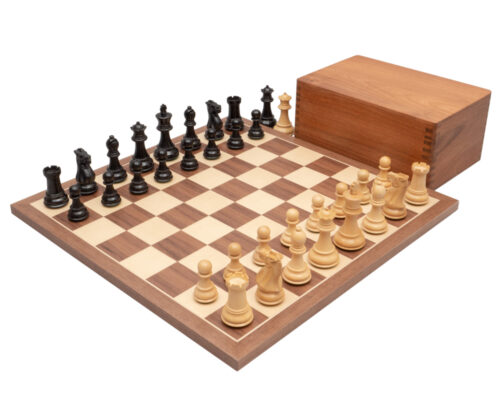
The Competition Set pairs a walnut and maple chess board with a boxwood chess set, complete with a golden rosewood storage box and two extra queens included.
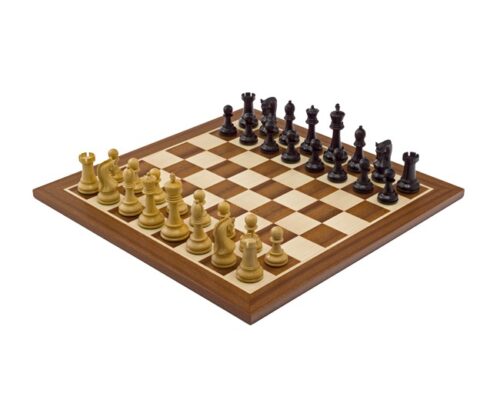
The Leningrad Set combines a mahogany chess board with an ebonised boxwood chess set, also supplied with 34 pieces.
How chess pieces move
How do chess pieces move?
Each chess piece follows precise movement rules. The King moves one square in any direction. The Queen moves along ranks, files and diagonals, with no limit on distance. The Rook moves horizontally and vertically, with no limit. The Bishop moves only diagonally, with no limit. The Knight moves in an «L» shape (2 squares + 1 square perpendicular) and can jump over other pieces. The Pawn advances one square forward and captures diagonally. No piece except the knight can jump over another.
| Piece | Movement | Can jump? |
|---|---|---|
| King ♔ | 1 square, any direction | No |
| Queen ♕ | Ranks, files, diagonals (unlimited) | No |
| Rook ♖ | Ranks and files (unlimited) | No |
| Bishop ♗ | Diagonals (unlimited) | No |
| Knight ♘ | L-shape (2+1 squares) | Yes |
| Pawn ♙ | 1 square forward (2 from start), captures diagonally | No |
How does the queen move in chess?
The queen is the most powerful piece in chess. It can move as many squares as it likes in every direction: horizontally (along ranks), vertically (along files) and diagonally. It thus combines the abilities of the rook and bishop combined. Its only restriction is that it cannot jump over other pieces: if a piece is in its path, it must stop before it or, if it’s an opponent’s piece, capture it by moving onto its square. From the centre of the board, the queen can control up to 27 squares.
How does the bishop move in chess?
The bishop moves exclusively diagonally, as many squares as it likes. It cannot move horizontally or vertically. A fundamental feature of the bishop: it stays on the same colour square throughout the game. A bishop placed on a light square can never reach a dark square, and vice versa. That’s why each player starts with two complementary bishops: a light-squared bishop and a dark-squared bishop. The bishop pair is particularly powerful because together they cover the entire board. The bishop cannot jump over other pieces.
Can the rook move backwards?
Yes. The rook moves horizontally and vertically (along ranks and files), in every direction, including backwards. It can move forwards, backwards, left or right, as many squares as it likes, as long as no piece blocks its path. The rook cannot, however, move diagonally. Remember that the pawn is the only piece that cannot move backwards; all other pieces, including the rook, can move both ways.
Is the knight allowed to jump over pawns?
Yes, indeed! The knight is the only piece in chess allowed to jump over other pieces, whether friendly or enemy. It moves in an «L» shape: two squares in one direction (horizontal or vertical) then one square perpendicular (or the other way round, one square then two). Pieces located between the starting square and the destination square have no bearing on the knight’s move. This is what makes the knight such a formidable piece in closed positions, where other pieces are blocked by pawn chains.
Can the bishop move backwards?
Yes. The bishop can move diagonally in every direction, including backwards. There is no directional restriction on the bishop, other than that it must stay on the diagonals and cannot jump over pieces. As with all pieces except the pawn, moving backwards is a perfectly legal and common move for the bishop.
Which chess piece cannot move diagonally?
The rook cannot move diagonally. It moves exclusively along ranks (horizontally) and files (vertically). It is this complementarity with the bishop (which only moves diagonally) that makes the queen so powerful, since she combines both types of movement. Note that the pawn, strictly speaking, doesn’t move diagonally either: its normal move is in a straight line forward. It only uses the diagonal to capture, not to move freely.
Can the queen do what the knight does?
No. Despite its power, the queen cannot jump over pieces. Only the knight has this ability. The queen moves in straight lines (horizontal, vertical and diagonal) and must have a completely clear path to the target square. If a piece is in its way, the queen must stop before it or capture it if it belongs to the opponent. This is precisely what gives the knight its value: its jumping ability lets it reach squares that are inaccessible to other pieces.
How does a queen capture a pawn?
The queen captures a pawn (or any other opposing piece) by moving onto the square occupied by that piece. The captured piece is then removed from the board. The queen can capture any opposing piece (pawn, knight, bishop, rook, or even the opposing queen) located on a square it can reach in a straight line — horizontally, vertically or diagonally — provided no piece blocks the path between it and its target. Capturing is never compulsory in chess: a player can choose to capture or play another move.
The king: powers and limits
Can the King capture the queen in chess?
Yes! The king can capture any opposing piece, including the queen, on one absolute condition: this capture must not put the king itself in check. Specifically, if the opposing queen is on a square adjacent to the king and is not defended by any other piece, the king can perfectly well capture it by moving onto its square. This is a legal and sometimes spectacular move. However, if the queen is defended by another piece (a rook, a bishop, a knight or even a pawn), the king cannot take it because it would end up in check, which is forbidden.
The king can capture any opposing piece, including the queen, provided this capture does not put it in check.
Why can’t the king take the queen?
In reality, the king can take the queen! But only if the queen is not defended by another opposing piece. If a bishop, rook, knight or pawn defends the queen, capturing it would place the king on a square attacked by that defending piece — the king would then be in check, which is illegal. The fundamental rule is simple: the king can never voluntarily move onto a square where it would be in check. This rule applies to all king moves, including captures. Before taking a piece with your king, always check whether it is defended.
Can the king take the other king?
No, never. Two kings can never be on adjacent squares. Indeed, for one king to capture the other, it would have to move onto the square occupied by the opposing king — but this square is defended by that same king, which would put the attacking king in check. And a king can never voluntarily put itself in check. As a result, the two kings must always remain at least one square apart. This is what is known as «opposition» in the endgame: the kings face each other with one square between them, never able to touch.
Can one king put the other king in check?
No. To put the opposing king in check, your king would have to move onto a square adjacent to it. But a square adjacent to the opposing king is, by definition, a square controlled by that king. Your king would therefore end up in check, which is illegal. It’s a vicious circle: to threaten the enemy king, your own king would have to endanger itself. That’s why one king can never give check to another king in a game of chess.
Can the king advance two squares?
As a general rule, no: the king only moves one square at a time, in any direction (horizontal, vertical or diagonal). There is one single exception: castling. During castling, the king moves two squares towards a rook, and the rook jumps over the king to land on the other side. This is the only moment in the entire game when the king travels more than one square, and it’s also the only move where two pieces move simultaneously. Apart from castling, the king remains limited to moving one square per turn.
Which pawn can take the king?
No piece ever «takes» the king in chess. Unlike other games, the king is never actually captured: when it is in checkmate (attacked with no possible defence), the game ends immediately, before the capture can take place. However, any piece can put the king in check (threaten it), including a simple pawn. A pawn gives check to the king when it stands diagonally directly in front of it. Checkmate delivered by a pawn, though rare, is entirely possible.
When do you say check?
You say «check» when a piece directly attacks the opposing king. In a friendly game, it is polite custom to announce «check» to warn the opponent, but this is not required by the official FIDE rules. In competition, players generally do not announce check — it is up to each player to recognise threats on the board. When the king is in check, the player concerned must respond to the threat on the very next move, either by moving the king, blocking with a piece, or capturing the attacking piece. If none of these three options is available, it’s checkmate.
Are you forced to capture in chess?
No. Unlike draughts, where capturing is compulsory, in chess no capture is ever forced. On each turn, the player chooses freely among all their legal moves, whether or not they involve a capture. The only obligation is to respond to a check: if your king is under attack, you must respond to this threat (flee, block, or capture the attacker), but even then, capturing is just one option among others. This freedom of choice is fundamental to chess and considerably enriches the strategy.
Where does the king start in chess?
At the start of the game, the white king is placed on e1 and the black king on e8. A very useful memory aid for remembering the starting position: «queen on her own colour». The white queen goes on the light square (d1) and the black queen on the dark square (d8). The king takes the remaining square next to the queen, i.e. e1 for White and e8 for Black. The rooks occupy the corners, the knights sit next to the rooks, the bishops next to the knights, and the row of pawns is placed in front of all the pieces.
Special moves
How do you swap the king and the rook? (Castling)
This special move is called castling. It’s the only move in the game where two pieces move simultaneously. The king moves two squares towards a rook, and the rook then jumps over the king to land on the other side. There are two types of castling:
• Kingside castling: the king goes from e1 to g1 and the rook from h1 to f1 (for White). Notation: O-O.
• Queenside castling: the king goes from e1 to c1 and the rook from a1 to d1 (for White). Notation: O-O-O.
Castling serves to tuck the king safely into a corner while bringing the rook into more active play towards the centre. It’s a fundamental move that should be aimed for early in the opening.
When can’t you castle?
Castling is subject to six strict conditions. If any one of them is not met, castling is forbidden:
1. The king has already moved during the game (even if it has returned to its starting square).
2. The rook in question has already moved (even if it has returned to its place).
3. Pieces stand between the king and the rook — all the squares between them must be empty.
4. The king is currently in check — you cannot castle to escape a check.
5. The king would pass through a square under attack from an opposing piece during castling.
6. The king would land on a square under attack — it cannot end up in check.
Note: the rook, on the other hand, can pass through an attacked square (only the king’s path counts). Also, the fact that the rook is under attack does not prevent castling.
When does a pawn become a queen?
A pawn becomes a queen (or any other piece of its owner’s choice) when it reaches the last rank of the board: the 8th rank for a white pawn, the 1st rank for a black pawn. This mechanism is called promotion. As soon as the pawn reaches that rank, the player must replace it with a queen, rook, bishop or knight of their colour. They cannot choose to keep a pawn or promote it to a king. The queen is almost always chosen because it’s the most powerful piece (worth 9 points), but under-promotion to a knight can sometimes deliver a decisive check.
What is en passant?
En passant is a special move reserved for the pawn. It occurs in a specific situation: when an opposing pawn advances two squares from its starting position and lands next to one of your pawns (on the same rank), you can capture that pawn «in passing», as if it had only advanced one square. Your pawn moves diagonally onto the square the opposing pawn passed over, and the opposing pawn is removed. This capture can only be made immediately after the opponent’s two-square pawn advance: if you don’t play it right away, you lose the right to do so. It’s one of the least-known moves among beginners.
Value and importance of the pieces
Which is the strongest piece in chess?
The most powerful piece in chess is the queen, with a conventional value of around 9 points. Here is the complete hierarchy of pieces:
| Piece | Value |
|---|---|
| Queen ♕ | 9 points |
| Rook ♖ | 5 points |
| Bishop ♗ | 3 points |
| Knight ♘ | 3 points |
| Pawn ♙ | 1 point |
| King ♔ | Priceless |
These values are strategic guidelines, not absolute rules. The concrete position on the board can change the relative importance of each piece. The king has no numerical value because it can never be exchanged: its loss means the end of the game.
Which chess piece has the lowest value?
The pawn, with a conventional value of 1 point, is the least powerful piece in chess. But don’t underestimate pawns! They play a fundamental role: they control the centre, define the structure of the position, protect the king and, above all, they can be promoted to a queen upon reaching the last rank. An advanced, well-supported pawn can be worth more than a knight or a bishop. As the great Philidor said: «Pawns are the soul of chess.»
Why is the queen the strongest piece in chess?
The queen is the most powerful piece because it combines the movements of the rook and bishop. It can move horizontally, vertically and diagonally, as many squares as it likes. Placed at the centre of the board, it controls up to 27 squares simultaneously. No other piece offers this versatility. With her mobility, she can attack, defend, block and deliver mate. This is why losing your queen is generally a decisive disadvantage, and why queen sacrifices are considered among the most spectacular moves.
Which is stronger, the king or the queen?
In terms of movement power, the queen is incomparably stronger than the king. She travels across the board in every direction with no limit on distance, while the king only moves one square at a time. However, in terms of importance, the king is the supreme piece: its loss (checkmate) ends the game. You can sacrifice your queen to gain a strategic advantage or achieve mate; you can never sacrifice your king. The queen is the strongest piece, the king is the most important piece. Strength and importance are two distinct notions in chess.
Which piece must absolutely be protected in a chess game?
The king, without a doubt. It is the only piece whose loss brings the game to an immediate end. The whole strategy of chess revolves around two complementary goals: protecting your own king and threatening your opponent’s. The queen is very powerful, but she can be sacrificed if it leads to mate; the king, on the other hand, is never expendable. This is why castling (to tuck the king away safely) is one of the first goals of the opening.
What are the names of the chess pieces in French and English?
Chess has six types of pieces. In French and English, their names are as follows: the King (Roi), the Queen (Dame or Reine), the Rook (Tour), the Bishop (Fou), the Knight (Cavalier) and the Pawn (Pion). In French algebraic notation, the abbreviations are R (Roi), D (Dame), T (Tour), F (Fou), C (Cavalier); the pawn has no abbreviation, only the destination square is noted. Remember that the term «pawn» specifically refers to the small pieces on the second rank, whereas «piece» is the generic term.
Endgames and draws
When is a chess game a draw?
A chess game can end in a draw in five situations defined by the FIDE rules:
1. Stalemate: the player to move is not in check but has no legal move available. The game is immediately drawn.
2. Insufficient material: neither player has enough pieces to force a checkmate (for example: king against king, king and bishop against king, king and knight against king).
3. Threefold repetition: the exact same position (same piece placement, same player to move, same castling and en passant rights) occurs three times.
4. The 50-move rule: if 50 consecutive moves are played without any capture or pawn move, a player can claim a draw.
5. Mutual agreement: both players agree to end the game as a draw.
What is a draw called in chess?
A draw in chess is simply called a draw. The most famous type of draw is stalemate, when a player has no legal move even though their king is not in check. Other forms have specific names: draw by mutual agreement, draw by repetition (threefold repetition of a position), draw by the 50-move rule (50 moves without a capture or pawn move), and draw by insufficient material (when there aren’t enough pieces left to deliver mate). In notation, a draw is shown as «½-½».
Why does stalemate exist?
Stalemate exists because a player cannot be forced to play an illegal move. When a player is not in check but none of their possible moves would be legal (every move would put their king in check, or they simply have no piece able to move), the game cannot continue normally. FIDE rules then declare the game drawn. This result is sometimes controversial: some argue that the stalemated player should lose since they are in an inferior position. But the current rule, in place since the 19th century, treats stalemate as a draw. This adds a fascinating strategic dimension: a player at a disadvantage can actively seek stalemate to save half a point.
How do you deliver checkmate in 1 move?
Delivering checkmate in a single move depends on the position on the board. For a mate to be possible in one move, three conditions must be met: your piece attacks the opposing king, the king has no square to escape to, and no opposing piece can block the attack or capture the attacker. The fastest possible checkmate from the starting position is Scholar’s Mate, in 4 moves: 1.e4 e5 2.Bc4 Nc6 3.Qh5 Nf6? 4.Qxf7#. The queen delivers check on f7, defended by the bishop on c4, and the black king has no escape. To train yourself to spot mates in 1 move, solving tactical puzzles is the ideal exercise.
What is the fastest checkmate?
The fastest possible checkmate in a game of chess is Fool’s Mate, achievable in just 2 moves: 1.f3 e5 2.g4 Qh4#. The black queen delivers check on h4, and the white king, trapped on e1, has no escape since the moves f3 and g4 have opened up the fatal diagonal. This mate requires White to play two extremely poor moves (weakening the e1-h4 diagonal). It practically never happens in competitive play, but it perfectly illustrates the importance of king safety from the very first moves.
How do you checkmate with a king and a bishop?
It’s impossible. King and bishop against a lone king is a case of insufficient material: the game is automatically declared drawn under FIDE rules. The bishop can only control squares of one colour, which always leaves escape squares for the opposing king. Similarly, king and knight alone against king is also insufficient. To force a checkmate, you need at least: king + queen, king + rook, king + two bishops, or king + bishop + knight. Checkmate with king + bishop + knight is the hardest to achieve and requires precise technique.
How do you checkmate with king and rook against king?
Checkmate with king + rook against king is one of the fundamental mates to master. The technique involves driving the opposing king towards the edge of the board by coordinating your king and rook. Here’s the method: use your rook to cut off the opposing king along a file or rank, then advance your king to gradually reduce the opposing king’s escape space. Repeat until the king is pushed to the edge, then deliver mate with the rook supported by your king. This technique becomes easy with a little practice and should be achievable in fewer than 20 moves.
Getting started and improving at chess
Which chess set is best for a beginner?
To get off to a good start, choose a wooden Staunton chess set with weighted pieces (with a weight in the base for good stability) and a standard-sized board (squares of 5 to 6 cm). The Staunton design is the universal standard used in all official competitions: its pieces are instantly recognisable and easy to tell apart. A folding set is handy for transport and storage. For those who want to train alone, electronic chess boards offer progressive difficulty levels and make excellent learning partners. Discover our folding chess sets, our complete chess sets and our electronic chess sets.
What age can you start playing chess?
Children can discover chess as early as 4 to 5 years old for the basics (moving the pieces, simple ideas of capturing), and can start playing full games around 6 to 7 years old. Many grandmasters learned to play between the ages of 4 and 6: Magnus Carlsen started at 5, as did Judit Polgár. But chess has no upper age limit! It’s a game you can play your whole life, and scientific studies have shown its benefits for memory and cognitive abilities at any age. The important thing is to learn at your own pace and enjoy yourself.
Which opening should you learn first?
For a beginner playing White, the Italian Game is ideal: 1.e4 e5 2.Nf3 Nc6 3.Bc4. It naturally teaches the three fundamental opening principles: controlling the centre, developing pieces quickly, and preparing to castle for king safety. As Black, replying symmetrically with 1.e4 e5 (then 2…Nc6 and 3…Bc5) is an excellent choice to start with. The Sicilian Defence (1.e4 c5) is also very popular but more complex. The most important advice: don’t memorise long lines. Understand the principles (centre, development, king safety) and apply them. Understanding is worth more than memorisation.
How do you become a good chess player?
Improving at chess rests on five pillars:
1. Play regularly — online (Chess.com, Lichess) or at a club. Practice is irreplaceable.
2. Solve tactical puzzles daily. Most games are won through tactics (forks, pins, skewers).
3. Analyse your games afterwards. Identify your mistakes and understand why a move was poor.
4. Study endgames before openings. Knowing how to mate with king and rook, understanding pawn endgames: that’s the foundation.
5. Read and learn from great players. Chess books remain a formidable tool for deepening your strategic and positional understanding.
Joining a club is also an excellent way to speed up your progress. Find a chess club near you using our directory.
Why do I keep losing at chess?
If you’re losing regularly, here are the most common mistakes made by beginners:
1. Moving the same piece several times in the opening instead of developing your other pieces.
2. Not developing your pieces: knights and bishops need to come out quickly.
3. Neglecting king safety: castle early to tuck your king away safely.
4. Playing without a plan: even a simple plan (controlling the centre, attacking a weak pawn) is better than random moves.
5. Ignoring your opponent’s threats: before every move, ask yourself «what is my opponent trying to do?»
The most effective remedy is solving tactical puzzles. Most games at beginner level are decided by tactical mistakes, not strategy. By solving 10 to 15 puzzles a day, you’ll progress quickly.
What is the average level in chess?
Chess level is measured in Elo rating points. Here are the main benchmarks:
| Level | Approximate Elo |
|---|---|
| Complete beginner | 400 – 800 |
| Casual player | 800 – 1200 |
| Beginner club player | 1200 – 1500 |
| Experienced club player | 1500 – 1800 |
| Expert | 2000 – 2200 |
| FIDE Master | 2300+ |
| International Grandmaster | 2500+ |
| Super Grandmaster (world top) | 2700+ |
On online platforms such as Chess.com, the average player rating sits around 800 to 1000 Elo. The absolute record is held by Magnus Carlsen with a FIDE rating of 2882 in 2014. Whatever your level, there are always players of your strength to play against and improve with.
What are the benefits of playing chess?
Chess brings many scientifically documented cognitive and educational benefits. It develops concentration and memory, improves problem-solving and decision-making skills, and encourages logical thinking and long-term planning. In children, playing chess is linked to better results in mathematics and reading. In adults and older people, it helps maintain mental sharpness. Beyond the cognitive benefits, chess teaches patience, stress management (learning to play under time pressure) and fair play. It’s also a wonderful way to build social connections, whether at a club or in a tournament.
Discover our chess sets
Now that you’ve mastered the rules, all that’s left is to choose your chess set. Discover our selection of luxury chess sets, made with fine materials and careful attention to detail.