


Buying Guides, Chess, News, Non classé
Which wood should you choose for a chess board and chess pieces? The wood-type guide

20
Jul
Jul
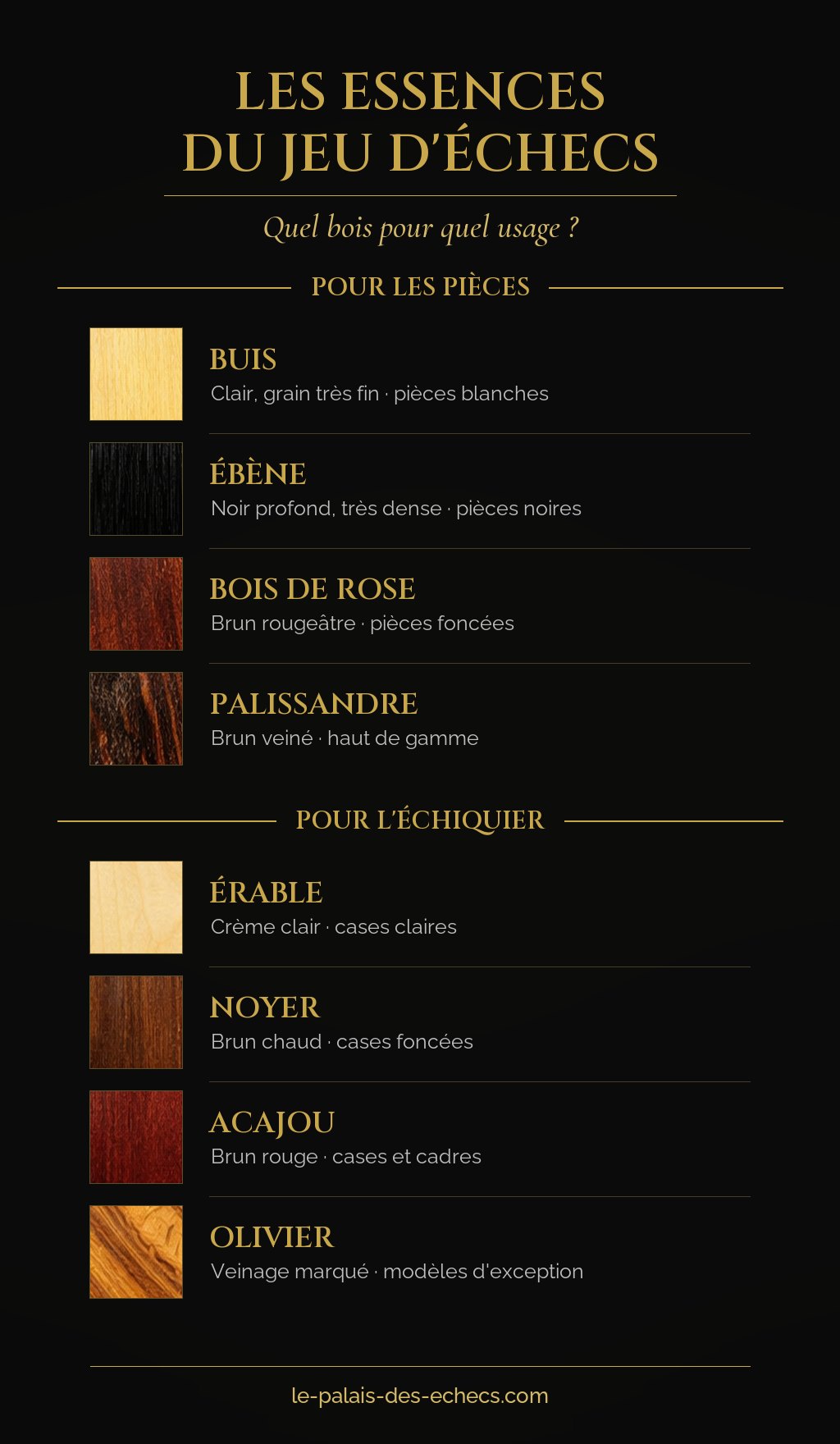
For the pieces of a chess set, boxwood is the benchmark: pale, dense and very fine-grained, it is traditionally paired with ebony or rosewood for the dark pieces. For the board, the maple (light squares) and walnut or mahogany (dark squares) duo offers the best contrast and excellent durability over time. Here’s how to choose, wood by wood.
Updated on 24 September 2026 · By Delphine D., Le Palais des Échecs editorial team
The essentials in 30 seconds
• Light pieces: boxwood, almost always.
• Dark pieces: ebony (the most prestigious), ebonised boxwood (same look, more accessible) or rosewood (warm tones).
• Chess board: maple for the light squares; walnut, mahogany or wenge for the dark squares.
• Exceptional models: palisander (rosewood), palisander burr, olive wood and burrs, for their unique grain.
• Golden rule: the pieces and the board must contrast, and each square should measure at least the king’s base diameter plus a quarter.
Why wood remains the material of choice for chess sets
The first Staunton-pattern set, sold in London in 1849, was already turned from boxwood and ebony. More than 175 years on, wood remains the reference material, in clubs and at home alike, for three very concrete reasons:
- Feel and weight: a dense, weighted, felted wooden piece is picked up with precision and set down silently.
- Readability: the natural contrast between a light wood and a dark wood is easier on the eye than glossy plastic, even after several hours of play.
- Longevity: well looked after, a wooden chess set develops a patina over time instead of wearing out. It is an object you keep, and pass on.
Our shop’s figures confirm this: across more than 3,600 orders placed with Le Palais des Échecs, the four most common woods in the sets sold are, in order, boxwood, maple, walnut and rosewood, followed by mahogany.
Which wood for chess pieces?
A chess piece is turned (shaft, base, collar) and then carved (the knight’s head, the rook’s crenellations, the bishop’s mitre). This calls for a dense, even, fine-grained wood that keeps crisp edges and doesn’t split. Four woods dominate.
Boxwood, the benchmark for white pieces
Boxwood is a pale yellow wood, very dense (around 0.9 to 1 g/cm³) and so fine-grained it looks almost smooth. It grows very slowly, which explains its compactness. It is the wood that allows the most precise carving: a boxwood knight keeps every detail of its mane and eyes. It equips the vast majority of quality Staunton chess sets, on the white side, and it is the wood most used across our sales.
Ebony, and ebonised boxwood
Ebony is absolute black: a wood so dense (1 to 1.2 g/cm³) that it sinks in water, with a deep, almost mineral polish. Paired with boxwood, it forms the historic Staunton pairing. Its rarity comes at a price, and several ebony species are now protected.
This is why many black pieces are made of ebonised boxwood: boxwood dyed black all the way through. The look is very close, the weight and feel are those of boxwood, and the price is noticeably gentler. This is not a flaw, provided it is clearly stated: a reputable seller always specifies “ebony” or “ebonised boxwood”. To tell them apart, look at the base of a piece or a scratch: natural ebony shows fine brown streaks, while ebonised boxwood reveals a lighter core underneath.
Rosewood, for warm dark pieces
Under the name “rosewood”, the chess world most often uses Indian palisanders such as sheesham (Dalbergia sissoo). Reddish brown, sometimes golden, it gives dark pieces a warmth that ebony lacks. Against boxwood, the contrast remains excellent, with a softer, more “woody” look. It is one of our customers’ favourite choices, notably in the Grand Championship set, our best seller.
Palisander and its burr, for exceptional models
Palisander offers dramatic dark grain; its burr (the knotted part at the base of the trunk) creates swirling patterns, different on every piece. It is reserved for high-end sets, such as this professional Staunton set in palisander burr. Worth knowing: most palisanders (genus Dalbergia) are listed under CITES Appendix II, which regulates their international trade. This is a mark of rarity, and one more reason to buy from a shop that knows the provenance of its woods.
Which wood for the chess board?
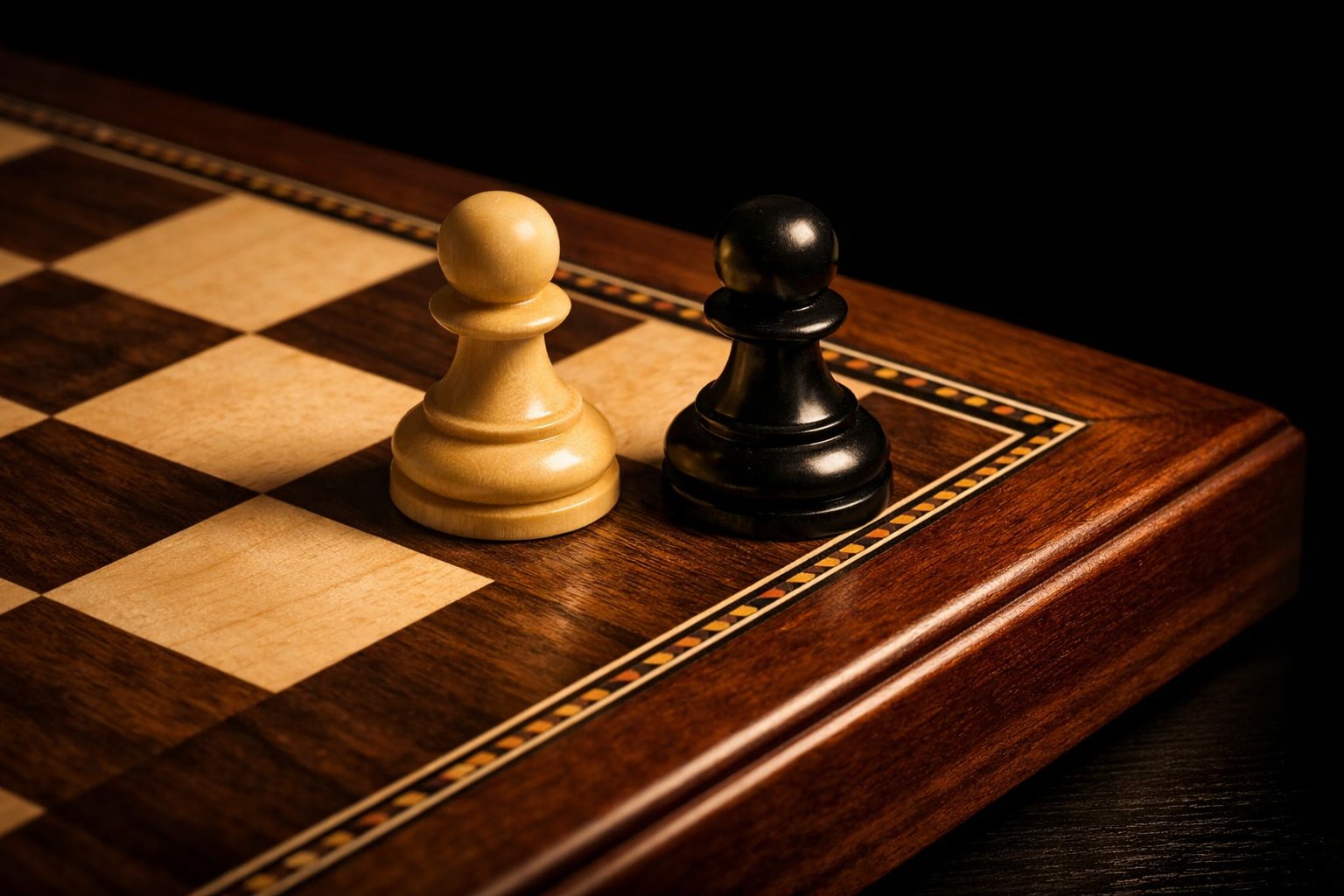
For the board, the priority shifts: you need two well-contrasted woods that remain stable over time and don’t reflect too much light. Wooden chess boards therefore almost always pair a light wood with a dark wood.
- Maple (light squares): cream, bright, with a discreet grain. It is the standard for light squares, in clubs as well as high-end sets.
- Walnut (dark squares): warm, deep brown. The walnut and maple duo is the most classic and versatile, as seen on this walnut and maple chess board.
- Mahogany (dark squares and frames): reddish brown, elegant, often used for framing and storage boxes.
- Wenge (dark squares): nearly black, very graphic, for maximum contrast and a contemporary style.
- Olive wood and burrs (exceptional models): olive wood has striking grain, never identical from one board to the next; burrs (growths on the trunk) create rippling patterns. See this rosewood chess set with an olive-wood burr board.
Veneer, marquetry or solid wood?
Contrary to a common belief, most fine chess boards are not made of solid wood. The squares are veneers (thin sheets of fine wood) assembled as marquetry and glued onto a stable core. This is not a cost-cutting measure: an entirely solid board reacts more to changes in humidity and can warp or split over time. Veneer allows the finest woods to be used while guaranteeing a perfectly flat board. Solid wood is mainly worthwhile for frames, storage boxes and certain tables.
Comparing chess wood types
| Wood | Colour | Density (g/cm³) | Main use | Range |
|---|---|---|---|---|
| Boxwood | Pale yellow | 0.90 to 1.00 | White pieces | All ranges |
| Ebony | Deep black | 1.00 to 1.20 | Black pieces | High-end |
| Ebonised boxwood | Black | 0.90 to 1.00 | Black pieces | Mid-range |
| Rosewood (sheesham) | Reddish brown | 0.75 to 0.85 | Dark pieces | Mid-range |
| Palisander | Grained brown | 0.80 to 0.90 | Pieces, edging | High-end |
| Maple | Light cream | 0.65 to 0.75 | Light squares | All ranges |
| Walnut | Warm brown | 0.60 to 0.70 | Dark squares | All ranges |
| Mahogany | Reddish brown | 0.50 to 0.60 | Dark squares, frames | Mid-range |
| Wenge | Very dark brown | 0.80 to 0.90 | Dark squares | Mid-range |
| Olive wood | Grained honey | 0.85 to 0.95 | Boards, backgammon sets | High-end |
Densities are indicative: they vary according to the origin and seasoning of the wood.
How to pair the pieces with the board
A handsome set is above all a coherent whole. Three criteria are enough:
- Contrast: boxwood and rosewood pieces stand out better on a maple and walnut board than on a board of a similar tone. Avoid dark pieces on squares that are almost as dark.
- Size: measure the king’s base diameter and add a quarter to get the minimum square size. A king with a 4 cm base needs squares of at least 5 cm. In official competition, FIDE recommends a king of around 9.5 cm and squares of 5 to 6 cm. Our chess board size guide details all the correspondences.
- Style: classic Staunton pieces call for an understated board; pieces with more modern lines can carry a bolder board (wenge, burr).
The simplest option is often to choose a wooden chess board with matching pieces: size, tones and finishes are designed together from the start.
How to spot a quality wooden chess set
Weight
A quality piece is weighted (a metal weight is inserted into the base). The king should stand firmly, without tipping at the slightest touch.
The felt
Each base is fitted with felt glued neatly, without overlap: it protects the squares and muffles the sound.
The knight
This is the piece that reveals a set’s quality: mane, nostrils and ears should be crisp and symmetrical from one knight to the next.
The board’s joints
Run your finger over the squares: the joins should be invisible to the touch, and the varnish or oil finish should be even, without overly glossy sheen.
For more, see our 7 criteria for choosing a quality chess set and our price guide by budget.
Caring for a wooden chess set
- Dust the pieces and the board with a soft, dry cloth. No water, no household cleaning products.
- Keep the set away from direct sunlight, which darkens or fades the wood, and from radiators, which dry it out.
- Aim for stable humidity, ideally between 45 and 60%: it is sudden swings that make wood move.
- Feed the pieces once or twice a year with a thin layer of colourless wax, then buff.
- Store the pieces in their box, separated, to avoid knocks between the knights’ heads.
Our favourites by wood type
Rosewood
The Grand Championship set: rosewood pieces on a maple and mahogany board, our best seller.
Ebony and boxwood
The Classic Staunton set, the historic tournament pairing.
Ebonised boxwood
The Leningrad set, on a mahogany board, for the Soviet style of the great years.
Walnut and maple
The Competition set: walnut and maple board, boxwood pieces, rosewood storage box.
Maple and palisander
The Black and White board, maple squares with a palisander burr border.
Olive wood
The olive wood backgammon set: every board has its own grain. See also our backgammon boards.
Frequently asked questions
Which wood is best for a chess board?
Maple for the light squares and walnut or mahogany for the dark squares: this is the most common combination, as it offers sharp contrast, good stability and a warm look. Wenge suits a stronger contrast, while olive wood and burrs suit an exceptional board.
What is the best wood for chess pieces?
Boxwood, for the light pieces: it is dense, very fine-grained and carves with great precision. For dark pieces, ebony is the most prestigious; rosewood and ebonised boxwood are excellent alternatives.
What is ebonised boxwood?
It is boxwood dyed black all the way through. It reproduces the look of ebony with the weight and fineness of boxwood, at a more accessible price. A reputable shop always states this clearly.
Is a solid wood chess board better?
Not necessarily. A board veneered in fine wood glued onto a stable core stays flatter over time than a solid board, which is more sensitive to humidity. Solid wood is mainly worthwhile for frames, storage boxes and tables.
How do you clean a wooden chess set?
With a soft, dry cloth, without water or household products. Once or twice a year, a thin layer of colourless wax feeds the wood and revives its shine.
Can a wooden chess board be personalised?
Yes. Many chess boards and backgammon sets can take an engraved plaque (initials, date, message): see our models compatible with personalised engraving. It’s a touch appreciated for a wedding gift or a retirement gift.
Find your wooden chess set
Boxwood, ebony, maple, walnut, rosewood: over 400 wooden chess sets, with free delivery within mainland France.
Wooden chess sets Fine wood chess boards Fine wood chess pieces
Unexpected incident at the Moscow Chess Open: a robot attacks a young prodigy
A Match Gone Wrong: During the Moscow Chess Open, an unexpected event disrupted the competition. [...]
The best Staunton chess sets: selection and size guide
We've put together a list of our best Staunton chess sets, from finely crafted pieces [...]
Giant Outdoor Chess Sets: XXL Chess for Your Garden
Giant outdoor chess sets transform a garden, terrace or park into a spectacular playing space. [...]