



Chess, Chess Culture, News, Non classé
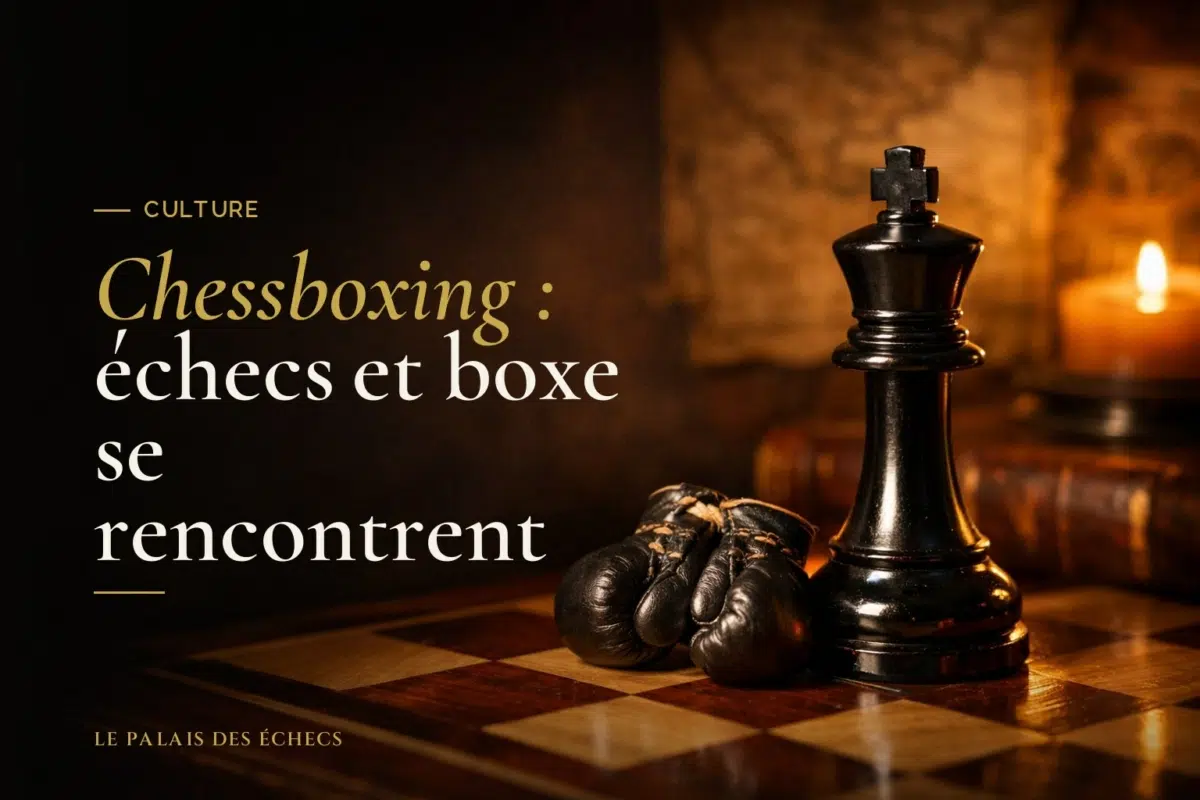
Chessboxing: when chess meets boxing
27
Mar
Mar
Chessboxing is one of the most unusual sports in the world: competitors alternate between rounds of boxing and rounds of rapid chess, testing both their physical strength and their strategic intelligence. Born from a comic book and now a genuine international sport, chessboxing fascinates and intrigues. Here’s everything you need to know.
What is chessboxing?
Chessboxing (or chess boxing) is a hybrid sport combining boxing and chess. Competitors face off, alternating between 3-minute boxing rounds and 4-minute chess rounds, for a total of 11 rounds (6 chess, 5 boxing). Victory can be achieved by checkmate, KO, referee stoppage, running out of time on the chess clock, or a points decision in boxing.
The rules of chessboxing
| Element | Details |
|---|---|
| Rounds | 11 rounds: 6 chess rounds (4 minutes each) + 5 boxing rounds (3 minutes each) |
| Start | The match begins with a chess round |
| Chess time control | 9 minutes per player in total (blitz format) |
| Victory by chess | Checkmate or running out of time |
| Victory by boxing | KO, TKO or referee stoppage |
| If tied | Points decision on boxing |
| Transition | 1 minute between each round to put on/remove gloves and headgear |
The rules of chessboxing require a minimum level in both disciplines: competitors must have an Elo rating of at least 1600 in chess AND amateur boxing experience. Being good at just one discipline simply won’t do — that’s the whole challenge of the sport.
The origin of chessboxing
The origin of chessboxing is as surprising as the sport itself. The idea comes from a Franco-Belgian comic book, Froid Équateur by Enki Bilal (1992), in which a character practises this fictional sport. In 2003, Dutch artist and sportsman Iepe Rubingh turned fiction into reality by organising the first official chessboxing match in Amsterdam. The sport quickly spread to Germany, England, Russia and India.
Chessboxing in France
Chessboxing in France is developing gradually. Clubs exist in Paris, Lyon and Marseille. France has hosted several international events, and French fighters take part in European championships. The sport’s media appeal — match videos rack up millions of views on YouTube — is attracting new practitioners. Chessboxing has even been mentioned as a potential candidate for the Olympic Games, although its candidacy is still far from succeeding.
Why chessboxing fascinates
🧠 Body and mind
Chessboxing is the only sport that tests intelligence and physical strength at the same time. Playing chess right after boxing — heart racing at 180 bpm, breathless, adrenaline at its peak — is an extreme cognitive challenge. Chess mistakes increase after each boxing round.
🏆 Spectacle
The alternation between the raw intensity of boxing and the silent concentration of chess creates a unique spectacle. The audience goes from the excitement of punches to the suspense of checkmate within seconds. Chessboxing videos on YouTube rack up millions of views.
⚔ Double strategy
A fighter may choose to play for time on the chess board if they know they are stronger at boxing, or conversely seek a quick checkmate to avoid the boxing rounds. Chess strategy blends with fighting tactics — an intellectually fascinating combination.
🌐 Broader appeal
Chessboxing attracts a wide range of people: former boxers discovering chess, club players taking up combat sport, streamers seeking the ultimate challenge. It’s a sport that breaks stereotypes about chess players.
Chessboxing champions
Among the chessboxing champions, there are some unusual profiles. Russia’s Nikolai Sazhin, Germany’s Frank Stoldt and India’s Sagar Shah have dominated the international circuit. In France, several fighters stand out in European competitions. The sport has around 500 active competitors worldwide, a figure that is growing fast.
★
Did you know? To take up chessboxing, you first need to be a good chess player. The chess portion is played in blitz format (9 minutes in total), which requires a good grasp of openings and tactics. If chessboxing appeals to you, start by improving your chess game!
To explore the link between chess and sport further, read our article on chess at the Olympic Games and the thousand-year history of chess.
Train your chess skills
Blitz, tactics, openings: master chess before stepping into the ring.
Complete chess sets Electronic sets Courses
Kasparov vs Deep Blue: the duel that changed the history of chess and AI
In 1996 and again in 1997, Garry Kasparov faced IBM's supercomputer Deep Blue. Revisit these [...]
Strategies to Increase Your Chess Elo Rating
The Elo rating is the universal system for rating chess players, created by Professor Arpad [...]
Beach chess: a new trend for summer 2023
Introduction Every summer, new game trends appear on beaches around the world. This year, a [...]