



Chess, Chess Culture, News, Non classé
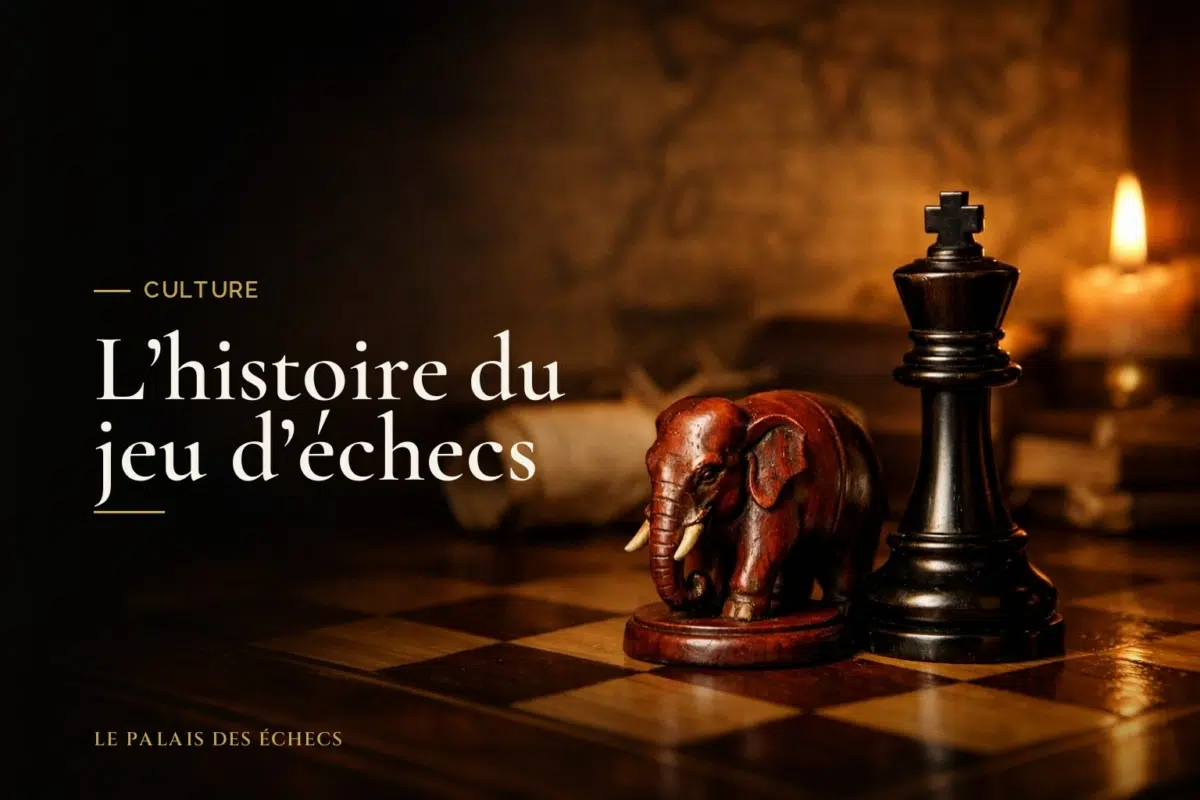
The history of chess: from Indian origins to the digital age
12
Sep
Sep
Chess is the oldest strategy game still played in the world today. Born in India more than 1,500 years ago, it travelled through the Persian and Arab empires before conquering medieval Europe. Here is the fascinating story of a game that has shaped humanity’s strategic thinking.
The origins: from India to Persia (6th – 7th century)
Chaturanga: the Indian ancestor
Who invented chess? The most historically sound answer points to 6th-century India. The ancestor of chess is called Chaturanga (from Sanskrit chatur = four, anga = limbs/divisions), referring to the four divisions of the Indian army: infantry, cavalry, elephants and war chariots.
Chaturanga was played on a board of 64 squares called an ashtāpada. The pieces represented the king’s four army corps: foot soldiers (future pawns), cavalry, elephants (future bishops) and chariots (future rooks). The king and his counsellor (future vizier, later queen) completed the set-up. This was the first time in history that a game combined pure strategy, an absence of chance and military simulation.
Shatranj: the Persian version
Chaturanga arrived in Persia in the 7th century, probably via trade routes between the Gupta Empire and the Sassanid Empire. The Persians adopted it under the name Shatranj and made crucial changes. It was in Persian that the terms “check” (shāh = king) and “checkmate” (shāh māt = the king is dead) were born.
When the Arabs conquered Persia in 651, they discovered Shatranj and became its most devoted ambassadors. The Abbasid caliphs organised the first chess tournaments as early as the 8th century in Baghdad, at the court of Harun al-Rashid. The first theoretical treatises were written in Arabic, laying the foundations of what would become chess strategy.
“Chess is the gymnasium of the mind.”
Blaise PascalThe conquest of Europe (10th – 15th century)
Two routes to the West
Chess arrived in Europe by two main routes:
🇪🇸 The Mediterranean route
Through Muslim Spain (Al-Andalus) and Arab-Norman Sicily, Shatranj spread across southern Europe from the 10th century onwards. The earliest written mention in Europe is the Latin poem Versus de Scachis, dated to around 950.
🇷🇺 The eastern route
Via Byzantium and Venetian merchants, the game reached Italy and Central Europe. The Vikings brought it back to Scandinavia — the famous Lewis chessmen (12th century) bear witness to this.
The European adaptation
Europeans profoundly transformed the game between the 11th and 15th centuries. The Indian elephant, unknown in Europe, became the bishop. The chariot became the rook (fortress). The vizier became the queen. Chess became part of courtly culture: one of the seven knightly arts, alongside horsemanship, archery and poetry.
But it was around 1475 that the most important revolution occurred: the queen and bishop acquired their modern moves (the queen able to move in any direction across any number of squares, the bishop diagonally). This “reform” considerably sped up the game and made it far more dynamic. In Italy, it was known as scacchi alla rabiosa (mad chess).
Key dates in the history of chess
~ 600
Invention of Chaturanga in northern India (Gupta Empire).
~ 650
The game arrives in Persia under the name Shatranj. Birth of the terms “check” and “mate”.
~ 750
The Arabs organise the first chess tournaments in Baghdad.
~ 950
First written mention of chess in Europe (Versus de Scachis).
~ 1475
Reform of the rules: the queen and bishop acquire their modern moves.
1749
François-André Philidor publishes L’Analyse du jeu des échecs, the first modern strategic treatise.
1849
Nathaniel Cook and Howard Staunton create the Staunton design, which becomes the world standard for chess pieces.
1886
Wilhelm Steinitz becomes the first official World Chess Champion by defeating Johannes Zukertort.
1924
Founding of FIDE (International Chess Federation) in Paris.
1972
Bobby Fischer defeats Boris Spassky in Reykjavik — the “Match of the Century” at the height of the Cold War.
1997
Deep Blue (IBM) defeats Garry Kasparov — the first victory of a machine over a world champion in a match.
2013
Magnus Carlsen becomes world champion at 22 and dominates chess for a decade.
2020
The Netflix series The Queen’s Gambit sparks a worldwide craze: chess set sales surge by 300%.
The Staunton style: the standardisation of chess pieces
Before 1849, each region of Europe used its own piece designs, often difficult to tell apart. The Englishman Nathaniel Cook designed a clean, immediately readable set, endorsed by the champion Howard Staunton, who lent it his name.
The Staunton style is characterised by universal symbolic shapes: the king’s cross, the queen’s crown, the bishop’s mitre, the knight’s head, the rook’s battlements. This design was adopted by FIDE as the mandatory standard for competition and remains, 175 years on, the reference model for all quality chess sets.
Did you know? The original Staunton design was patented on 1 March 1849. The first pieces were made by John Jaques & Son in London, in boxwood and ebony. Today, our luxury wood chess pieces faithfully reproduce these historic proportions, using the same noble woods — ebony, boxwood, palisander (rosewood).
The champions who made history
| Champion | Reign | Country | Style & legacy |
|---|---|---|---|
| Wilhelm Steinitz | 1886-1894 | Austria | Father of modern positional strategy |
| Emanuel Lasker | 1894-1921 | Germany | 27-year reign, the longest in history |
| José Raúl Capablanca | 1921-1927 | Cuba | The “Mozart of chess”, clear and natural style |
| Alexander Alekhine | 1927-1946 | Russia/France | Brilliant attacker, spectacular combinations |
| Bobby Fischer | 1972-1975 | United States | Solitary genius, popularised chess in the West |
| Garry Kasparov | 1985-2000 | Russia | Highest Elo rating in history (2851), faced Deep Blue |
| Magnus Carlsen | 2013-2023 | Norway | Dominant at all time controls, ambassador for blitz chess |
| Ding Liren | 2023-present | China | First Chinese world champion |
The digital age: from computers to streaming
Artificial intelligence in chess
In 1997, IBM’s Deep Blue defeated Garry Kasparov in a match — an event that made headlines around the world. But it was in 2017 that the real revolution arrived: AlphaZero, developed by DeepMind (Google), learned to play chess from scratch in 4 hours and crushed the strongest existing program (Stockfish). The AI no longer calculated like a machine — it developed an “intuitive” understanding of the game that fascinated grandmasters. To explore this decisive turning point in more depth, read our detailed account of the Kasparov vs Deep Blue duel.
Today, electronic chess boards integrate these AIs directly into the board, allowing anyone to play against an opponent of adjustable strength, analyse their games and improve — the dream of every player for centuries.
The online chess boom
Online chess sites such as Chess.com (100+ million members) and Lichess have democratised the game like never before. Online blitz has become a spectator sport, with streamers such as Hikaru Nakamura and France’s Kevin Bordi (Blitzstream) drawing millions of viewers.
The Netflix series The Queen’s Gambit (2020) amplified this phenomenon: chess set sales jumped by 300%, sign-ups on online platforms soared, and chess club membership doubled. Chess has never been as popular as it is in the 21st century.
Chess in France
France holds an important place in the history of chess. François-André Philidor (1726-1795), considered the best player of his time, published L’Analyse du jeu des échecs in 1749, a foundational work of modern theory. His maxim, “pawns are the soul of the game”, remains a reference to this day.
Today, the French Chess Federation has more than 60,000 registered members. France has produced great players such as Maxime Vachier-Lagrave (known as MVL), regularly ranked among the world’s top 5 players, and Alireza Firouzja, a Franco-Iranian prodigy who became a grandmaster at 14. Chess is increasingly taught in French schools, recognised for its benefits to concentration and cognitive development.
Did you know? Our video courses are designed by Grandmaster Tigran Gharamian, French champion in 2018, and Anthony Wirig, coach of the French youth team. A direct legacy of France’s great chess tradition.
1,500 years of history, one board
From Indian Chaturanga to streaming on Twitch, chess has spanned 15 centuries without ever losing its appeal. The pieces have changed names, the rules have evolved, the champions have come and gone — but the essence of the game remains the same: two minds face to face, 64 squares, infinite possibilities.
Whether you’re drawn to studying openings, to the repertoire of moves, or simply to the pleasure of a family game, every time you place a piece on a chess board, you are carrying on a thousand-year-old tradition.
Carry on 1,500 Years of Tradition
Discover our handcrafted chess sets, faithful to the 1849 Staunton design. From pieces in luxury wood to historic and themed sets that pay tribute to the great eras of chess.
See our Chess Sets
Why is the queen so powerful in chess?
Long ago, the queen was not a strong player on the board; historians say there [...]
Which chess clock should you choose? Digital clock guide
The chess clock (also called a chess timer or timer) is an essential instrument for [...]
Civil War Chess Sets: Our Themed Selection
Fight courageously for the reunification of the country with one of these striking Civil War [...]