




Chess, Great Players, News, Non classé
Garry Kasparov: biography, origins, Deep Blue and legacy
20
Oct
Oct
Garry Kasparov, born in 1963 in Baku to a family of Armenian and Jewish heritage, reigned over world chess for 15 years and still holds the historic Elo rating record with 2851 points reached in 1999. His 1997 match against the Deep Blue computer marked a turning point in the history of artificial intelligence. Kasparov remains an essential reference for understanding the evolution of modern chess.
The essentials
• Origins: born 13 April 1963 in Baku (Soviet Azerbaijan), birth name Garik Weinstein, mother of Armenian heritage and father of Jewish heritage
• Elo record: 2851 points reached in 1999, a mark that remained the historic benchmark for many years
• World reign: world champion from 1985 to 2000, 15 years of dominance, and world no. 1 for 255 consecutive months (1984-2005)
• Deep Blue: in 1997, Kasparov became the first world champion defeated by a computer in an official match
• Legacy: author of My Great Predecessors and Deep Thinking, his style continues to influence today’s best players, including Magnus Carlsen
Updated 2 November 2026: Title and summary reworked to better address searches about Kasparov and his origins.
Fact file
Full nameGarry Kimovich Kasparov
Born13 April 1963, Baku (Azerbaijan, USSR)
Grandmaster title1980, aged 17
World champion1985-2000 (15 years)
Highest Elo rating2851 (historic record)
World no. 1 ranking1984-2005 (255 months, a record)
Retirement2005
After chessAuthor, speaker, political activist
A prodigy’s early years
Garry Kasparov was born Garry Weinstein in Baku, Soviet Azerbaijan. His father, Kim Weinstein, was of Jewish heritage; his mother, Klara Kasparian, was of Armenian heritage. It was his father who taught him chess at the age of 6 by solving a newspaper puzzle. The young Garry’s talent was immediately evident.
At 13, he won the USSR junior championship. At 16, he took part in his first Grandmaster tournament and finished first. At 17, he earned the International Grandmaster title — the youngest of his time. The chess world understood that a phenomenon was emerging.
The youngest world champion
In 1984, Kasparov faced the reigning champion Anatoly Karpov in a marathon match that lasted 5 months and 48 games — the longest in history. The match was stopped without a winner by FIDE, under controversial circumstances. Kasparov was ahead on score, and many believe he was on the verge of winning.
The rematch took place in 1985 in Moscow. This time, Kasparov won the title at 22, becoming the youngest world chess champion in history — a record that would stand until Magnus Carlsen broke it in 2013 (at 22 years and 357 days versus 22 years and 210 days for Kasparov). For a detailed comparison of these two legends’ careers and styles, see our comparison between Kasparov and Carlsen.
« Chess is the gymnasium of the mind. It doesn’t just teach you to think, it teaches you to think under pressure. »
Garry KasparovKasparov’s Elo rating: a record that made history
Garry Kasparov’s Elo record stands at 2851 points, reached in 1999: for many years, this remained the highest rating ever recorded in chess history.
How did Kasparov build this rating?
Becoming a Grandmaster at 17, Kasparov entered the world’s elite in the early 1980s. He held the world’s top ranking from 1984 to 2005, or 255 consecutive months — a record for longevity at the top.
Is this Elo record still relevant today?
Kasparov’s 2851 has since been surpassed by other champions, starting with Magnus Carlsen. It nonetheless remains a historic benchmark, achieved at a time when preparation was done without today’s analysis engines.
The Kasparov style
Kasparov’s playing style was marked by remarkable energy and aggression, combined with unprecedented theoretical preparation. Where his rival Karpov excelled at patient positional play, Kasparov preferred dynamic, complex and tactically explosive positions.
⚔ Preparation
Kasparov revolutionised chess preparation. The first player to make extensive use of computers and databases to prepare his openings, he arrived at every game armed with theoretical novelties that unsettled his opponents.
♕ Dynamism
His attacking style relied on permanent initiative: material sacrifices for the initiative, attacks on the king, favourable transformations. Kasparov wasn’t looking for the perfect move — he was looking for the move that caused his opponent the most problems.
💪 Steel mind
Kasparov was feared for his piercing gaze and his ability to intimidate opponents psychologically. His concentration and will to win were legendary — he never gave up a game, even in the most difficult positions.
📚 Theoretical legacy
Kasparov enriched chess theory in many openings: the Sicilian Najdorf, the King’s Indian, the Queen’s Gambit. His games are studied in chess books around the world.
Kasparov vs Karpov: the greatest rivalry
The rivalry between Kasparov and Karpov is the most famous in the history of chess. Between 1984 and 1990, the two players met in 5 world championship matches totalling 144 games. Kasparov won 3 matches, Karpov 1, and 1 was interrupted.
This rivalry went far beyond the board: Karpov, backed by the Soviet system, represented the establishment; Kasparov, young and rebellious, embodied the new generation. Their clash also symbolised the collision of two diametrically opposed playing styles — Karpov’s patience against Kasparov’s fire.
Deep Blue: man against machine
In 1996, Kasparov faced Deep Blue, IBM’s supercomputer, in a 6-game match in Philadelphia. Kasparov won the match 4-2, proving the superiority of human intellect. The world breathed a sigh of relief.
But in 1997, IBM returned with an improved version. The match was played in New York under the cameras of the world’s media. Deep Blue won the 6th and final game — and the match — 3.5 to 2.5. It was the first victory by a computer over a world champion in a match. The event made headlines everywhere and marked a turning point in the history of chess and of artificial intelligence. To relive this historic duel in detail, minute by minute, see our full account of the Kasparov versus Deep Blue duel.
Kasparov accused IBM of cheating by having humans intervene in the machine’s decisions — an accusation never proven. IBM refused a rematch and dismantled Deep Blue. The mystery persists, but the event changed forever the relationship between man and machine in chess.
Did you know? Today’s modern electronic chess boards pack far more powerful AI than Deep Blue into a simple wooden board. What the Kasparov-Deep Blue match made possible is now found on your own living-room table — at an affordable price.
An outstanding record
| Year | Event | Result |
|---|---|---|
| 1980 | Youngest Soviet Grandmaster | Aged 17 |
| 1985 | World champion (vs Karpov) | 13-11 |
| 1986 | Title defence (vs Karpov) | 12.5-11.5 |
| 1987 | Title defence (vs Karpov) | 12-12 (title retained) |
| 1990 | Title defence (vs Karpov) | 12.5-11.5 |
| 1993 | Match vs Short (PCA) | 12.5-7.5 |
| 1995 | Title defence (vs Anand) | 10.5-7.5 |
| 1996 | Match vs Deep Blue | 4-2 (win) |
| 1997 | Rematch vs Deep Blue | 2.5-3.5 (defeat) |
| 1999 | Elo record | 2851 (historic record) |
| 2000 | Loss of title (vs Kramnik) | 6.5-8.5 |
| 2005 | Retirement from professional chess | — |
Life after chess: author and thinker
Since his retirement in 2005, Kasparov has devoted himself to writing, public speaking and political activism. His book My Great Predecessors (5 volumes) is considered one of the greatest works of chess literature ever written. In it, he analyses in depth the games of the world champions who preceded him, from Steinitz to Karpov.
More recently, his book Deep Thinking (2017) explores the relationship between human and artificial intelligence, drawing lessons from his experience with Deep Blue. In it, Kasparov argues that the future lies in human-machine collaboration rather than competition.
Choose a chess set worthy of a legend
To extend your admiration for Kasparov, nothing beats a chess set worthy of his legacy: a Staunton set in fine wood, the format he used throughout his career.
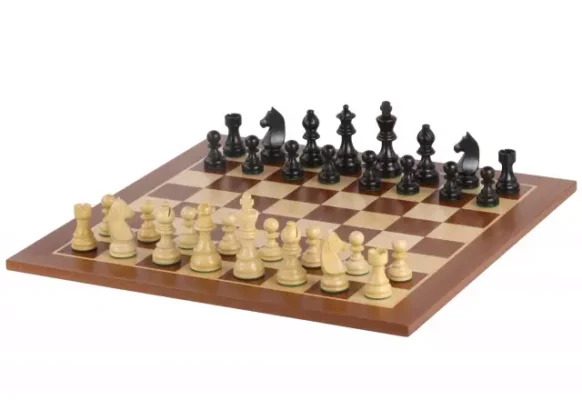
This classic Staunton set in ebony and boxwood, with its mahogany chess board, embodies the rigour and elegance of top-level play.
For a more prestigious interior, our luxury chess sets and chess sets in fine woods bring together our most refined pieces, while the Staunton chess sets collection gathers the whole of the format established in 1849.
Frequently asked questions
What are Garry Kasparov’s origins?
Garry Kasparov was born on 13 April 1963 in Baku, Soviet Azerbaijan. His father, Kim Weinstein, was of Jewish heritage, and his mother, Klara Kasparova (Kasparian), was of Armenian heritage.
What is Garry Kasparov’s Elo record?
Garry Kasparov reached an Elo rating of 2851 points in 1999, a record that remained the historic benchmark for several years before being surpassed by the next generation.
Why did Garry Kasparov carry the name Weinstein?
Born Garik Weinstein, he adopted his mother’s surname, Kasparov — derived from the Armenian name Kasparian — as a teenager.
How old was Kasparov when he became world champion?
Kasparov was 22 when he won the world championship title against Anatoly Karpov in 1985, becoming the youngest world champion in history at the time.
Sources
Delphine D., editorial team at Le Palais des Échecs, a French shop specialising since 2008 in wooden chess sets and chess boards. Our guides are informed by our customers’ questions, the official FIDE rules, and the products we sell and measure ourselves. They are reviewed and updated regularly. The editorial team
Kasparov and chess today
Kasparov’s legacy continues to influence modern chess. His dynamic attacking style, rigorous preparation and pioneering use of computers defined contemporary chess. Magnus Carlsen himself acknowledges Kasparov’s influence on his own play.
For enthusiasts wishing to discover the Kasparov style, his games are analysed in our chess books and our video courses. And to play like a champion — on a chess board worthy of the name — discover our Staunton pieces in fine wood, the same format Kasparov used throughout his career.
Play Like the Champions
Discover our complete chess sets in the Staunton format, the standard of champions since 1849. From entry-level sets to prestige boxes.
View our Chess Sets
Where is chess most popular in France? The top 7 regions!
Chess in France: the 7 regions and cities where the game is a passion! According [...]
Top 7: the world’s most bling-bling chess sets
Chess, with its origins tracing back to the ancient Indian game of Chaturanga, has become [...]
Chess players: why memory is your best ally on the board
The role of memory in becoming a good chess player The chessboard, that 64-square battlefield [...]