



Chess Culture, Great Players, Non classé
Kasparov vs Deep Blue: the duel that changed the history of chess and AI
26
Sep
Sep
On 11 May 1997, in New York, IBM’s supercomputer Deep Blue defeated world champion Garry Kasparov at the end of a six-game match, winning 3.5 to 2.5. It was the first time a machine had defeated a reigning world champion in a complete classical match. A year earlier, in 1996, Kasparov had won a first duel against the same machine by a score of 4 to 2. These two encounters remain, to this day, one of the most discussed episodes in the history of artificial intelligence.
Published on 25 September 2026 · By Delphine D., Le Palais des Échecs editorial team
The essentials
• 1996: Kasparov wins the first Kasparov vs Deep Blue duel, 4 to 2, in Philadelphia.
• 1997: in the return match in New York, Deep Blue takes its revenge and wins 3.5 to 2.5.
• Game 2 of 1997: a move judged “too human” deeply unsettles Kasparov, who would suspect outside interference, though this was never proven.
• Deep Blue: an IBM supercomputer designed by a team of engineers, including Feng-hsiung Hsu and Murray Campbell, assisted by grandmaster Joel Benjamin.
• Legacy: this duel paved the way for modern engines such as Stockfish and self-learning artificial intelligences such as AlphaZero.
Who was Garry Kasparov before facing a machine?
In 1996, Garry Kasparov had been world champion since 1985, renowned for an aggressive style and a level of preparation feared by his opponents. No computer had ever seriously threatened his supremacy: the chess world believed human superiority was secured for many years to come.
You’ll find his full career in our biography of Garry Kasparov, and his place among other legends such as Bobby Fischer or, later, Magnus Carlsen.
Deep Blue: the IBM computer designed to beat a world champion
Deep Blue was a supercomputer developed by IBM, specifically designed to play chess at the highest level. This chess computer relied on chips dedicated to position calculation, capable of evaluating around 200 million positions per second, far beyond what a general-purpose computer of the time could achieve.
The project was led by a team of IBM engineers, including Feng-hsiung Hsu and Murray Campbell, heirs to an earlier university programme called Deep Thought. To refine its play, the team also relied on American grandmaster Joel Benjamin, tasked with preparing the opening book and steering the machine towards lines that would trouble Kasparov.
1996: the first confrontation, a victory for Kasparov
In February 1996, in Philadelphia, Deep Blue won the very first game of the Kasparov vs Deep Blue duel: a historic event, as it was the first time a computer had beaten a reigning world champion in a classical game played at normal time controls. Kasparov then regrouped, won three games and drew the other two, ultimately prevailing 4 to 2. The machine’s performance in that first game left a lasting impression, including on the champion himself.
1997: the rematch that changed history
The return match was played in New York in May 1997, over six games. Kasparov won the first, but Deep Blue equalised straight away in the second with a move that would go down in the history of the game (see below). Games 3, 4 and 5 ended in draws, with tension rising with every move. In the sixth and final game, Kasparov made a mistake right from the opening and lost in just under twenty moves, visibly affected by the way the match had gone. Deep Blue ultimately won 3.5 to 2.5: the first time a reigning world champion had lost a match to a machine.
The scores of both matches, at a glance
| Year | Location | Final score | Winner | Notable fact |
|---|---|---|---|---|
| 1996 | Philadelphia | 4 – 2 | Garry Kasparov | Deep Blue wins the 1st game: a historic first |
| 1997 | New York | 3.5 – 2.5 | Deep Blue | First match lost by a reigning world champion against a machine |
Score in standard chess format: a win is worth 1 point, a draw 0.5 point.
The mystery of game 2: the move that unsettled Kasparov
During the second game of the 1997 match, Deep Blue, playing white, gave up an immediate tactical continuation in favour of a quiet, purely positional move. This choice surprised Kasparov: he judged it too cautious, too “human” for a program renowned for brute-force calculation. Convinced that a chess player might have intervened behind the scenes, he demanded, in vain, the machine’s calculation logs from IBM.
Kasparov eventually resigned that same game in a position that later analyses would judge tenable, even drawn by perpetual check. This double shock, a move he could not understand and a premature resignation, destabilised him for the rest of the match. IBM has always denied any human intervention during play, but Kasparov’s doubt never entirely disappeared.
What this duel changed for chess and artificial intelligence
Kasparov’s defeat in 1997 went far beyond the game itself: it became a symbol, reported around the world, of the moment a machine surpassed man in a discipline long associated with pure intellect. The encounter between Garry Kasparov and artificial intelligence left a lasting mark on the collective imagination, well beyond the circle of chess players.
IBM, which had invested in this project for research as much as for its image, refused the rematch Kasparov requested and withdrew Deep Blue from competition shortly after the match. The event also reignited debate over the limits of artificial intelligence, a debate we explore further in our article has artificial intelligence in chess really put humanity in checkmate?. In the decades that followed, chess engines would progress well beyond Deep Blue, becoming training tools accessible to everyone, including those who want to sharpen their thinking or track their progress with the Elo rating.
To remember: after 1997, Deep Blue never played again. IBM refused the rematch Kasparov requested and withdrew the machine from competition.
Deep Blue against today’s engines: what’s the difference?
Deep Blue calculated by brute force: it explored a very large number of positions using dedicated hardware, guided by an evaluation function written by hand by its designers. Today’s engines such as Stockfish combine this search with a trained neural network, allowing them to play at a far higher level on an ordinary personal computer, with no specialised hardware.
Another approach, embodied by AlphaZero, developed by DeepMind, relies on no opening book nor any rule written by a human: the program learns to play by facing itself an enormous number of times. This methodological break shows just how much the 1997 Kasparov vs Deep Blue duel, striking as it was, already belongs to another era of artificial intelligence applied to chess.
Replaying history: equip yourself like a champion for your own duels
You don’t need a supercomputer to face artificial intelligence today: many applications include engines far stronger than Deep Blue, playable on a simple electronic chess board.
Duel against an AI
Head to our electronic chess sets category.
Replay the great games
The Staunton design remains the standard for official competitions: discover our Staunton chess sets, such as this Staunton set with chess board with built-in storage.
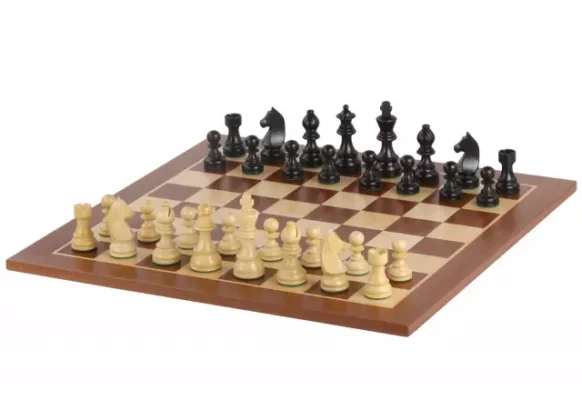
For a set worthy of the legend, our chess sets in precious wood and precious wood chess boards combine noble species such as ebony and boxwood, as seen in this classic Staunton set in ebony, boxwood and mahogany.
For a prestige set, our supreme sets category offers pieces in solid brass on a walnut and maple chess board, such as this Staunton set in walnut, maple and solid brass.
Fancy training against an app wherever you go? A travel chess set such as this magnetic wooden travel set slips into a bag and lets you replay the positions you’ve studied on your phone, wherever you are.
Frequently asked questions
Who won the Kasparov vs Deep Blue match?
Each side won one match. In 1996, Kasparov won 4 to 2. In 1997, in the return match, Deep Blue took its revenge and won 3.5 to 2.5.
In what year did Deep Blue beat Kasparov?
In 1997, in New York, during the return match. It was the first time a reigning world champion had lost a chess match to a machine.
Did Kasparov get a rematch after 1997?
No. Kasparov requested a third match, but IBM refused and withdrew Deep Blue from competition shortly after its 1997 victory.
What became of Deep Blue after the 1997 match?
The machine never played in public again. IBM ended the project after this victory, considering its research goal achieved.
What is Garry Kasparov doing today?
Having ended his career as a professional player, Garry Kasparov has become involved in defending democracy and human rights, notably with the Human Rights Foundation. He continues to speak regularly on chess and on artificial intelligence.
Was the controversial move in game 2 really supernatural?
No. It was a positional choice by Deep Blue that Kasparov found strange, and in which he saw the hallmark of human intervention. IBM has always denied any outside help during the games.
Fancy your own duel?
Staunton chess sets, precious wood chess boards and electronic chess sets: equip yourself to replay history, with free delivery within mainland France.
Staunton chess setsElectronic chess setsChess sets in precious wood
Top 7 board games that will (really) boost your intelligence!
We all know it, entertainment isn’t just a source of fun, it can also be [...]
Blitz chess: rules, strategies and tips for playing fast
Blitz is the most intense and addictive form of chess. With 3 to 5 minutes [...]
Cheating in chess: how to detect and prevent fraudsters
From the Hans Niemann scandal to FIDE’s anti-cheating in chess measures, chess cheating has become [...]