




Buying Guides, Chess, Chess Culture, News, Non classé
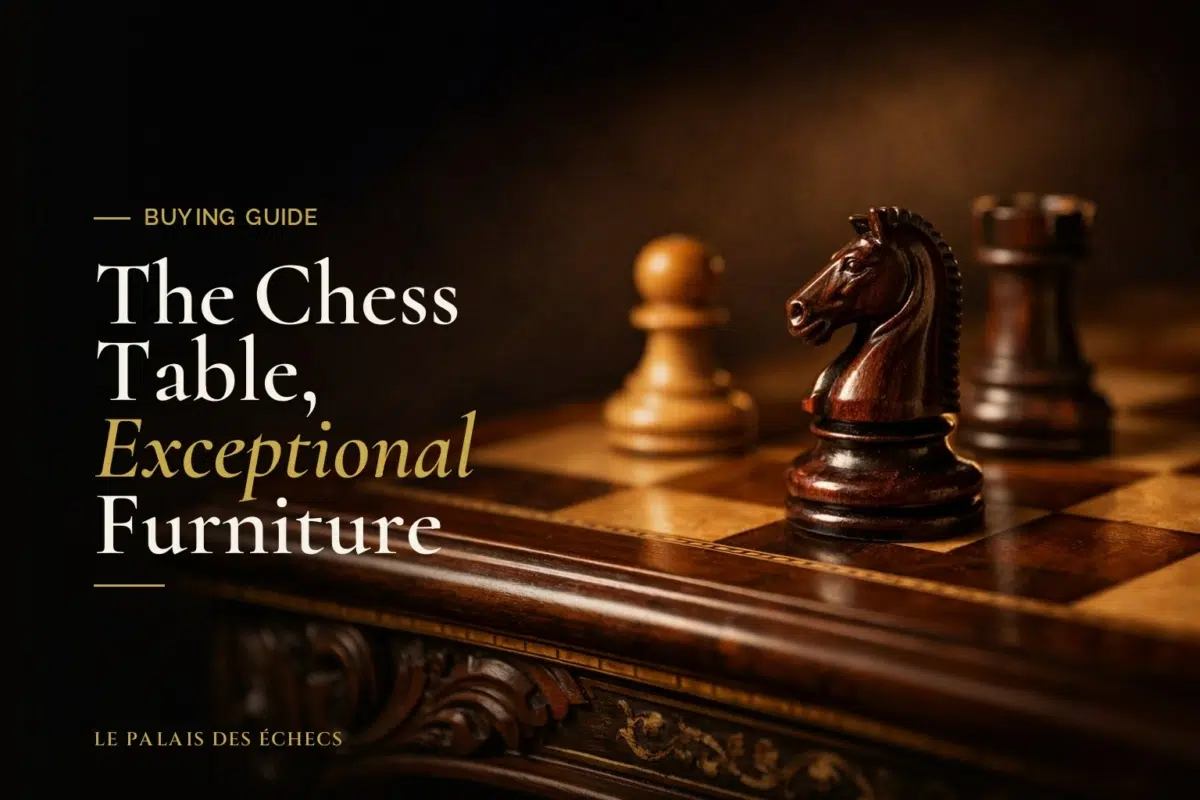
The most prestigious chess tables: exceptional chess furniture
04
Nov
Nov
A chess table is a piece of furniture in its own right: a chess board inlaid into its top, often completed with drawers or storage for the pieces, designed to comfortably host a game. It differs from a simple chess board placed on a coffee table through its overall design: height, seating, finish and the nobility of the wood are all considered together. From an antique solid walnut model to the clean lines of a modern table, here is how to recognise a fine chess table and choose the one that will suit your home.
Updated on 9 November 2026 · By Delphine D., Le Palais des Échecs editorial team
The essentials
• Definition: a chess board inlaid into the tabletop, often with storage drawers.
• Styles: with drawers, antique style, round or octagonal, modern and minimalist.
• Noble woods: walnut, maple, mahogany, ebony and rosewood dominate the finest examples.
• Common sizes: tops of 50, 60 or 70 cm a side, for heights of 55 to 75 cm.
• Golden rule: the base of the king should occupy roughly three quarters of the square.
• Vintage: tables from the 1950s to 1970s are highly sought after by collectors.
Update of 9 November 2026: complete overhaul: turning a showcase article that was too short (590 words) into a genuine reference buying guide to chess tables: styles (classic,….
What is a chess table, and why does it appeal to enthusiasts?
A quality chess table can be recognised by three criteria: the nobility of the wood used, the precision of the marquetry that forms the squares, and the intelligence of the design (height, drawers, reversible top). It differs from a chess board simply placed on an ordinary piece of furniture in that the game is part of the furniture itself: the board is inlaid, not merely printed or glued onto the surface.
This status as a dual object, both furniture and game, explains its appeal: a chess table remains visible and useful even when no one is playing, unlike a game box stored away in a cupboard. This is also why it holds a special place in the Le Palais des Échecs chess table collection, somewhere between furniture and collector’s item.
Which style of chess table should you choose: classic, modern or design?
Four main families of tables stand out, depending on the intended use and the style of your home.
Table with drawers
The most practical model: two side drawers store the pieces after the game. On some models, the top is reversible, a chess board on one side and a smooth surface on the other, so it can also serve as a side table.
Antique-style table
Inspired by the 18th and 19th centuries, these tables feature curved legs, mouldings and aged finishes. They evoke the drawing rooms where chess was a way of life, and fit naturally into a classic home or a study.
Round or octagonal table
Less common but very elegant, these tables place the chess board at the centre, surrounded by a rim for resting captured pieces. They make excellent side tables in a living room. Our round chess table in mahogany, hornbeam and maple is one such example, with its inlaid chess board 65 cm in diameter.
Modern, design table
Clean lines, contrasting materials, minimalist marquetry: the modern chess table favours simplicity over ornamentation. It pairs well with pieces of contemporary design, to be found in our modern design chess sets.
Tables with drawers remain the most sought after, as they solve a genuine practical problem: where to store the pieces between games. For a more compact format, a chess board with built-in storage follows the same logic without taking up the space of an entire piece of furniture.
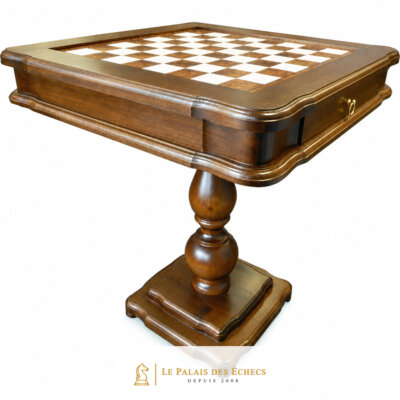
The Classic Table in briarwood and beech answers exactly this need: a storage drawer is built into its 58 x 58 cm top, with 5 cm squares. Standing 68 cm tall, it arrives fully assembled and pairs with pieces whose king has a base of 3.5 to 4 cm in diameter.
Which wood species make an exceptional chess table?
The choice of wood determines both the look of the table and how well it stands the test of time. Five species come up most often among specialist cabinetmakers.
| Wood | Colour | Character | Use |
|---|---|---|---|
| Walnut | Warm brown | Classic, pronounced grain | Traditional tables, the most common |
| Maple | Light blond | Bright, fine grain | Light squares, contrast with walnut |
| Mahogany | Reddish-brown | Noble, warm highlights | English-style tables |
| Ebony | Deep black | Luxurious, very dense | Dark squares, high-end tables |
| Rosewood | Purplish-brown | Exotic, striking grain | Prestige tables |
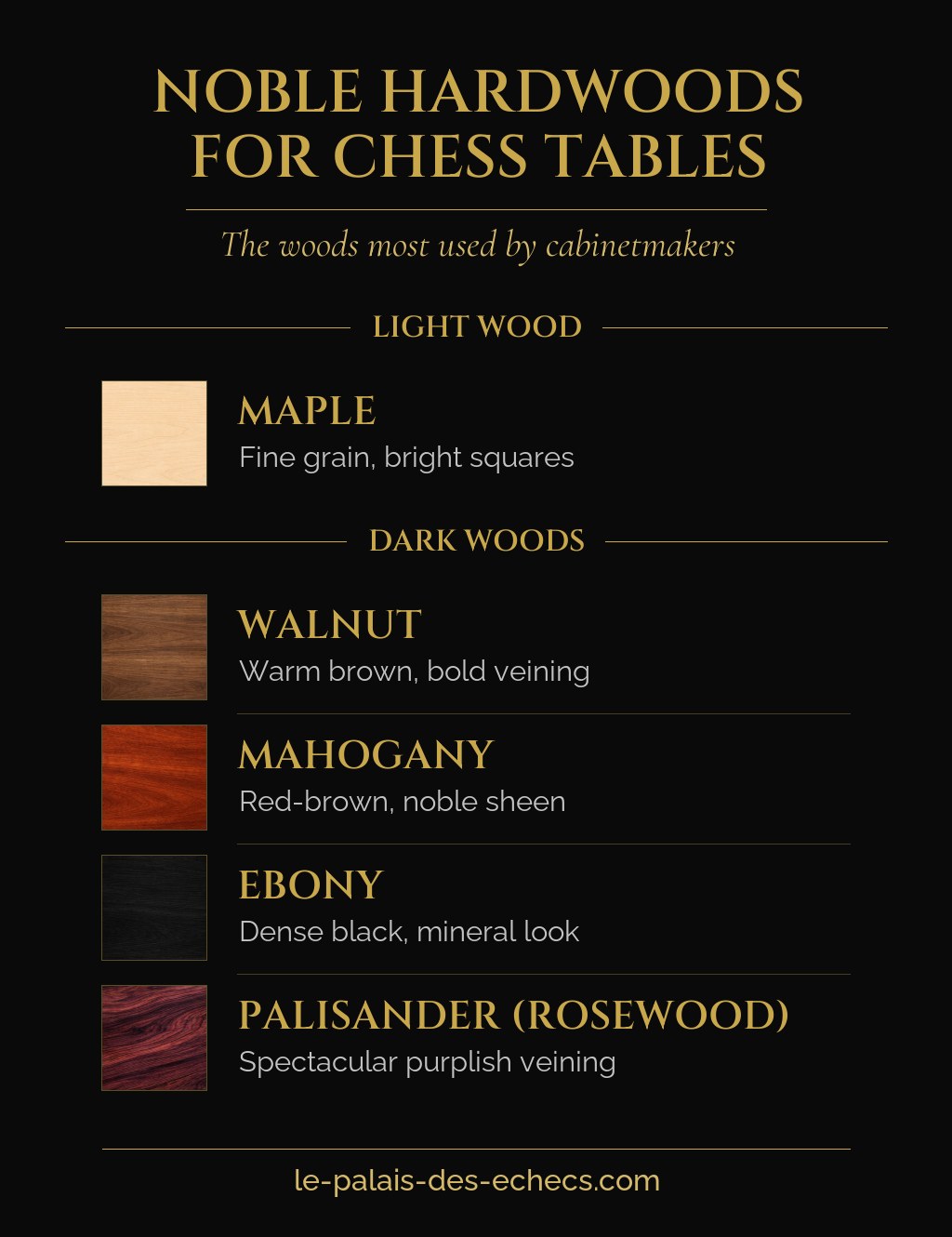
The walnut and maple duo remains the most widespread, as it offers a clear contrast between light and dark squares while ageing well. For a more understated table, mahogany recalls the English style, as seen on our chess table in mahogany and maple with two drawers; for a more luxurious look, ebony and rosewood offer the finest contrasts, to be found in our chess boards in precious wood and our pieces in precious wood.
The carving and marquetry of a table require precise craftsmanship; our article on the manufacturing techniques of hand-carved wooden sets details these steps, from selecting the wood to the final polish.
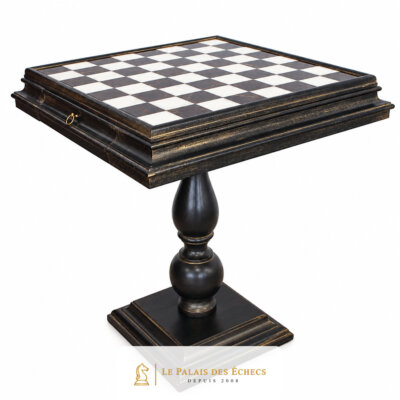
Other species lend themselves to the carver’s craft: the Tilia Table is made of lime wood, a wood used for intricate carvings, hand-painted in a slate tone. Its 60 x 60 cm top in milky-white Tuscan alabaster offers 6.2 cm squares, for a table 70 cm tall. To stay with the most classic species, our complete chess sets in walnut and our complete chess sets in mahogany echo the contrasts described above.
Prestigious chess tables and collector’s pieces: what are enthusiasts looking for?
At the very top of the range, some tables become genuine works of art. Grand marquetry tables, with tops in bronze or pietra dura (inlaid hardstone), show what the craft of wood and stone can achieve at its most refined; today they are mostly found among collectors and in specialist sales.
If you would rather choose stone than wood, our guide to marble chess boards presents the finest examples; for bronze and gold finishes, our guide to luxury chess sets details the materials used. In our catalogue, bronze and gold tables and chess sets complete this offering for lovers of precious finishes.
The charm of vintage tables
Vintage chess tables are highly sought after by collectors. A table from the 1950s to 1970s, in walnut or mahogany, with its natural patina and signs of use, tells a story: you can find one at a flea market, an auction or a specialist antique dealer. If you prefer something new with a retro spirit, the antique-style tables mentioned above faithfully recreate the look of those eras, without the uncertainties of an older piece of furniture (stability of the top, sturdiness of the drawers).
At Christmas time, a chess table or a fine complete set also makes a gift that is remembered for years: our 2026 Christmas gift guide helps you choose according to the recipient and your budget.
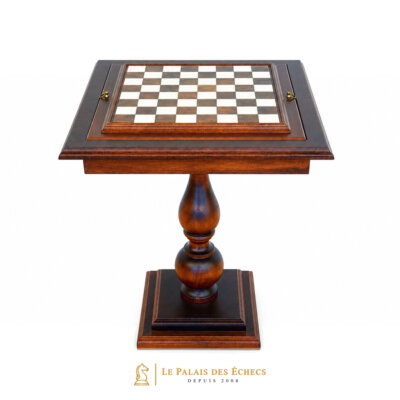
To recapture today the spirit of these stone tops, the T&C Table pairs a playing surface in Carrara marble and Tuscan alabaster with a frame and carved border in solid beech. The 58 x 58 cm top, with 4.5 cm squares, is removable: small rings allow you to lift it to access the storage compartment beneath. Our complete chess sets in marble extend this choice of stone.
How do you choose a chess table to suit your budget and your space?
The right size depends on the space available and the intended use: an occasional side table or a regular playing spot. Here are the standard formats.
| Top dimensions | Height | Square size | Ideal for |
|---|---|---|---|
| 50 x 50 cm | 55 to 60 cm | ~5 cm | Side table, small living room |
| 60 x 60 cm | 65 to 70 cm | ~6 cm | Comfortable play, standard use |
| 70 x 70 cm | 70 to 75 cm | ~7 cm | Large pieces, clubs |
Golden rule: the size of the squares should remain proportional to that of the pieces. The diameter of the king’s base should occupy roughly three quarters (75%) of the square, so that the pieces move without touching each other or looking lost on the board.
For installation and mistakes to avoid, our article 8 things to know before buying a chess table covers every point in detail. On the budget side, a chess table is a piece of furniture and sits above a classic set in price: our chess tables alone form the first price bracket, while complete sets with table are found in our range above €1,000. For a more modest budget, a fine set without a table, board and pieces alone, can be found in our €200 to €500 and €500 to €1,000 selections.
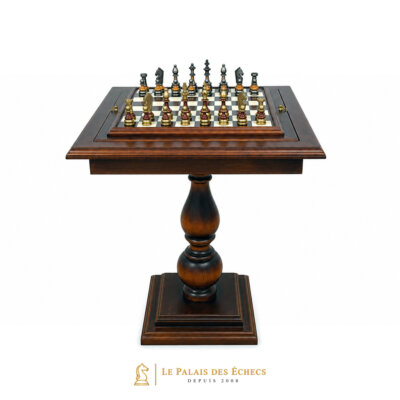
If you would like the table and its pieces together in one go, the Stylised Set II brings together a table in solid beech, with a top in Carrara marble and Tuscan alabaster (58 x 58 cm, 4.5 cm squares, storage compartment), and a 32-piece set in wood and solid brass inspired by the Staunton style, whose king stands 9 cm tall.
For outdoor use, no classic solid wood chess table can reliably withstand the weather: it is better to reserve the garden or terrace for a giant outdoor chess set, designed for that purpose, and keep the wooden table indoors.
How do you care for a wooden chess table to preserve it over time?
- Dust the top and drawers regularly with a soft, dry cloth, without water or household cleaning products.
- Keep the table away from direct sunlight and heat sources, which warp the wood and fade the marquetry unevenly.
- Stabilise the room’s humidity as far as possible: sudden changes are what tire an inlaid top the most.
- Feed the wood once or twice a year with a colourless wax, then buff it to bring out the grain.
- Store the pieces in the drawers or in a dedicated storage box rather than loose on the top, to avoid scratches.
Frequently asked questions
What exactly is a chess table?
It is a piece of furniture whose top features an inlaid chess board, often completed with drawers or a storage space for the pieces. It differs from a simple board placed on an ordinary table in that the game is an integral part of the furniture.
What size chess table should you choose?
For occasional use or a small living room, a 50 x 50 cm top with squares of around 5 cm is enough. For comfortable everyday play, aim for 60 x 60 cm, and 70 x 70 cm for larger pieces or club use.
Can you find chess tables at Ikea?
Large general furniture retailers do not offer a dedicated chess table, with an inlaid top and storage drawers: it is a specialist piece of furniture. Our chess tables and our complete sets with chess table bring together the models we have available.
Are there chess tables for outdoor use?
A classic chess table in solid wood or marquetry is not designed to stay outdoors: humidity and temperature changes damage the top. For playing outdoors, a giant chess set remains the most suitable solution.
How do you recognise a quality antique chess table?
A fine antique table, typically from the 1950s to 1970s, shows a natural, even patina, drawers that slide without play, and marquetry whose joints remain invisible to the touch despite the age of the wood.
What budget should you plan for a chess table?
Prices vary considerably according to the wood, the marquetry and whether drawers are included: sets with a table are found across several price brackets, from solid wood models to pieces with fine marquetry or bronze and gold finishes.
Delphine D., Le Palais des Échecs editorial team, a French shop specialising since 2008 in wooden chess sets and chess boards. Our guides draw on our customers’ questions, the official FIDE rules, and the products we sell and measure ourselves. They are reviewed and updated regularly. The editorial team
Find your chess table
Solid wood tables, fine marquetry, built-in storage, or bronze and gold tables for lovers of exceptional pieces.
Chess tablesComplete sets with tableBronze and gold tables
Chess Puzzle No. 308: Does Black’s castling hide an immediate trap?
White has just seen Black castle: can you find the combination that strikes right after?
Does Playing Chess Make You Smarter? The Scientific Evidence
Is playing chess a way to become smarter? You need to master openings, middlegames and [...]
Chess players: why memory is your best ally on the board
The role of memory in becoming a good chess player The chessboard, that 64-square battlefield [...]