



Buying Guides, Chess, News, Non classé
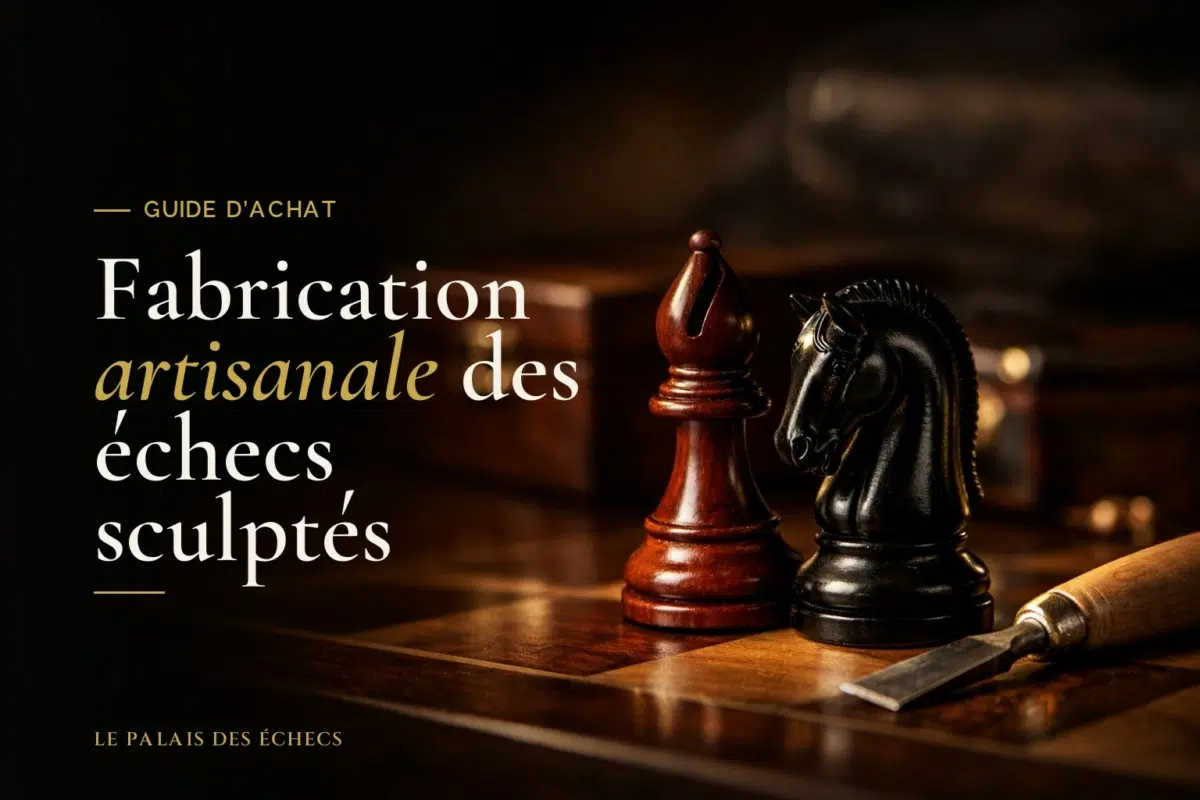
Handcrafted carved wooden chess sets: the techniques
31
Aug
Aug
Behind every wooden chess set lie hours of skilled craftsmanship. From choosing the wood species to the final felting, making a carved wooden chess set is an art that demands patience, precision and passion. Here is a journey into the workshops where the world’s finest sets are born.
Choosing the wood: the first crucial step
It all begins with selecting the wood. Craftsmen choose each piece of timber according to its density, grain, colour and freedom from defects (knots, cracks, moisture variations). The finest species for carved wooden chess sets are:
| Species | Colour | Density | Use | Origin |
|---|---|---|---|---|
| Ebony | Deep black | Very dense (1.1 kg/dm3) | Black pieces, premium | Africa, South-East Asia |
| Rosewood | Reddish-brown, veined | Dense (0.85) | Black pieces, high-end | India, South America |
| Boxwood | Pale yellow | Dense (0.9) | White pieces, standard | Europe, Turkey |
| Sheesham | Golden brown | Medium (0.8) | Alternative to rosewood | India, Pakistan |
| Lime wood | Light cream | Light (0.5) | Figurative carving | Alps, Central Europe |
| Walnut | Warm brown | Medium (0.65) | Chess boards, dark squares | Europe, North America |
| Maple | Light cream | Medium (0.65) | Chess boards, light squares | Europe, Canada |
Drying: before any shaping takes place, the wood must be dried for several months (or even years for the densest species). Poorly dried wood warps, cracks and twists once worked. Our suppliers use natural open-air drying followed by drying in a controlled chamber to reach an optimal moisture content of 8–12%.
To learn more about each species, see our complete guide to fine woods used in our chess sets.
Turning: shaping the Staunton pieces
Staunton pieces — the international standard since 1849 — are shaped on a wood lathe. The turner fixes a rough block of wood onto the chuck and uses various gouges and chisels to create each piece’s characteristic profile: the flared base, the tapered body, the slender neck and the distinctive finial (the king’s cross, the queen’s coronet, the rook’s battlements).
⚖ Precision to a tenth of a millimetre
Every piece in a given set must be identical in proportion. The turner works with jigs and callipers to ensure the 32 pieces (16 white, 16 black) are perfectly consistent. A 95mm king must measure exactly 95mm — not 94, not 96.
⏳ 15 to 30 minutes per piece
Each piece spends 15 to 30 minutes on the lathe, depending on its complexity. The pawn is quickest (15 min), the queen and king take longest (25–30 min). For a complete set of 32 pieces, allow 10 to 15 hours of turning.
Carving the knight: the craftsman’s true test
The knight is the only piece that cannot be made on the lathe: its horse’s head is carved entirely by hand with a knife and gouge. It is the most complex and costly piece to make. A fine Staunton knight takes an experienced carver 45 minutes to an hour.
The quality of the knight is, in fact, the best indicator of a set’s overall quality: a knight with fine features, flared nostrils, a detailed mane and expressive eyes reflects genuine craftsmanship. A crude knight with a barely defined head betrays low-cost industrial production.
Did you know? Our Val Gardena chess pieces (South Tyrol) are ENTIRELY hand-carved — not just the knight but every piece. The craftsmen of Ortisei continue a wood-carving tradition dating back to the 17th century. Each figure is unique, with expressive faces, detailed armour and realistic drapery.
The marquetry of the chess board
Making a fine wooden chess board is a work of decorative marquetry. The 64 squares are individually cut from two contrasting species (typically walnut/maple or ebony/maple), then fitted and glued one by one into a moulded frame.
🎨 Cutting
Each square is cut to a precision of less than a millimetre. The joints between squares must be invisible to the naked eye. A quality chess board shows no gaps between squares, even after years of use.
✨ Decorative inlay lines
High-end chess boards feature marquetry striping: thin strips of a third wood species (often boxwood or maple) inserted between the squares and the frame. This delicate, jewel-like craftsmanship turns the board into a genuine work of art.
🛠 The frame
The moulded frame surrounds the 64 squares and protects the edges. It is made from the same species as the dark squares (walnut, rosewood) and receives a router-cut moulded profile. Some models feature brass or metal corners.
💧 The finish
The board receives a matt or satin varnish that protects the wood without altering its natural colour. The varnish is applied in several coats with intermediate sanding for a perfectly smooth, even finish.
Weighting and felting: the finishing touches that make the difference
This is where a quality wooden chess set is set apart from an industrial product:
⚖ Weighting
A lead or steel weight is inserted into a cavity hollowed out at the base of each piece. The weight must be pre-formed in a mould, slightly smaller than the cavity, then fixed with a special adhesive applied with precision to allow the wood’s natural expansion. Low-cost manufacturers pour molten lead directly into the wood, which “cooks” it from within and shortens its lifespan.
🌳 Felting
A green or black felt is glued to the base of each piece. It protects the board from scratches, cushions the sound of moves and ensures smooth, silent gliding across the board. It is an invisible but essential detail for comfortable play.
The quality test: to check a set’s quality, turn a piece over and examine the weight and felt base. A quality set has a neatly inserted weight (no visible glue, no scorch marks) and a precisely cut felt base, perfectly aligned with the edge of the base. See our buying guide for further criteria.
The different manufacturing techniques
| Technique | Description | Result | Examples |
|---|---|---|---|
| Turning | Piece shaped on a wood lathe | Classic, symmetrical Staunton pieces | Fine woods |
| Hand carving | Each piece carved with knife and gouge | Expressive, unique figures | Alpine wood |
| Resin casting | Mould + crushed-stone-type resin | Fine detail, polychrome painting | Painted resin |
| Metal casting | Lost-wax casting + bronze or brass | Substantial weight, metallic sheen | Metal and bronze |
| Marquetry | Inlaid wood veneer, piece by piece | Decorative boards, geometric patterns | Wooden chess boards |
Replacement pieces
As each set is crafted individually, there may be slight variations in colour and grain from one set to another. If you lose or damage a piece, we offer individual replacement pieces. Send us an original piece so that we can match the replacement as closely as possible. Contact us for a quote.
From the workshop to your chess board
Understanding how a carved wooden chess set is made helps you appreciate the true value of each piece. Behind a 95mm ebony king lie months of drying wood, 30 minutes of turning, meticulous weighting and precise felting. Behind a carved wooden chess board lie hours of marquetry, millimetre-precise cutting and varnish finishing.
It is this attention to detail that sets a handcrafted set apart from an industrial product — and it is what you feel every time you place a piece on the board. To discover the millennia-old history of these techniques, and how the Staunton design standardised piece-making in 1849, read our dedicated articles.
Discover the craftsmanship
Our wooden sets are made using these traditional techniques by European workshops. Discover the difference.
Fine woods Alpine wood Wooden chess boards Complete sets
Becoming a professional female chess player: journey and secrets
From Judit Polgar to Hou Yifan, professional female chess players have proved that there’s no [...]
The Isle of Lewis Chess Pieces: History, Mystery and Collection
Recreate the 12th century by playing with the Isle of Lewis chess set. This article [...]
Which wood should you choose for a chess board and chess pieces? The wood-type guide
Boxwood, ebony, rosewood, maple, walnut, mahogany, olive wood: which wood should you choose for the [...]