



Chess, Learn Chess, News, Non classé
The knight in chess: movement, strategic value and winning combinations

25
Nov
Nov
The knight moves in an « L » shape: two squares in a horizontal or vertical direction, then one square perpendicular to that, or the reverse. It’s the only piece on the chess board able to jump over other pieces, both friend and foe. Its conventional value is 3 points, the same as the bishop, but its most feared weapon remains the fork: a double attack that can target the king and queen at once.
Updated on 3 October 2026 · By Delphine D., Le Palais des Échecs editorial team
The essentials
• Movement: in an L shape, two squares then one perpendicular, or the reverse; the only piece that jumps over others.
• Value: 3 points, the same as the bishop; the knight and bishop together form the minor pieces.
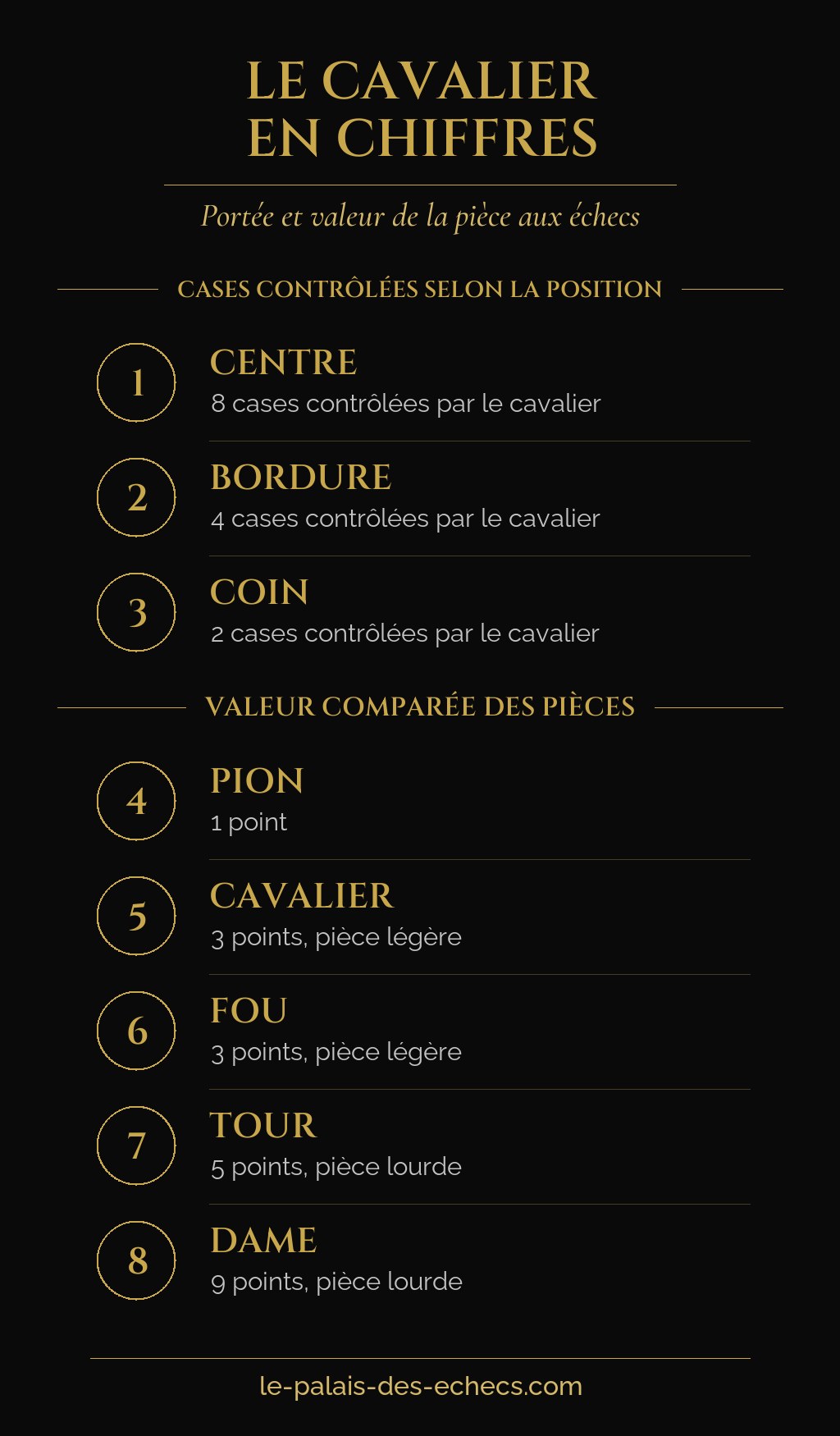
• Reach: 8 squares controlled from the centre, 4 on the edge, 2 in a corner.
• Strength: the fork, a formidable double attack, particularly on the king and queen.
• Mistake to avoid: leaving a knight on the edge or in a corner, where it loses the most power.
How does the knight move in chess? The L-shape rule explained
The knight moves along a path shaped like an « L »: two squares in a horizontal or vertical direction, then one square perpendicular to that, or the reverse, one square then two perpendicular. This movement allows it to reach up to eight different squares from the centre of the chess board.
The only piece that jumps over others
The knight is the only piece on the chess board able to jump over other pieces, whether they belong to its own side or the opponent’s. A piece placed between its starting square and its destination square never blocks its move, unlike the rook, bishop or queen. This is what makes it so useful early in the game, when the board is still crowded with pawns.
Another quirk: with every move, the knight must change the colour of the square it stands on. A knight on a light square always lands on a dark square, and vice versa.
Visually, it’s also the most recognisable piece in a chess set: its carved horse-head shape is a convention of the Staunton pattern, designed by Nathaniel Cooke and sold by Jaques of London in 1849. It remains the benchmark for our Staunton chess sets.
What is the knight’s value compared to the other pieces?
The knight is conventionally worth 3 points, the same value as the bishop. Together with the bishop, it forms the minor pieces, as opposed to the major pieces, the rook and the queen. Unlike the knight, the queen combines the movements of the rook and the bishop, which explains why she is the most powerful piece on the board.
| Piece | Value | Category |
|---|---|---|
| Pawn | 1 | — |
| Knight | 3 | Minor piece |
| Bishop | 3 | Minor piece |
| Rook | 5 | Major piece |
| Queen | 9 | Major piece |
The king has no exchange value: the game ends as soon as he is checkmated, without ever being captured.
Knight or bishop: it all depends on the type of position
These 3 points are an average: the knight’s real value varies according to the position. In closed positions, with pawn chains blocking the diagonals, the knight gains the advantage, as it leaps over obstacles. In open positions, with clear diagonals, the bishop becomes superior: it crosses the whole board in a single move, whereas the knight must proceed in stages.
These are also the two minor pieces carved with the greatest care in our chess sets in fine woods.
« A knight on the rim is dim »: why position matters
A knight does not control the same number of squares depending on where it stands. At the centre of the board, it covers up to 8 squares. On an edge file or rank, this number drops to 4. In a corner, it has only 2 left.
Rule to remember: the closer a knight is to the centre, the more squares it controls and the more active it is. A knight stuck in a corner is almost out of the game.
This loss of mobility explains the well-known saying among players: a knight relegated to the edge sees its controlled squares halved, and quartered in a corner, compared to a centralised knight. It becomes an easier target to neutralise and carries far less weight in both attack and defence.
What is an outpost for a knight?
An outpost is a central square, often in enemy territory, that can never again be attacked by an enemy pawn. A knight placed on a solid outpost, for example on d5 or e5, and supported by a friendly pawn, becomes a piece that is very difficult to dislodge: it controls key squares without fear of being driven away.
The knight fork: the most fearsome tactic
A fork is a simultaneous attack by the knight on two opposing pieces, which cannot both be saved in a single move. It owes its strength to the knight’s L-shaped path, often difficult to anticipate. To discover other combinations such as the pin or the skewer, see our article on chess tactics.
Example of a fork on the king and queen
A knight placed on f7 attacks both d8 and h8 at once. If the opponent’s king is on h8 and their queen on d8, the knight threatens both pieces in a single move: this is a royal fork, one of the most devastating in the game, since the king must step out of check and the queen is lost.
Example of a fork on the king and rook
The same principle applies with a rook: a knight on e7 attacks c8 and g8 simultaneously. If the black king has castled to g8 and a rook has remained on c8, both pieces fall to the same fork.
Before playing your knight, always ask yourself: « From this square, does it attack two unprotected opposing pieces? » This is the reflex that speeds up tactical progress the most.
To see how a fork can lead all the way to checkmate, see our complete guide to checkmate.
Other classic combinations and traps involving the knight
Beyond the fork, the knight features in several recurring tactical patterns.
Attacking a pinned piece
When an opposing piece is pinned, meaning it is immobilised because it is protecting a more valuable piece behind it, a knight can attack it without fear of immediate retaliation, since it cannot move to capture it.
The knight sacrifice
Sacrificing a knight to open up the opponent’s king position, or to clear a file or diagonal, is a classic attacking resource. The 3 points lost are compensated by direct access to the king.
The knight in checkmate patterns
The knight features in many mating patterns: it controls the king’s escape squares while another piece delivers the final check.
The knight and stalemate
An opposing king with no legal move, but not in check, results in stalemate: the game is drawn, even if you have an extra knight in material.
Common beginner mistakes with the knight
- Developing it too late: knights should come out early, often before the rooks and sometimes before the bishops, as they need several moves to reach a good square.
- Placing it on the edge: « a knight on the rim is dim » holds true from the opening onwards. Favour squares such as c3, f3, c6 or f6.
- Trading it without thinking: giving up your knight for an opposing bishop is not always equivalent. In closed positions, it’s often giving away your best asset.
- Forgetting that it jumps over pieces: many beginners look for a « free » square along the knight’s whole path, when only the starting and destination squares matter.
- Overlooking opposing forks: before every move, check whether a square reachable by an enemy knight threatens two of your pieces at once.
Improving with the knight takes regular practice, whether against an opponent or through tactical exercises. Our article on Elo ratings and how to improve at chess sets out concrete ways to structure this training.
Frequently asked questions
Can the knight jump over opposing pieces?
Yes. It is the only piece on the chess board able to jump over any piece, friend or foe, to reach its destination square along the L shape.
How many knights does each player start with?
Each player begins the game with two knights, placed between the rooks and bishops: on b1 and g1 for White, on b8 and g8 for Black.
Why is the knight represented by a horse’s head?
The knight is traditionally carved in the shape of a horse’s head, a convention carried on by the Staunton pattern, designed by Nathaniel Cooke and sold by Jaques of London in 1849.
What is the difference between a knight and a bishop?
Both are worth 3 points and belong to the minor pieces, but their movements are opposite: the knight jumps in an L shape over alternating square colours, while the bishop glides diagonally, always staying on the same square colour.
What is a knight fork?
It is a simultaneous attack by the knight on two unprotected opposing pieces, which cannot both be saved in a single move.
Can a lone king and knight force checkmate?
No. A lone king and knight are never enough to force checkmate against a lone king: this is a case of insufficient material, which results in a draw.
Choosing a beautiful knight for your chess board
The knight is the most delicate piece to carve in a chess set: its horse’s head demands precise relief, a crisp mane and perfect symmetry between the two copies in the set. It is often on this piece that the quality of a set is judged.
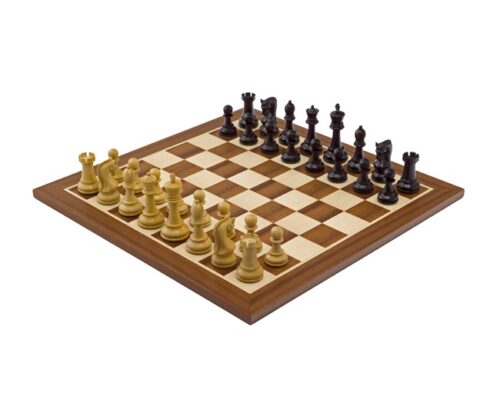
In the Leningrad Set, the boxwood and ebonised boxwood pieces are carved by hand, with a strikingly detailed knight, set upon a mahogany wood chess board.
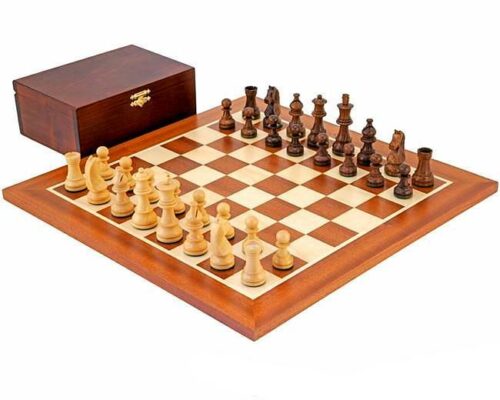
The Championship Set pairs a mahogany and maple wood chess board with a golden rosewood and boxwood chess set, its pieces hand-carved and hand-waxed, delivered in a birch wood storage box.
To understand how this relief is achieved, our article on how carved wooden chess sets are made details the turning and carving stages.
Staunton sets in fine woods
For a knight with classic lines and a good feel in the hand, our Staunton chess sets and our pieces in fine woods remain a safe choice.
Matching chess boards
Choose a board worthy of your pieces among our wooden chess boards.
Taking your knight on the road
The folding Staunton wooden chess board with storage and the magnetic wooden travel set protect the pieces during transport thanks to their built-in storage.
Complete chess sets
Find a knight and its matching chess board in our selection of Staunton chess sets.
Find the chess set that does justice to your knights
Staunton sets, fine woods and travel sets: free delivery across mainland France, with same-day dispatch for orders placed before midday on business days.
Staunton chess setsPieces in fine woodsTravel sets
Why is the queen so powerful in chess?
The queen always stands on a square of her own colour, before becoming the most [...]
Chess Puzzle No. 298: Black strikes in just two moves — can you find the first?
A two-move checkmate awaits on an interactive board: Black to play — can you spot [...]
Chess Puzzle No. 282: Tense endgame: can White find the winning path here?
Tense endgame: will the white king grab an extra pawn? Test your endgame skills on [...]