


Chess, Learn Chess, News, Non classé
Checkmate: definition, mating patterns and complete guide
27
Mar
Mar
Checkmate: two words that end every decisive game of chess. But what do they actually mean? Where does the expression come from? And which mating patterns should you know to win your games? Here’s the complete guide to checkmate, from beginner to seasoned player.
What is checkmate?
Checkmate (often shortened to “mate”) is the situation in which a player’s king is under attack (in check) and cannot flee, block the attack, or capture the attacking piece. The game ends immediately: the player who delivers mate wins.
Precise definition: a king is in checkmate when it is threatened by an opposing piece AND the following three conditions are met: (1) the king cannot move to any safe square, (2) no friendly piece can capture the piece giving check, (3) no friendly piece can be interposed between the attacking piece and the king. If all three conditions are met, it’s checkmate.
Checkmate: origin of the expression
The expression comes from the Persian shah mat, meaning “the king is dead” (or more precisely “the king is helpless”). When chess passed from Persia to the Arab world in the 7th century, the term was retained. It was then adapted into every European language: “checkmate” in English, “Schachmatt” in German, “scacco matto” in Italian. To find out more about these origins, read our article on the history of chess.
The origin of the word “check”: a Persian play on words
The word “check” also comes from the Persian shah, meaning “king”. Taken up as it stood in Arabic, it became “eschec” or “eschac” in Old French when the game was introduced into Europe, around the 11th century. The full expression “checkmate” thus brings together two distinct origins: “check”, from shah (“king”), and “mate”, from mat (“dead”, “helpless”). Literally, the expression therefore means “the king is dead”. To trace this journey of the game from India to Europe, read our history of chess.
Check, mate and stalemate: the differences
| Situation | Is the king attacked? | Can the player move? | Result |
|---|---|---|---|
| Check | Yes | Yes (must parry the check) | The game continues |
| Checkmate | Yes | No (no defence possible) | Victory for the mating player |
| Stalemate | No | No (no legal move) | Draw |
The difference between checkmate and stalemate is crucial: in stalemate, the king is NOT in check but the player has no legal move. It’s a draw, not a win. Many beginners confuse the two situations and accidentally stalemate their opponent when they had a winning position. To master these subtleties, see our complete guide to chess moves.
How to recognise a stalemate on the board?
Stalemate is recognised by a locked position: the king is not in check, but there is no longer any legal move, either for the king or for any other piece. The most common case occurs in the queen and king versus lone king endgame: if the queen gets too close without leaving the opposing king an escape square, she stalemates him instead of mating him.
To avoid this classic pitfall, always leave the opposing king at least one retreat square until the final move. Practise replaying this endgame on a wooden chess board with clearly readable squares.
Classic mating patterns to know
⚔ Scholar’s mate
The fastest mate: in just 4 moves (1.e4 e5 2.Bc4 Nc6 3.Qh5 Nf6?? 4.Qxf7#). The queen captures on f7, protected by the bishop. Devastating against beginners, easy to counter once you know it. See our dedicated article on Scholar’s mate.
⚔ The back-rank mate
The king is trapped on the back rank by its own pawns, and a rook or queen delivers mate on that rank. To avoid it, create a “luft” by advancing a pawn (h3 or g3). The back-rank mate is the most common trap in blitz.
⚔ Smothered mate
The knight mates a king surrounded by its own pieces. The king cannot flee anywhere because it is “smothered” by its allies. This mate often requires a prior queen sacrifice to draw the pieces around the king.
⚔ Anastasia’s mate
The knight and rook work together to mate the king trapped against the edge of the board. An elegant pattern that appears regularly in grandmasters’ games.
⚔ Damiano’s mate
The queen sacrificed on h7 (or h2), the g-pawn recaptures, and the rook mates on the open h-file. A classic of attacks against castled positions.
⚔ Arabian mate
Rook and knight work together in the corner of the board. The knight controls the escape squares while the rook delivers mate. This pattern takes its name from the earliest chess treatises written in Arabic in the 8th century — a nod to the Arabic origins of the term “checkmate”.
The staircase mate: a progressive pattern to know
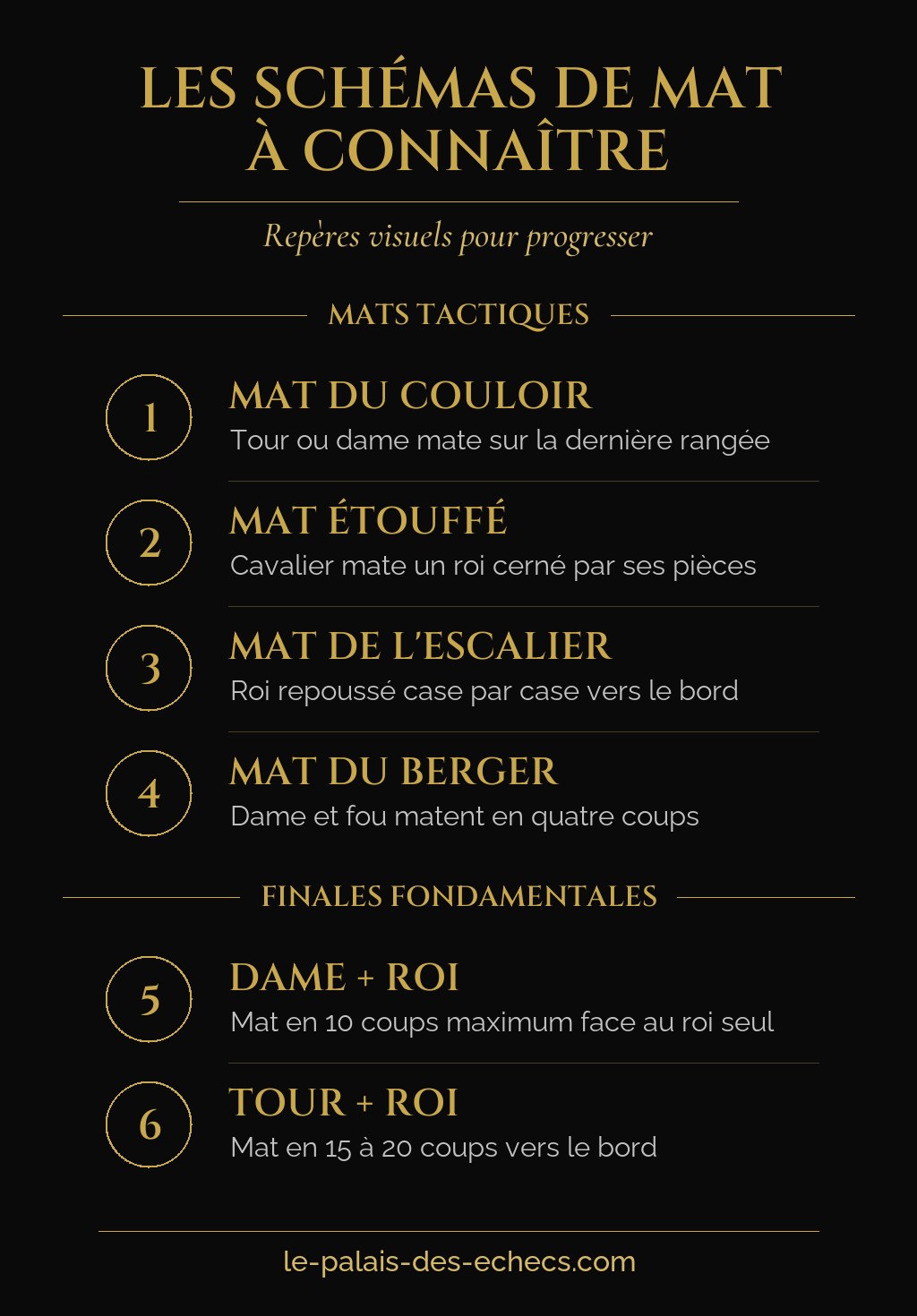
The staircase mate involves pushing the opposing king back towards the edge of the board by alternating checks from two pieces, as if climbing the steps of a staircase. It is mostly found in rook and king or queen and king versus lone king endgames, where each check reduces the opposing king’s space by one rank or file.
This pattern illustrates the logic common to all classic mates: progressively reducing the available squares before delivering the final blow. The table below summarises the most useful patterns to memorise.
| Pattern | Pieces involved | Key idea |
|---|---|---|
| Back-rank mate | Rook or queen + pawns | The king is blocked by its own pawns on the back rank |
| Smothered mate | Knight | The king is surrounded by its own pieces |
| Staircase mate | Rook or queen + king | The opposing king is pushed back rank after rank |
| Scholar’s mate | Queen + bishop | A rapid attack on the f7 square straight from the opening |
| Anastasia’s mate | Knight + rook | The king is trapped against the edge of the board |
To reproduce these positions and practise, a wooden chess board with sufficiently large squares makes it easier to visualise escape squares. Our Staunton sets and our chess sets in fine woods are equally suited to study and to competition.
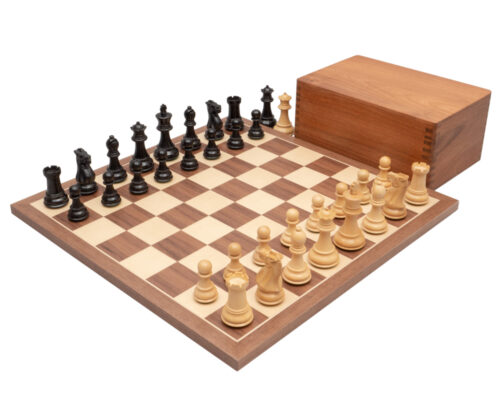
The Competition set, with its walnut and maple wooden chess board and boxwood chess pieces, offers 4.4 cm squares that are wide enough to work through these mating patterns rank by rank.
How to checkmate quickly?
Beginners often wonder how to checkmate in as few moves as possible. Here are the fastest possible mates:
| Mate | Moves | Notation | Likelihood in a real game |
|---|---|---|---|
| Fool’s mate | 2 moves | 1.f3 e5 2.g4?? Qh4# | Very rare (White must play very poorly) |
| Scholar’s mate | 4 moves | 1.e4 e5 2.Bc4 Nc6 3.Qh5 Nf6?? 4.Qxf7# | Common among beginners |
| Légal’s mate | 7 moves | Queen sacrifice + mate with minor pieces | Rare but spectacular |
| Italian mate | 8-12 moves | Rapid attack on f7 in the Italian opening | Common in amateur games |
★
Expert tip: rather than chasing quick mates (which only work against beginners), focus on the fundamentals: setting up your pieces correctly, controlling the centre, developing quickly and castling. Good development naturally leads to mating opportunities. To make lasting progress, see our beginner’s strategy guide and our 11 tips to improve your game.
Fundamental mating endgames
In the endgame, when few pieces remain, you need to know how to deliver mate with minimal material. Here are the mating endgames you absolutely must master:
♕ King + Queen vs King
The simplest mate. The queen pushes the opposing king back towards the edge, then the allied king approaches to help. Mate in 10 moves at most. Every player must master this endgame.
♖ King + Rook vs King
Trickier than Queen vs King. The rook cuts off the opposing king along a rank or file, gradually pushing it back towards the edge. Mate in 15-20 moves.
♖♖ King + 2 Rooks vs King
The “lawnmower” mate: the two rooks take turns to push the king back rank by rank towards the edge. Very easy, even for a beginner.
♗♗ King + 2 Bishops vs King
Possible but technical. The two bishops work together along the diagonals to confine the king to a corner. It takes practice. King + Bishop + Knight vs King is even harder (one of the most complex mates in chess).
Checkmate in culture
The expression “checkmate” has gone beyond the world of chess to enter everyday language. People say someone has been “checkmated” to mean a decisive, unanswerable victory. The term has inspired films, books and even a clothing brand. The film Checkmate (2023) on Netflix renewed the public’s interest in this expression and in the game itself, following in the footsteps of the success of The Queen’s Gambit.
To practise your mating patterns, nothing beats a beautiful chess board and daily exercises. Our electronic chess boards feature mate puzzles that adapt to your level. And our video courses by Grandmasters include modules dedicated to mating endgames.
Frequently asked questions
What is checkmate, in one sentence?
Checkmate is the situation where the king is attacked and no legal move can parry that attack: the game stops immediately and the player who delivered the mate wins.
What’s the simplest definition of mate in chess?
A mate is a check that cannot be answered: the king can neither flee, nor be defended, nor capture the attacking piece.
Who invented the expression “checkmate”?
No one invented the expression as such: it passed down from the Persian shah mat into Arabic, then into European languages as the game spread from Asia to medieval Europe.
Is “mate” a synonym for “checkmate”?
Yes, “mate” is simply the short form of “checkmate”: both terms refer to the same end of the game.
Master Checkmate
Courses, puzzles, training chess boards: everything you need to perfect your mating technique.
Complete sets Electronic sets Courses
Blitz chess: rules, strategies and tips for playing fast
Blitz is the most intense and addictive form of chess. With 3 to 5 minutes [...]
The Sicilian Defence: chess’s most powerful opening
The Sicilian Defence (1.e4 c5) is the most played and most analysed opening in the [...]
Which wood should you choose for a chess board and chess pieces? The wood-type guide
Boxwood, ebony, rosewood, maple, walnut, mahogany, olive wood: which wood should you choose for the [...]