




Chess, Learn Chess, News, Non classé
Scholar’s Mate in chess: how to play it and defend against it in 4 moves

27
Mar
Mar
Scholar’s Mate delivers checkmate in just 4 moves, exploiting the f7 square, the only square in Black’s camp defended solely by the king at the start of the game. The white queen and bishop combine to strike the fatal blow if Black fails to react in time. A single defensive move is enough to neutralise it completely, and to turn your opponent’s mistake into a lasting advantage.
The essentials
• Definition: Scholar’s Mate is a mate in 4 moves targeting the f7 square, defended only by the king at the start of the game.
• Typical sequence: 1.e4 e5 2.Bc4 Nc6 3.Qh5 Nf6?? 4.Qxf7#.
• Best defence: 3…g6! chases away the queen and gives you the development advantage.
• Classic mistake: playing 3…Nf6 thinking it attacks the queen, which actually allows the mate.
• Beyond 1000-1200 Elo: this trap barely works any more; it’s better to learn proper openings.
• Symmetrical variant: the same idea exists with Black, this time targeting the f2 square.
Updated on 4 November 2026: addition of variations, common mistakes, step-by-step defence and FAQ.
Scholar’s Mate move by move
Scholar’s Mate (sometimes called the Four-Move Checkmate) unfolds in 4 moves with White:
Move 1: 1.e4 e5 — Both players advance their king’s pawn two squares. The most classic opening.
Move 2: 2.Bc4 — White’s bishop develops to c4, pointing directly at f7, Black’s weak point. This f7 pawn is only protected by the king — it’s the only square in the opening defended by a single piece.
Move 3: 3.Qh5 — The queen comes out to h5, threatening both the e5 pawn and, more importantly, the f7 square. Two pieces now target f7. If Black isn’t careful…
Move 4: 3…Nf6?? 4.Qxf7# — Black plays Knight f6, thinking it attacks the queen. But the queen captures the f7 pawn with checkmate! The king cannot flee (blocked by its own pieces), and the queen is protected by the bishop on c4. Game over in 4 moves.
The full notation: 1.e4 e5 2.Bc4 Nc6 3.Qh5 Nf6?? 4.Qxf7#
Variations of Scholar’s Mate
The most common move order brings out the bishop before the queen (2.Bc4 then 3.Qh5), but some players reverse the order as early as the 2nd move.
Aggressive variation: 2.Qh5 on the 2nd move
After 1.e4 e5, some players bring the queen out immediately with 2.Qh5. This is premature: 2…Nc6! develops a piece while defending e5, and the white queen has gained no time at all. White must then play 3.Bc4 to return to the main line, but the element of surprise has already been lost.
Why this trap still catches out online players
On rapid games platforms, Scholar’s Mate continues to work because many beginners play their first moves out of habit rather than checking for threats. A move that seems to develop a piece, such as 3…Nf6, can in fact open the door to mate if the square it leaves without additional defence is not controlled. To revisit the algebraic notation used in these sequences, see our complete list of chess moves.
Why does it work?
⚠ The f7 (and f2) point
In the opening, the squares f7 (for Black) and f2 (for White) are the weakest points on the board. They are only protected by the king. Any combined attack on these squares is dangerous. Scholar’s Mate exploits this weakness ruthlessly.
♕ Queen and bishop coordination
The power of Scholar’s Mate relies on the collaboration between the queen (which captures on f7) and the bishop (which protects the queen from c4). It’s a perfect example of coordination between pieces — a fundamental principle of chess strategy.
How to defend against Scholar’s Mate?
If your opponent attempts Scholar’s Mate, don’t panic! It’s easy to defend against once you know what to do. Here are the defences:
Defence 1: Block with g6 (the best option)
After 1.e4 e5 2.Bc4 Nc6 3.Qh5, simply play 3…g6!. The g6 pawn attacks the queen, which must retreat. Not only do you parry the threat, but White’s queen is now poorly placed and has lost time. You already have the advantage!
Defence 2: Develop the knight to f6
Careful, 3…Nf6 looks like it attacks the queen, but this is precisely the move that ALLOWS the mate (4.Qxf7#). However, if White plays 2.Qh5 as early as move 2 (a more aggressive variation), then 2…Nc6! develops a piece while defending e5.
Defence 3: Develop the bishop to e7
After 3.Qh5, the move 3…Qe7 defends f7 while preparing development. Less dynamic than g6 but perfectly solid.
★
Golden rule: if your opponent brings their queen out very early (before move 5), it’s usually a mistake on their part. Don’t panic. Develop your pieces normally, force the queen to retreat by attacking it with your minor pieces, and you’ll gain development time. A player who attempts Scholar’s Mate and fails often ends up badly behind in development.
After the defence: turning the avoided trap into a material advantage
An opponent who fails to deliver Scholar’s Mate has brought out their queen very early and now has to reposition it, often losing an extra move in the process. This is the moment to go on the attack rather than simply breathing a sigh of relief.
After 3…g6 and the queen’s retreat, complete your development with …Bg7, …Nf6 and short castling. The white queen, moved twice for nothing, delays the development of her own minor pieces: your light pieces come into play faster, and you can look to pin or fork that poorly placed queen as soon as she returns to an accessible square. Our article on chess tactics details these combinations (fork, pin, skewer) that let you turn this developmental lag into a material gain.
Scholar’s Mate with Black
Scholar’s Mate with Black is symmetrical, targeting the f2 square instead of f7. The typical sequence: 1.e4 e5 2.Nc3 Bc5 3.d3?? Qh4 and the queen threatens f2. If White doesn’t see the threat: 4.Nf3?? Qxf2#. Same principle: queen and bishop collaborate on the weak f2 point.
Scholar’s Mate vs Lion’s Mate: what’s the difference?
| Name | Moves | Principle |
|---|---|---|
| Scholar’s Mate | 4 moves | Queen + Bishop on f7. The “pure” 4-move mate. |
| Lion’s Mate | Variable | Queen sacrifice to force a mate. More spectacular, more complex. |
| Fool’s Mate | 2 moves | 1.f3 e5 2.g4?? Qh4#. The fastest possible mate (but White has to play very badly). |
| Légal’s Mate | 7 moves | Queen sacrifice + mate with minor pieces. A classic of chess history. |
The term “kiddie mate” is sometimes used colloquially as a synonym for Scholar’s Mate, referring to how it typically catches out beginners.
Why you should move beyond Scholar’s Mate
Scholar’s Mate is fun and satisfying when it works. But it only works against beginners who don’t know the defence. Against a player who knows 3…g6, you’ll end up with a poorly placed queen and a development deficit.
⚠ The limits of Scholar’s Mate
From around 1000-1200 Elo (advanced beginner level), nobody falls for Scholar’s Mate anymore. If you want to improve at chess, you need to learn genuine openings based on sound principles.
♔ The real foundations
Rather than hunting for 4-move mates, invest your time in fundamental principles: controlling the centre, developing your pieces, castling early. These principles will lead you to far more satisfying and lasting victories. The harmonious development of the knight, often underestimated, plays a key role in these principles: discover why in our article on the importance of the knight in chess.’},{
To learn all the special moves in chess (castling, en passant, promotion) and understand algebraic notation, see our complete guide. And to master the most common checkmate patterns, our dedicated article gives you all the keys. To dig deeper into another often misunderstood special move, read our guide on en passant in chess.
“Strong moves don’t come from traps, but from a deep understanding of the game.”
José Raúl Capablanca, World Champion 1921-1927
José Raúl Capablanca, World Champion 1921-1927
Where does the name « Scholar’s Mate » come from?
The exact origin of the expression isn’t documented with certainty. In French, it’s known as the « mat du berger » (the shepherd’s mate), evoking a simple trick, much like a shepherd catching his flock off guard without any real show of strength. In English, it’s called Scholar’s Mate, a name that refers more to the level of the player falling for the trap than to the one delivering it.
In both languages, the name highlights the same idea: a mate that only works if your opponent hasn’t yet learned to watch out for it.
Practising so you never fall for this trap again
Replaying the sequence on a real chess board, piece in hand, helps you remember the threat far better than a simple diagram.
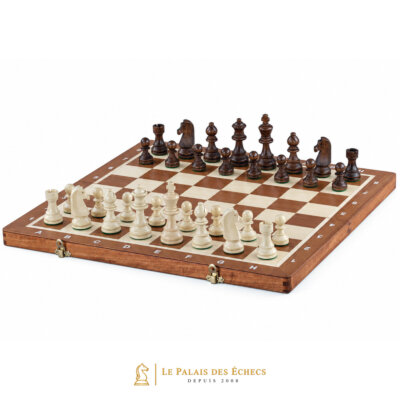
A folding Staunton chess board with built-in storage lets you replay Scholar’s Mate and its defences at home, then pack the pieces away without losing track of a game in progress. Other models can be found in our Staunton chess sets category.
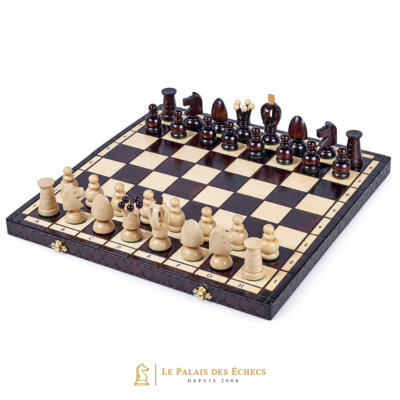
To follow the notation (1.e4 e5 2.Bc4…) square by square during practice, a chess board with alphanumeric coordinates makes it easier to read the moves.
To take the position on holiday or to friends’ houses, a wooden magnetic travel chess set keeps the pieces in place during the journey, a good option among our travel and folding chess sets. Younger players will find suitable sets in our chess sets for children and beginners selection, while lovers of fine wood will enjoy our chess pieces in precious wood.
Frequently asked questions
How do you perform Scholar’s Mate?
Play 1.e4 e5 2.Bc4 Nc6 3.Qh5, targeting the f7 square with the queen and bishop. If Black replies 3…Nf6??, 4.Qxf7# ends the game; against a wary opponent, this trap almost never works.
Why is it called Scholar’s Mate?
The exact origin of the name isn't documented with certainty. It evokes a quick trick, rather like a shepherd catching his flock off guard without any real show of strength — indeed, in French it's called « mat du berger », the shepherd's mate.
How can I regain the initiative if my queen comes out too early?
Move it back to a safe square as soon as it’s attacked, then continue your development as normal. Bringing the queen out early costs you tempo; it’s better to accept this setback and catch up on development rather than making repeated queen moves.
Does Scholar’s Mate still work online?
Yes, especially in rapid games against beginners who play on instinct. From around 1000-1200 Elo upwards, the 3…g6 defence is generally known and the trap fails.
Delphine D., editorial team at Le Palais des Échecs, a French shop specialising since 2008 in wooden chess sets and chess boards. Our guides draw on our customers’ questions, the official FIDE rules, and the products we sell and measure ourselves. They are regularly reviewed and updated. The editorial team

Chess Puzzle No. 291: Black to move: can you spot the move that settles it?
Black to play and mate in two: a sacrifice clears the path to the white [...]
Civil War Chess Sets: Our Themed Selection
Fight courageously for the reunification of the country with one of these striking Civil War [...]
Chess Puzzle No. 312: Can you spot Black’s forced mate in three moves?
Black must deliver mate in three moves after Rxa6. An expert-level chess puzzle to solve [...]