



Chess, Learn Chess, Non classé
Chess tactics: fork, pin, skewer and other combinations to win material
30
Oct
Oct
A chess tactic is a sequence of forcing moves, often short, that wins material or delivers checkmate through a combination of precise threats: fork, pin, skewer or discovered attack. Unlike strategy, which builds a plan over several moves, tactics are calculated immediately, move by move. Learning to recognise these four patterns is the fastest way to improve, whatever your level.
Published on 30 October 2026 · By Delphine D., Le Palais des Échecs editorial team
The essentials
• Fork: a single piece attacks two targets at once.
• Pin: an opposing piece is immobilised because moving it would expose a more serious loss.
• Skewer: the reverse of a pin, the more valuable piece is in front and must move, giving up the one behind it.
• Discovered attack: a move shifts one piece and reveals the attack of another, hidden until then.
• Deflection and overloading: more advanced tactics that exploit a poorly placed or overburdened piece.
• Training regularly on a clear chess board helps you memorise these patterns visually.
What is a chess tactic? The difference with strategy
A tactic is a short-term calculation: a sequence of forcing moves (checks, captures, threats) aimed at a concrete gain, material or checkmate, within just a few moves. Strategy, on the other hand, builds a plan over time: pawn structure, piece activity, king safety. The two complement each other: good strategy creates the weaknesses that a tactic then exploits.
A player may know every opening and still lose a piece within a few moves for failing to spot a simple fork. This is why tactics often improve faster than strategy for a beginner or intermediate player. To revisit the basics of building a game before tackling combinations, our guide to chess strategy for beginners lays the necessary groundwork.
The fork: attacking two pieces with one move
A fork is when a single move attacks two or more opposing pieces at once, so the opponent cannot save them both. The knight is the most fearsome piece for this motif, as it attacks squares that other pieces do not control.
Classic example: a knight on d5 attacks both the king on e7 and the rook on c7. Check is forced, the king must move, and the rook falls on the next move. The gain is clear: the knight, worth 3 points, has captured a rook worth 5.
A pawn can fork too: when it advances and simultaneously attacks two minor pieces standing side by side on the same rank, one of them is lost. This is a common mistake right from the opening, when two minor pieces end up on adjacent, undefended squares. To explore this piece’s role in combinations further, read our article on the knight in chess.
The pin: immobilising an opposing piece
A pin targets an enemy piece aligned with a more valuable piece behind it: bishop, rook or queen attacking from a distance along a rank, file or diagonal. The pinned piece cannot move without exposing the piece behind it.
Absolute or relative pin?
We speak of an absolute pin when the piece behind is the king: moving the pinned piece would be an illegal move, since it would place the king in check. A bishop on b5 pinning a knight on c6 against the king on e8 is a typical example: the knight simply cannot move.
A relative pin involves any other more valuable piece, most often the queen. The pinned piece can legally move, but doing so would cost the more valuable piece standing behind it. In both cases, the pinned piece loses most of its usefulness: it no longer defends anything and becomes an easy target for a further attack.
The skewer: the pin in reverse
A skewer relies on the same alignment as a pin, but in reverse order: the more valuable piece is in front, the weaker one behind. The piece in front must move to escape the attack, which automatically exposes the one behind it.
A common example in the endgame: a rook placed on an open file skewers the opposing queen and a rook standing just behind it. The queen must move to avoid capture, and the rook falls on the next move. The skewer is particularly effective against a king: a discovered check along a file forces the king to move and frees up the capture of the piece behind it.
The discovered attack and discovered check
A discovered attack occurs when one piece moves and reveals the attack of another piece, hidden behind it until then. If the revealed move places the opposing king in check, this is called a discovered check. The strength of this motif lies in the fact that the piece which moves can also create a threat of its own.
Double check, the ultimate combination
When the piece that moves gives check itself as well as revealing the attack of another piece, both pieces put the king in check simultaneously: this is a double check. No piece can block both attacks at once or capture both attackers with a single move: the king is forced to move. It is one of the most devastating tactical weapons in chess.
To practise a short pattern combining several threats in just a few moves, our article on the list of chess moves details some classic sequences, including Scholar’s mate, often studied first by beginners to get used to spotting a hidden threat behind an apparently harmless move.
Deflection, overloading and opening-line sacrifices: advanced tactics
Beyond the four basic motifs, three ideas come up often in the games of more experienced players.
- Deflection: forcing, often through a sacrifice, a defensive piece away from the square or piece it protects.
- Overloading: a piece defending two things at once cannot fulfil both roles. By attacking it on a second front, one of the two inevitably falls.
- The line-opening sacrifice: giving up material early to open a file or diagonal towards the opposing king, with a view to recouping more afterwards.
Modern tactical players, such as Magnus Carlsen or Alireza Firouzja, are renowned for their ability to calculate this type of combination quickly, particularly in rapid formats. Our article on blitz chess explains why pattern recognition matters more than deep calculation in that context.
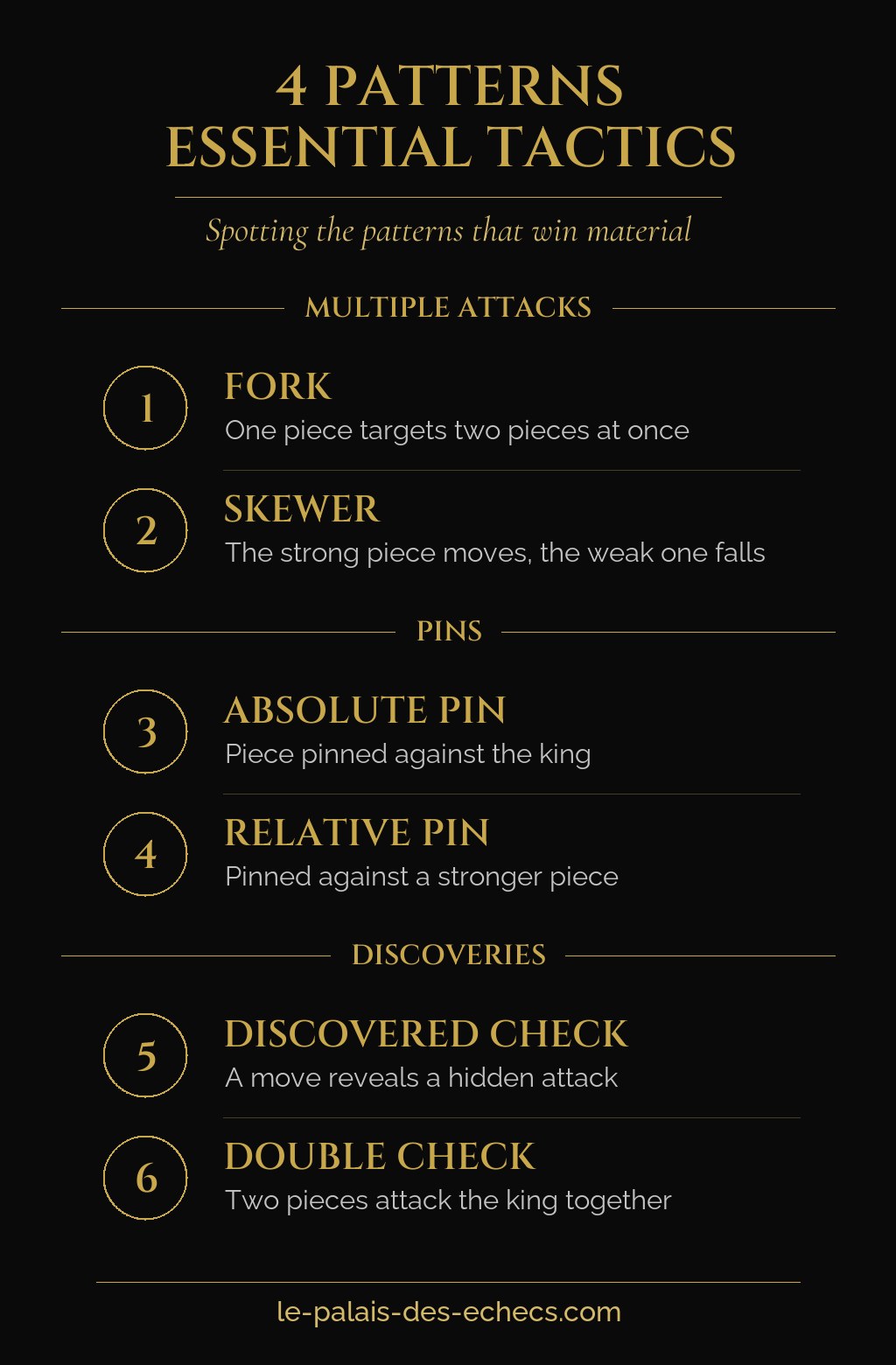
Comparison of the main tactical motifs
| Motif | Mechanism | Typical pieces | Desired outcome |
|---|---|---|---|
| Fork | One piece attacks two targets at once | Knight, pawn, bishop | Winning the less well-defended piece |
| Absolute pin | The pinned piece protects its own king | Bishop, rook, queen | Piece frozen, capturable afterwards |
| Relative pin | The pinned piece protects a more valuable piece | Bishop, rook, queen | Loss of material if it moves |
| Skewer | The more valuable piece is in front and must move | Rook, queen | Capture of the piece standing behind |
| Discovered attack | A move reveals a hidden attack | All pieces | Gain of material or surprise check |
| Deflection | A defensive piece is forced away | All pieces | Loss of the defended square or piece |
| Overloading | A piece defends two things at once | All pieces | One of the two falls |
How to train yourself to spot tactical motifs every day
Recognising a fork or a pin in a split second is learned through repetition, not theory alone.
Daily tactical puzzles
Solving a few tactical positions each day, even short ones, trains the brain to recognise typical configurations (aligned pieces, an exposed king, an overloaded piece) even before calculating variations. Consistency matters more than quantity. It is also one of the most effective ways to improve your Elo rating, as detailed in our guide on strategies to raise your Elo rating.
Replaying on a physical chess board
Handling the pieces yourself, on a well-finished, clear board, helps you memorise motifs visually: the position of light and dark squares, the shape of the pieces, the alignment of a pin are better retained by seeing and touching them than by scrolling past them on a screen. A quality chess board, with clearly contrasting squares, makes these patterns easier to spot at a glance.
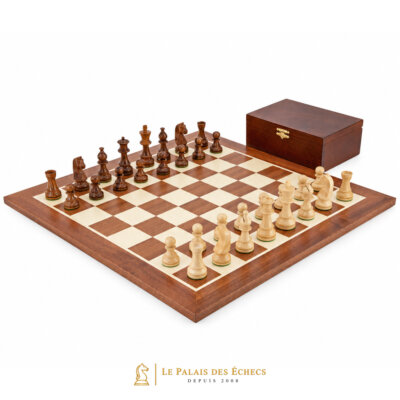
To practise at home on a clear, well-contrasted board, a Staunton chess set such as the Grand Championship Set, in rosewood on a maple and mahogany chess board, makes alignment motifs (pin, skewer) easier to read.
To practise anywhere, at work, while travelling or between two online games, a folding chess set lets you replay a combination spotted the day before without waiting to get home.
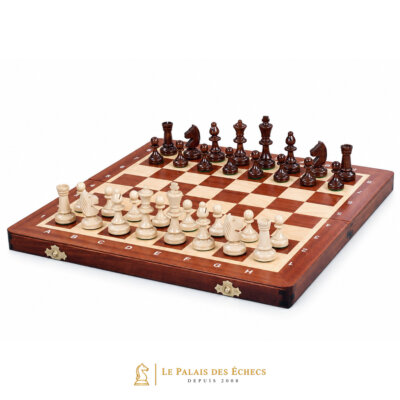
This folding board in sycamore and mahogany, with pieces in hornbeam, slips into a bag and unfolds in seconds to reproduce a fork or discovered attack spotted in a puzzle.
For younger players or those just starting out, a wooden student chess set with storage offers a compact, practical format for fitting in several short training sessions, and complements our chess sets for children and beginners selection nicely. A wooden magnetic travel set is also a solid option for replaying a position without worrying about knocking the pieces over.
Finally, if you are looking to update your equipment to train in good conditions, browse our selection of wooden chess boards: a clear board with well-contrasted squares remains the best support for memorising these combinations visually.
Frequently asked questions
What is the difference between tactics and strategy in chess?
Tactics are short-term calculations: a sequence of forcing moves aimed at an immediate gain, material or checkmate. Strategy builds a plan over time, drawing on pawn structure, piece activity and king safety. Good strategy often creates the conditions that a tactic then exploits.
How do you train chess tactics?
By regularly solving short tactical puzzles, ideally every day, and replaying those positions on a physical board to anchor the motifs visually. Regular repetition is more effective than long occasional sessions.
What is a combination in chess?
A combination is a sequence of several forcing moves, often based on one or more tactical motifs (fork, pin, discovered attack), which leads to a gain of material or checkmate. Each move in the sequence forces the opponent’s response.
Is there a free pdf of chess tactics?
We do not offer a downloadable pdf on this topic, but this article covers the four essential motifs with commented examples you can reproduce on a physical chess board to practise.
Is a pin always winning?
No. A pin immobilises a piece and makes it vulnerable, but it then needs to be attacked a second time, often with a pawn or another piece, to turn the immobilisation into an actual material gain.
What is the difference between a pin and a skewer?
In a pin, the less valuable piece is in front and cannot move without exposing the more valuable piece behind it. In a skewer, the order is reversed: the more valuable piece is in front, it must move, which exposes the weaker piece behind it.
Train on a chess board that helps you spot the motifs
A clear, well-finished board makes forks, pins and skewers easier to visualise, at home and on the move.
Staunton chess sets Folding chess sets Wooden chess boards
Veil lifted: women chess players brave the silence and reveal a dark side of the community
Voices Break the Silence: French Women Chess Players Denounce Unacceptable Abuse In an open letter [...]
Chess player, is your opponent secretly cheating? The 3 signs to watch out for!
Chess, a game of strategy several centuries old, requires concentration, careful thought and honesty. However, [...]
Pocket Chess Sets: The Perfect Gift for Any Enthusiast
Compact, magnetic and always ready to play: the pocket chess set. A pocket chess board [...]