




Board Games, Chess, Learn Chess, News, Non classé
Draughts vs chess: the differences between the two strategy games
30
Nov
Nov
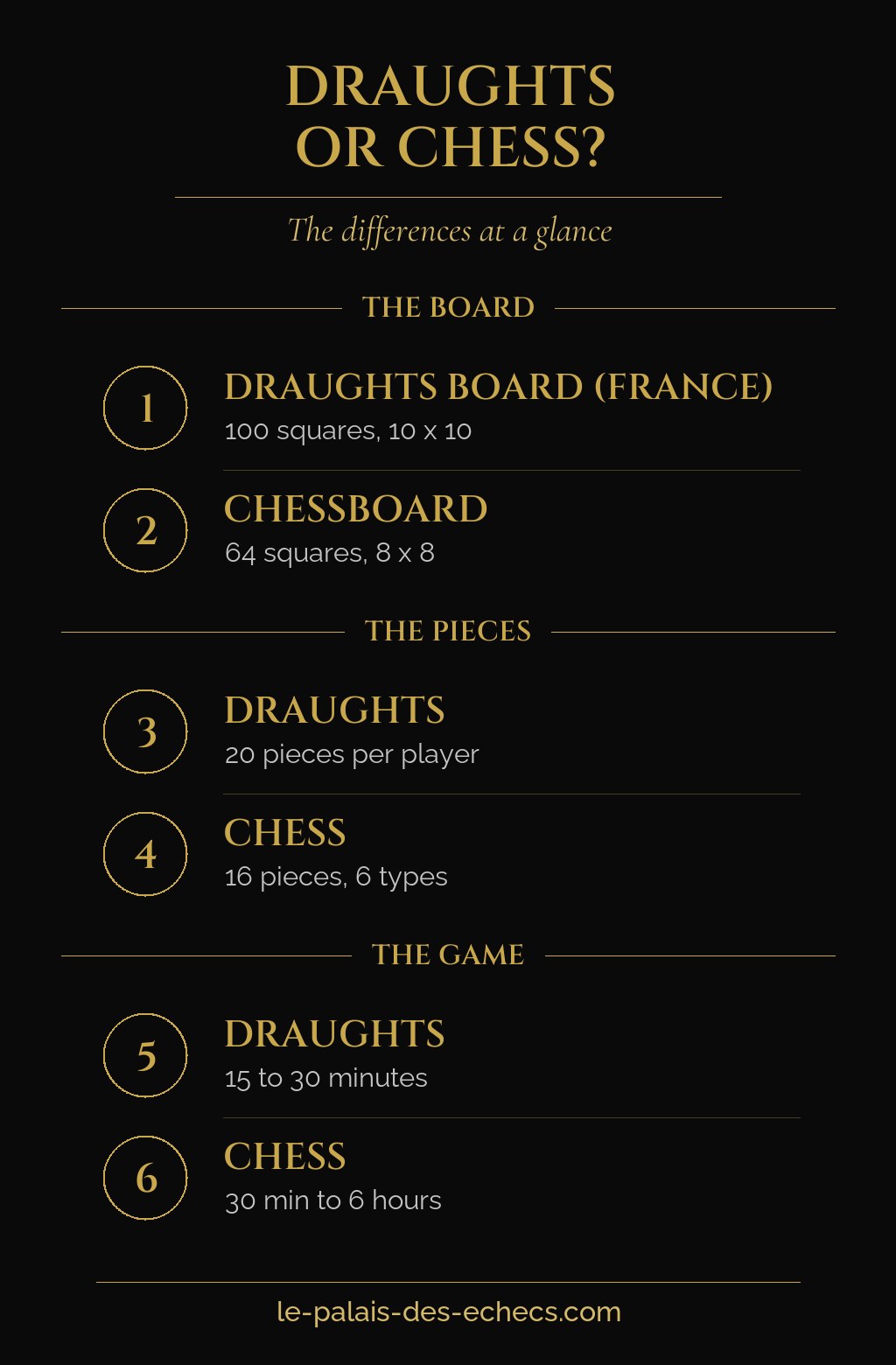
Draughts and chess are both played on a board of alternating squares, but their rules, equipment and strategic depth differ almost entirely. The French board has 100 squares (10 × 10), against 64 for the chessboard (8 × 8); draughts pits 20 identical pieces that move diagonally, while chess brings 16 pieces of 6 different types into play, each with its own moves. Draughts can be played in a few minutes and mastered quickly; chess takes years to explore its full richness.
Updated on 7 November 2026 · By Delphine D., Le Palais des Échecs editorial team
The essentials
• Board: 100-square board (10 × 10) in France for draughts, against 64 squares (8 × 8) for the chessboard.
• Pieces: 20 identical pieces in draughts, against 16 pieces of 6 different types in chess.
• Learning curve: draughts rules can be understood in 5 minutes, chess already takes 30 minutes for the basics.
• Game length: 15 to 30 minutes for draughts, from 30 minutes to 6 hours for chess in tournament play.
• Buying: a solid wood or folding draughts board, alone or in a set with chess, is chosen according to board size and use.
Update of 7 November 2026: complete rewrite: turning the existing comparison article (593 words, with a 69% drop in clicks) into a comprehensive reference guide: rule differences,….
Draughts and chess: two board games, two philosophies
Draughts and chess are both played on a board of alternating squares, but that is about their only common point. Draughts relies on identical pieces and a single type of move, for quick games accessible from a very young age. Chess relies on the diversity of its pieces and a combinatorial depth so vast that the game has, to this day, never been solved by a computer.
Draughts board or chessboard: what is the real difference?
A draughts board and a chessboard do not have the same number of squares: the official French draughts board has 100 (10 squares by 10), while the chessboard has only 64 (8 squares by 8). This is the most common confusion among beginners, with a concrete consequence on which equipment to buy.
How many squares are on a draughts board?
In France, a draughts board has 100 squares, meaning 50 light squares and 50 dark squares. Under the Anglo-Saxon rules (checkers), however, draughts is played on a 64-square board, identical to a chessboard. A standard chess board (8 × 8) can therefore be used for both games, but the official French variant requires a 10 × 10 board. This is why our chess and draughts sets often come with a reversible board or a dedicated board, supplied with the pieces.
The rules: what really changes between draughts and chess
The board is only the visible part: the rules of movement, capture and ending a game differ almost entirely between the two games. Here is a summary comparison, before the full detail on our page dedicated to the rules of draughts.
| Criterion | Draughts | Chess |
|---|---|---|
| Board | 100-square board (10 × 10) in France, or 64 squares (8 × 8) in the Anglo-Saxon version | 64-square chessboard (8 × 8) |
| Pieces | 20 identical pieces per player | 16 pieces of 6 different types |
| Movement | Diagonally, forwards only (the king also moves backwards) | Varies by piece: in a line for the rook, diagonally for the bishop, in an “L” shape for the knight |
| Capture | Compulsory, by jumping over the opponent’s piece | Optional |
| Promotion | The piece becomes a king, with unlimited diagonal range | The pawn becomes a queen, rook, bishop or knight |
| Game length | 15 to 30 minutes on average | From 30 minutes to 6 hours in classical tournament play |
| Learning the rules | About 5 minutes | 30 minutes for the basics, years for mastery |
| Recommended minimum age | 5 to 6 years | 6 to 7 years |
The 6 types of chess pieces do not all carry the same conventional value: pawn 1, knight 3, bishop 3, rook 5, queen 9. The king has no exchange value, since it can never be captured: a game ends in checkmate, or in a stalemate, which is a draw rather than a defeat. Chess also adds rules unknown to draughts, such as kingside castling, queenside castling or en passant.
How are the pieces set up at the start?
In draughts, the 20 pieces are placed on the dark squares of each player’s first 4 rows; the 2 central rows remain empty. Each piece moves diagonally one square forward, until it reaches the opponent’s side and becomes a king.
In chess, the 16 pieces occupy each player’s first 2 rows: major and minor pieces at the back, pawns in front. “Queen on her own colour” remains the best way to check the set-up, detailed in our guide to setting up a chessboard correctly.
Which game is easier to learn? Which is deeper to master?
Draughts can be mastered in a few minutes: a single rule of movement, compulsory captures, and quick games. Chess takes longer to learn the basics, and a whole lifetime is not always enough to exhaust its strategic depth.
This difference can also be measured in combinatorics. Draughts, in its 8 × 8 Anglo-Saxon variant, was fully solved by researchers in 2007: the computer proved that a game played perfectly by both sides always ends in a draw. Chess, meanwhile, offers a number of possible games so vast that no computer has yet managed to solve the game.
To improve at chess, it is best to start with the fundamentals of strategy for beginners, then explore the best openings. And for another pure logic challenge, try our matchstick puzzle, dreaded by most visitors. For a change with another age-old strategy game, discover also how to learn to play shogi, Japanese chess.
Draughts or chess: which game to choose according to age and player profile
The right choice depends less on age than on what you are looking for: a quick introduction, a lasting challenge, or a gift the whole family will enjoy.
Child starting out
Start with draughts: simple rules, short games, first notions of strategy without the complexity of chess. Once the rules of draughts are mastered, the child is ready for a chess set for beginners.
Intellectual challenge
Chess offers an almost infinite depth: openings, tactics, endgames. Our beginner’s strategy guide lays the foundations, for a game that will occupy a whole lifetime.
Family gift
A wooden set combining chess, draughts and backgammon is the most versatile gift: children play draughts, adults play chess, and everyone plays backgammon.
Both at once
Many players enjoy both: draughts for a relaxed game, chess for the depth. A reversible draughts and chess board lets you switch from one to the other without changing equipment.
How to choose a good wooden draughts board
A good draughts board is chosen on three concrete criteria: board size, material and everyday practicality. Here is how to find your way before buying.
- Board size: for official French draughts, aim for a 10 × 10 board (100 squares); an 8 × 8 board (64 squares), identical to a chessboard, suits the Anglo-Saxon rules and also allows you to play chess.
- Square and piece size: pieces should fit comfortably on their square, with enough margin to move them without catching neighbouring pieces.
- Material: a solid or folding wooden board, with turned wooden pieces, remains the most stable and durable choice compared with a cardboard board.
- Practicality: a folding model is easy to store and carry, a real asset for playing on holiday or with family.
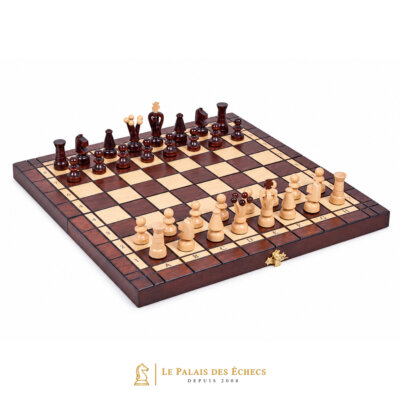
The Folding Wooden Chess and Draughts Set combines both games on a single beech wood board, with pieces made of hornbeam. Folded, it measures 35 x 17.5 x 4.5 cm; open, it spans 35 x 35 x 2.25 cm, with a king height of 6 cm. A complete and portable format, for playing both draughts and chess on a single board.
For a draughts board alone, or to compare more models, our draughts sets and chess-draughts combinations category brings together all our references. If you are still torn between draughts and chess, a wooden chessboard alone remains a versatile purchase, able to accommodate both games depending on its size.
Chess and draughts sets: the best of both worlds
A chess and draughts set combines both games on a reversible or shared board, with a single storage space for all the pieces. It is the format most often given as a gift, because it suits every level and every age.
These sets come in several finishes, from solid folding wood to faux-leather sets with built-in storage compartments, sometimes rounded off with a third game, backgammon, for a true 3-in-1 set. For a complete chess set on its own, browse our complete chess sets category; for a matching backgammon board, our dedicated buying guide details sizes and materials. To check the quality of a set before buying, our criteria for choosing a quality chess set also apply to multi-game sets.
Before your board arrives, a useful reminder: correctly setting up a chessboard also applies to the draughts board, whose orientation follows the same logic. For a complete gift idea, according to budget and profile, see our gift guide.
Frequently asked questions
What is the difference between draughts and chess?
Draughts is played with 20 identical pieces that move diagonally, on a 100-square board in France. Chess brings 16 pieces of 6 different types into play, with varied moves, on a 64-square board. Draughts is quicker to learn, while chess offers far greater strategic depth.
Can you play draughts on a chessboard?
Yes, provided you play by the Anglo-Saxon rules (checkers), which are played on a 64-square board identical to a chessboard. For official French draughts, however, a 100-square board (10 × 10) is required.
What is the difference between a draughts board and a chessboard?
A French draughts board has 100 squares (10 × 10), against 64 squares (8 × 8) for a chessboard. An Anglo-Saxon 64-square draughts board, meanwhile, is identical to a chessboard and can be used for both games.
Which board should you choose for draughts?
Choose a 10 × 10 solid or folding wooden board if you play by the French rules, or an 8 × 8 board if you also want to use it for chess. The square size should leave a comfortable margin around each piece.
Is draughts easier than chess?
Yes, in terms of learning: the rules of draughts can be grasped in about 5 minutes, against 30 minutes for the basics of chess. Draughts was in fact fully solved by computer in 2007, which is still not the case for chess.
Can you play draughts and chess on the same board?
Yes, provided you have a 64-square board (8 × 8): it suits both chess and draughts under the Anglo-Saxon rules. Many sets indeed come with a reversible board for both games, sometimes with backgammon as well.
Delphine D., Le Palais des Échecs editorial team, a French shop specialising since 2008 in wooden chess sets and chessboards. Our guides draw on our customers’ questions, the official FIDE rules, and the products we sell and measure ourselves. They are reviewed and updated regularly. The editorial team
Draughts, chess, or both?
Chess and draughts sets, complete sets and beginner’s games: all in wood, with free delivery within mainland France.
Draughts sets and combinationsComplete chess setsGames for children and beginners
Chess Puzzle No. 281: Can a sudden strike settle the game in just two moves?
Checkmate in 2: can you spot Black's winning combination? Try it now on the interactive [...]
Chess Puzzle No. 317: Checkmate in two: can you spot it before Black does?
A checkmate in two awaits on the board: can you find the combination before Black [...]
The English Opening in chess: the basics to master it
The English Opening (1.c4 (also known as the c4 opening)) is a sophisticated flank opening, [...]