



Chess, Learn Chess, News, Non classé
Chess Strategy for Beginners: The Fundamentals to Improve Your Game

05
Sep
Sep
Chess and strategy go hand in hand: without a plan, even the most talented player loses their way on the board. This complete guide has been designed to help you get started in chess with solid foundations and develop genuine strategic thinking. Whether you’re just discovering the 64 squares or looking for a strategy to win at chess more consistently, you’ll find concrete principles, examples in notation and chess tips you can apply straight away. Take the time to understand each concept, and your results will improve game by game.
The 3 fundamental principles of chess strategy
Before memorising openings or tactical combinations, you need to master three principles that have governed every chess game for centuries. These fundamentals form the bedrock of any solid chess technique, from beginner to grandmaster.
1. Control the centre of the board
The centre of the board — squares e4, d4, e5 and d5 — is the most valuable ground on the board. A piece placed in the centre radiates in every direction: a knight on e4 controls up to 8 squares, compared with just 2 if it’s stuck on a1. This is why the very first opening moves aim to occupy or control these central squares.
Concrete example: after 1.e4, your pawn immediately controls squares d5 and f5, while also freeing the diagonal for your light-squared bishop (Bf1) and your queen. A single move, and already three strategic advantages. Compare this with 1.a4: the pawn controls only one useful square (b5), and no piece is freed.
The golden rule: place your pawns and pieces in the centre or towards the centre in the opening moves. You’ll gain more space, more mobility and more tactical options than your opponent.
2. Develop your pieces quickly
Every piece that remains on its starting square is a piece doing nothing useful. The aim of the first 10 moves is to bring your knights and bishops out to active squares, prepare castling and connect your rooks. Every developing move gives you a concrete advantage: more pieces ready to attack or defend.
Concrete example: after 1.e4 e5 2.Nf3 Nc6 3.Bc4, White has already developed two pieces (knight to f3, bishop to c4), controlled the centre and prepared kingside castling. Three moves, three objectives achieved. By contrast, a beginner playing 1.e4 e5 2.Qh5 brings their queen out too early: it will be chased away by 2…Nc6 then 3…g6, and White will have lost time.
Three rules to remember: don’t move the same piece twice during the opening (unless absolutely necessary), bring your knights out before your bishops when possible, and don’t launch an attack before developing at least three minor pieces.
3. Get your king to safety
The king is the most important piece but also the most vulnerable. As long as it remains in the centre, it’s exposed to attacks along open files and diagonals. Castling (kingside O-O or queenside O-O-O) tucks your king away behind a wall of pawns while also activating a rook.
Concrete example: after 1.e4 e5 2.Nf3 Nc6 3.Bc4 Bc5 4.O-O, White’s king is safe on g1, protected by the pawns on f2, g2 and h2. The rook on f1 is already active on the semi-open f-file. White can now focus on the middlegame without fear of a premature attack.
Essential rule: don’t push the pawns in front of your castled king (f2-f4, g2-g4, h2-h4) unless you have a very clear attacking plan. Every pawn advance creates lasting weaknesses in your king’s protective shield.
The 4-step progression plan for learning chess effectively
Learning chess follows a logical order: the rules, then tactical patterns, then correcting the mistakes that cost you the most games, and finally regular practice that consolidates what you’ve learnt. Following this order stops you spreading yourself too thin and makes each new concept easier to retain.
| Step | Goal | What you need to master |
|---|---|---|
| 1. The rules | Understand the game | How pieces move, kingside and queenside castling, en passant, promotion, checkmate |
| 2. Basic tactics | Stop losing material needlessly | Fork, pin, skewer (see the next section) |
| 3. Correcting mistakes | Eliminate the errors that cost you games | Development, king safety, a plan for every move |
| 4. Regular practice | Make your progress last | Annotated games, post-game analysis, tracking your rating |
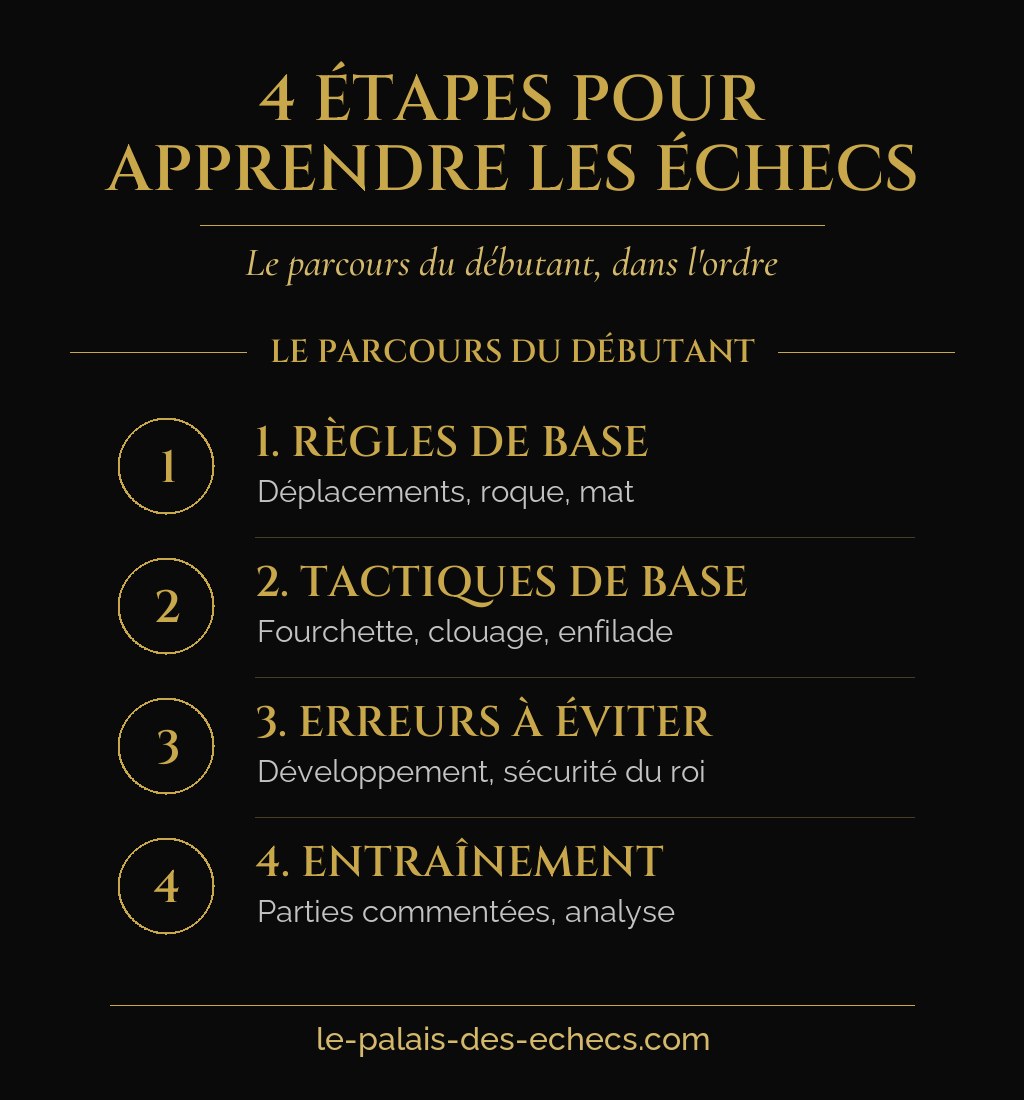
This progression isn’t set in stone: a player who struggles with forks and pins can quite happily return to step 2 after several games, giving the reflex time to settle in. To measure your progress in concrete numbers, our article on the Elo rating in chess explains how to interpret your development.
10 strategic tips to win at chess
Here are ten concrete chess tips that will immediately improve your game. Each tip is based on a proven strategic principle you can apply from your very next game. It’s the best answer to the question every player asks: how do I win at chess more consistently?
1 Don’t move the same piece twice in the opening
Every move where you shift a piece you’ve already developed is a move where another piece stays inactive. If your opponent develops a new piece while you retreat your knight, they gain a lead in development. Exception: if your piece is attacked and retreating is the only sensible move. But don’t create that situation yourself by placing your pieces on fragile squares. Aim for stable squares from the very first development move.
2 Occupy the centre with your pawns
The moves 1.e4 or 1.d4 are played by the vast majority of top-level players for a simple reason: a pawn in the centre controls key squares and gives your pieces room to breathe. If your opponent occupies the centre and you don’t, your pieces will be passive and cramped. Always answer a central pawn with a central pawn of your own — or with control from a distance using your pieces.
3 Don’t bring your queen out too early
The queen is the most powerful piece, but also the ideal target. Bringing it out before move 6 hands your opponent free tempi: they’ll develop their pieces while attacking your queen, which will have to flee. After 1.e4 e5 2.Qh5 Nc6 3.Bc4 g6 4.Qf3 Nf6, Black has developed two pieces while chasing the white queen, which has already moved three times for nothing.
4 Connect your rooks
Two rooks are connected when no piece stands between them on the back rank. They protect each other and can double on an open file — one of the most powerful formations in chess. To achieve this: castle, develop your minor pieces, then move your queen one square if needed. Connected rooks dominate open files and are formidable in the endgame.
5 Think before every exchange
Before capturing an opponent’s piece, ask yourself: does this exchange work in my favour? Trading an active bishop for a passive knight is often a mistake. Exchange when you’re ahead in material (to simplify the position), when you’re removing a dangerous enemy piece, or when the exchange opens a file for your rooks. Never capture on reflex — capture by calculation.
6 Look after your pawn structure
Pawns never move backwards: every advance is permanent. An isolated pawn (with no friendly pawn on adjacent files) is a lasting weakness. Doubled pawns (two pawns on the same file) lose mobility. Favour chains of connected pawns that protect each other. A good pawn structure is the backbone of a solid, long-term position.
7 Don’t neglect any part of the board
Beginners often focus all their attention on the kingside and forget the queenside. A good player sees the whole board: they keep an eye on both flanks and the centre at once. If your opponent attacks on the right, a counter-attack on the left can be devastating. The player who sees the entire board is always a move ahead of the one who only looks at one corner of it.
8 Form a plan for every move
Playing without a plan means wandering around the board hoping your opponent slips up. A chess game plan doesn’t need to be complicated: “I’m going to place my knight on d5 via c3 then d5” or “I’m going to open the c-file by playing c4 then cxd5”. Even an imperfect plan is better than no plan at all. Revise it with every move depending on your opponent’s response.
9 Think about your opponent’s threats before you play
Before every move, ask yourself: what is my opponent threatening? A mate in one? A fork? A material gain? If you don’t spot the threat, you can’t defend against it. This simple habit — checking your opponent’s threats before thinking about your own move — eliminates most of the “blunders” that cost beginners their games. It’s the most valuable chess tip you’ll ever apply.
10 Analyse your games afterwards
Progress comes through analysis. After every game, replay the critical moves: where did you go wrong? Where could you have played a better move? Use an analysis engine (Stockfish is free) to check your intuitions. Grandmasters spend more time analysing their defeats than playing new games. It’s the most effective chess technique for lasting improvement.
Beginner chess tactics: the essential patterns
Strategy is the long-term plan; tactics is short-term execution. A good strategist with no tactical talent will let winning combinations slip away; a good tactician with no strategy will play brilliant moves in mediocre positions. To get started in chess effectively, you need to master the four fundamental tactical patterns that appear in every game.
The fork
A fork is a simultaneous attack on two (or more) enemy pieces with a single piece. The knight is the king of forks thanks to its unique “L-shaped” move — no piece can block its path.
Example: a white knight lands on e7. It simultaneously attacks the black king on g8 and the black rook on c8. The king must move (it’s in check), and the knight captures the rook on the next move. Result: winning a rook (worth 5 points) for the mere threat of a knight (worth 3 points). Learn to spot the squares from which your knight can strike two targets at once — it’s the most common tactical pattern among beginners.
The pin
A pin immobilises an enemy piece that’s shielding a more valuable piece standing behind it on the same line or diagonal. The pinned piece can’t (or shouldn’t) move without losing material.
Example: a white bishop on g5 attacks the black knight on f6. Behind that knight, on the same diagonal, sits the black queen on d8. If the knight moves, the queen is captured. The knight is “pinned” — it can no longer play its defensive role. Bishops and rooks are the ultimate pinning pieces. Learn to pin enemy knights in front of their king or queen.
The skewer
A skewer is the reverse of a pin: you attack the more valuable piece first, forcing it to move, which exposes a less valuable piece standing behind it.
Example: a white rook on e1 gives check to the black king on e8. The king must move (say, to d7 or f8). The rook then captures the black rook on e8, left unprotected. The skewer is especially devastating with rooks and queens on files and ranks, or with bishops on diagonals. Watch for alignments between the enemy king and its other pieces.
The sacrifice
A sacrifice means voluntarily giving up material (a pawn, a piece, sometimes even the queen!) to gain a greater advantage: a mating attack, a pawn promotion, or an overwhelming position.
Example: White sacrifices a bishop on h7 with Bxh7+. The black king takes with Kxh7. Then Ng5+ and White launches a decisive attack on the exposed king. This classic pattern (the “bishop sacrifice on h7”, also known as the Greek gift sacrifice) is one of the oldest and most elegant tactical motifs. Rule: only sacrifice if you can see a forced sequence that recovers the material or leads to mate.
The best chess openings for beginners
The ideal opening for beginner chess players respects the three fundamental principles: control the centre, develop your pieces, get your king to safety. Here are five proven, accessible and instructive openings that anyone wanting to get started in chess seriously should know.
The Italian Game (1.e4 e5 2.Nf3 Nc6 3.Bc4)
The Italian Game is the best gateway into the world of chess. Its first three moves perfectly illustrate the fundamental principles: the e4 pawn occupies the centre, the knight on f3 develops a piece while attacking e5, and the bishop on c4 targets the sensitive f7 square (the weakest point in Black’s position early in the game). After 3…Bc5 4.O-O, White has a harmonious position with three pieces developed and the king safe. It’s an attacking opening that teaches natural development, central plans and tactical combinations. Played since the 16th century, it remains relevant at every level.
The Sicilian Defence (1.e4 c5)
The Sicilian is the most popular reply to 1.e4, played by world champions from Kasparov to Carlsen. The move 1…c5 challenges the centre asymmetrically: instead of mirroring with 1…e5, Black creates imbalance from the very first move. The resulting positions are combative and rich in tactical possibilities. The most common variations — Najdorf, Dragon, Scheveningen — offer clear plans for both sides. It’s a demanding but extremely instructive opening for developing a dynamic game.
The French Defence (1.e4 e6)
The French Defence is the ideal choice for players who prefer solidity. With 1…e6, Black prepares 2…d5, immediately challenging White’s centre. The resulting pawn structure (black pawns on e6-d5, white pawns on e4/e5-d4) is stable and offers clear strategic plans. The main drawback: Black’s light-squared bishop (on c8) is often blocked behind the pawn chain. Learning to free it is part of the learning process. The French teaches patience, active defence and the importance of pawn structure.
The Ruy Lopez / Spanish Opening (1.e4 e5 2.Nf3 Nc6 3.Bb5)
The Ruy Lopez is one of the oldest and most respected openings in the history of chess. With 3.Bb5, White puts pressure on the knight on c6, the indirect defender of the e5 pawn. The idea isn’t to capture on c6 straight away (that would reinforce Black’s centre), but to maintain long-term strategic tension. Ruy Lopez games are masterpieces of positional strategy where every tempo counts. It’s the favourite opening of legendary players such as Anatoly Karpov and Fabiano Caruana.
The Queen’s Gambit (1.d4 d5 2.c4)
The Queen’s Gambit is the flagship opening of positional play. With 2.c4, White offers a pawn to lure the d5 pawn away from the centre. But it isn’t really a gambit at all: after 2…dxc4 (Queen’s Gambit Accepted), White easily wins the pawn back while gaining an ideal centre with d4 and a potential e4. After 2…e6 (Queen’s Gambit Declined), Black keeps a solid but slightly passive position. This opening teaches long-term strategic play, positional pressure and patience — essential qualities for any serious player.
How to build a game plan in chess
A chess game plan is what separates a player who’s improving from one who’s stuck. Playing move by move, with no direction, is like sailing without a compass. But how do you build a concrete plan? Here’s a method based on three questions to ask yourself before every move, along with goals suited to each phase of the game. It’s the key for anyone looking for a strategy to win at chess consistently.
The three essential questions:
- What is my opponent threatening? Before thinking about your own move, identify the immediate threat. Is your opponent preparing a fork? A mate? A pawn win? If you don’t respond to a serious threat, the best plan in the world won’t save you.
- Which of my pieces is worst placed? On every move, look for your most passive piece and find it a better square. This simple method gradually improves your entire position. A bishop blocked behind its own pawns? A knight stuck on the edge of the board? Spot them and improve them.
- What’s my medium-term goal? You don’t need to see 15 moves ahead. A goal spanning 3-5 moves is enough: “I’m going to place my knight on d5”, “I’m going to open the c-file”, “I’m going to prepare f2-f4”.
Adapt your plan to the phase of the game:
- In the opening: develop your pieces, control the centre, castle. The plan is clear and universal. Don’t try to attack before finishing your development.
- In the middlegame: identify your opponent’s weaknesses (isolated pawns, an exposed king, passive pieces) and build a plan to exploit them. Improve your least active piece. Prepare a pawn break (e4-e5, d4-d5, c4-c5, f2-f4) to open lines.
- In the endgame: activate your king (it becomes an attacking piece in the endgame!), create a passed pawn and push it towards promotion. In rook endgames, the seventh rank is key — a rook on the e7 or d7 square paralyses the opponent.
Even the best players in the world don’t calculate everything. They rely on clear strategic plans, adjusted with every move. Adopt this habit, and you’ll see a dramatic difference in your results.
The mistakes that cost beginners games at chess
Wondering how to win at chess more often? Start by eliminating recurring mistakes. Here are the four most common flaws among beginner players — and how to fix them.
Playing without a plan
Mistake number one. Shifting pieces around at random and hoping your opponent slips up isn’t a strategy. Without a plan, your pieces don’t work together and your position gradually deteriorates. The solution: before every move, put your goal into a single sentence. “I’m going to put my rook on the open d-file”, “I’m going to attack the weak pawn on c6”. Even a modest plan gives your moves direction and your game coherence.
Ignoring your opponent’s threats
A typical beginner thinks about their own move without checking what their opponent is preparing. The result: mates in one, obvious forks, pieces left hanging. The fix is simple but requires discipline: after every opponent’s move, ask yourself “what are they threatening?” before touching your own pieces. This one habit alone can be worth 200 Elo points.
Neglecting development
Moving the same knight three times, pushing five pawns in the opening, launching a premature attack with only two pieces developed — all mistakes that will cost you games. Every undeveloped piece is a piece taking no part in either attack or defence. After 10 moves, you should have developed both knights, both bishops, castled, and ideally placed your rooks on useful files.
Playing too passively
Some beginners, afraid of making mistakes, play extremely cautious moves: pieces held back, pawns left still, no initiative at all. The problem: in chess, passivity is a mistake in itself. An active opponent will gain space, control open lines and dictate the pace of the game. The solution: always look for a move that improves your position or creates a threat, even a modest one. An active move that isn’t the best is often better than a “safe” passive one.
How long does it take to improve at chess? A realistic timeline
Allow around a month to grasp the rules and play a complete game without making a movement error, then a further two to three months to instinctively recognise the basic tactical patterns. The pace depends above all on consistency: two or three analysed games a week will help you improve faster than ten games played without any review.
- Weeks 1 to 4: learning the rules, piece values and opening principles (centre, development, king safety).
- Weeks 5 to 8: focused training on forks, pins and skewers, with a few tactical exercises each day.
- Weeks 9 to 12: putting it into practice in complete games, systematically reviewing any mistakes made.
- Beyond that: deepening your knowledge of openings, endgames and calculating variations, at whatever pace suits the time you can devote to it.
This timeline is only indicative: it gives you a direction, not a guaranteed figure. Move notation becomes useful as soon as you want to review your own games to spot where you departed from your plan.
Improving at chess: the next steps
You now have a grasp of the fundamental strategic principles, the essential tactical patterns and the reference openings. It’s time to put them into practice and deepen your knowledge.
To go further, take a look at our complete guide to the rules and frequently asked questions about chess. To practise online against players of your own level, discover our selection of the 10 best online chess sites.
And to play with beautiful equipment that makes you want to improve:
Frequently asked questions
How do I play chess as a beginner?
Start by learning how each piece moves, castling and checkmate, then play slow games while applying the three basic principles: control the centre, develop your pieces and get your king to safety. Speed will come with practice, not the other way round.
Which app or website should I use to learn chess?
Several free platforms let you play online and train with tactical exercises suited to your level. Compare their features before choosing one, depending on whether you mainly want to play games or work through targeted exercises.
Is chess difficult to learn as a beginner?
The basic rules can be learnt in a few hours: what takes time is recognising tactical patterns and anticipating your opponent’s moves. The difficulty lies in the depth of the game, not in getting started.
Do I need a particular chess set to start playing?
No, but a board with sufficiently large squares and stable pieces makes it easier to learn castling, exchanges and tactical combinations. A classic wooden Staunton chess set remains the simplest reference for identifying each piece.
Getting equipped to progress well: which chess board to choose as a beginner
A beginner improves faster with a clear chess board and stable pieces: look for squares of at least 3 cm and a well-proportioned king, easy to spot while you’re calculating. A solid wooden set, heavier than a plastic version, also helps keep the pieces firmly in place while you’re learning castling or exchanges.
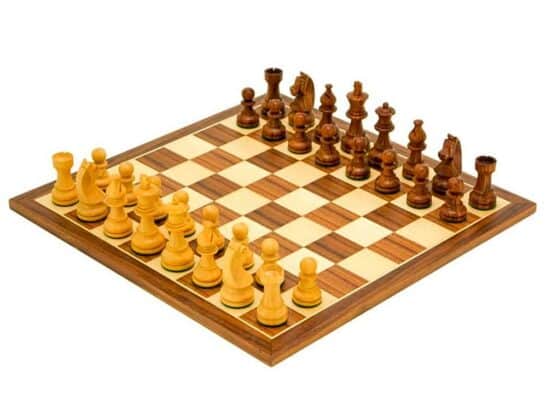
The Knight Academy set brings together a walnut and maple wood chess board with a rosewood Staunton chess set, with 3.3 cm squares suited to learning at home.
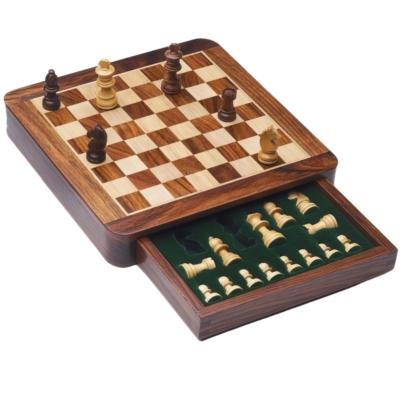
To replay positions or practise while travelling, a magnetic wooden travel set stops the pieces moving between moves.
Our Discovery selection brings together chess boards and chess sets designed for this first level, and the Staunton chess sets category remains the benchmark for recognising each piece without hesitation. Fancy something in a nobler wood once you’ve mastered the basics? Our fine wood chess sets selection features pieces in woods such as rosewood or maple.

How much does a beautiful chess set cost? Complete guide by budget
As much for its strategy and tactics, chess is known for its complex and magnificent [...]
Beach chess: a new trend for summer 2023
Introduction Every summer, new game trends appear on beaches around the world. This year, a [...]
What are the rules of draughts (checkers)?
Draughts is one of the oldest and most widely played strategy games in the world. [...]