



Chess, Learn Chess, News, Non classé
How to Set Up a Chess Board: The Complete Guide

08
Nov
Nov
Just received a chess set and not sure how to set up the pieces? Don’t worry. Placing the pieces on the chess board follows simple, logical rules. This guide shows you, step by step and in pictures, how to correctly position each piece to start a game the proper way.
Setting up the chess board: the first step
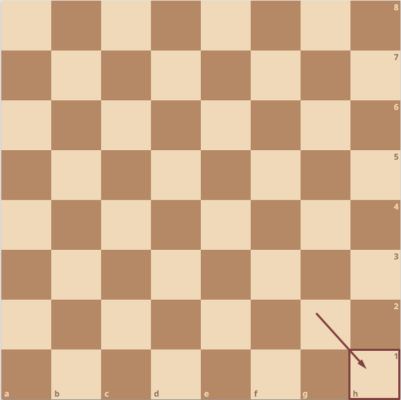
Before placing a single piece, you need to orient the chess board correctly. This is a very common mistake among beginners.
Golden rule: the square in the bottom right corner must always be a white (or light) square. If it’s black, turn the board 90°.
The chess board has 64 squares arranged in 8 columns (from a to h) and 8 rows (from 1 to 8). White occupies rows 1 and 2, Black occupies rows 7 and 8. All the major pieces go on the first row, with the pawns on the second.
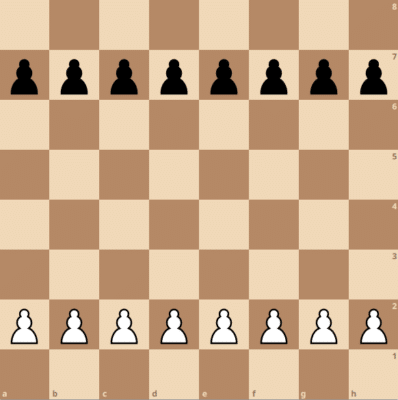
How to place the pawns in chess
Pawns are the most numerous pieces: each player has 8 of them. They’re also the smallest pieces in the set. They form the first line of defence in front of your major pieces.
Placement: line up your 8 pawns in a straight row on the second rank.
▶ White: the pawns occupy the whole of row 2 (squares a2 to h2).
▶ Black: the pawns occupy the whole of row 7 (squares a7 to h7).
▶ White: the pawns occupy the whole of row 2 (squares a2 to h2).
▶ Black: the pawns occupy the whole of row 7 (squares a7 to h7).
This is the first thing to do: placing the pawns first clears the view and makes it easier to position the other pieces behind them.
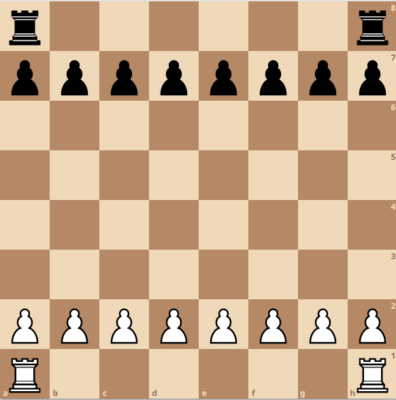
How to place the rooks in chess
Each player has 2 rooks. These are usually the tallest pieces after the king, shaped like a castle turret.
Placement: the rooks go in the four corners of the board.
▶ White: squares a1 and h1 (the two ends of the first row).
▶ Black: squares a8 and h8.
▶ White: squares a1 and h1 (the two ends of the first row).
▶ Black: squares a8 and h8.
Rooks are powerful pieces that move in a straight line — horizontally and vertically — across as many squares as they wish. Their position in the corners will matter later for castling.
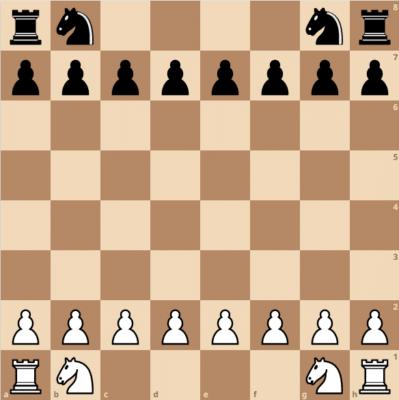
How to place the knights in chess
Knights are the pieces shaped like a horse’s head. Each player has 2. They’re the only pieces able to jump over others.
Placement: the knights go right next to the rooks.
▶ White: squares b1 and g1.
▶ Black: squares b8 and g8.
▶ White: squares b1 and g1.
▶ Black: squares b8 and g8.
Knights move in an “L” shape: two squares in one direction, then one square perpendicular to it (or vice versa). It’s the only piece that can jump over the pawns on the first move.
How to place the bishops in chess
Bishops are the pieces with a pointed top (or rounded, depending on the style). Each player has 2: one that stays on the light squares throughout the game, and the other on the dark squares.
Placement: the bishops go next to the knights, towards the centre.
▶ White: squares c1 and f1.
▶ Black: squares c8 and f8.
▶ White: squares c1 and f1.
▶ Black: squares c8 and f8.
Bishops move only diagonally, across as many squares as they wish. They never change the colour of square they’re on throughout the game.
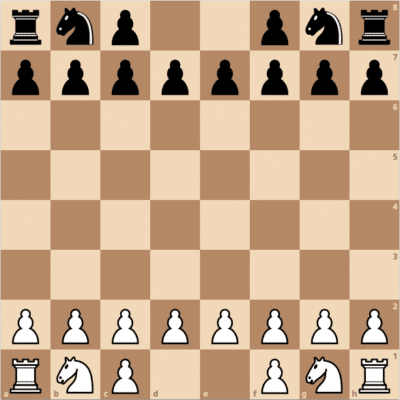
How to place the queen in chess
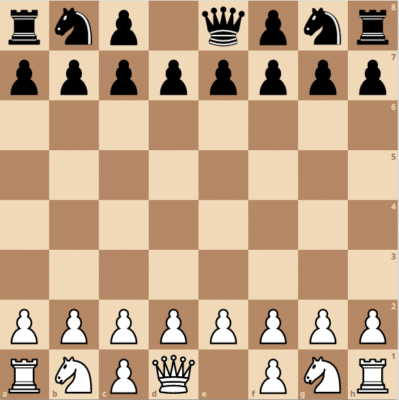
The queen is the most powerful piece in the game. Each player has only one. It’s often the tallest piece after the king, topped with a crown.
Placement: the queen goes on the central square of her own colour.
▶ White queen: square d1 (white square).
▶ Black queen: square d8 (black square).
▶ White queen: square d1 (white square).
▶ Black queen: square d8 (black square).
Memory tip: “Queen on her colour.” The white queen goes on the white square (d1), the black queen goes on the black square (d8). It’s the easiest rule to remember, so you never confuse the king’s and queen’s positions.
The queen combines the moves of the rook and the bishop: she can move in any direction (horizontal, vertical, diagonal) across as many squares as she wishes.
How to place the king in chess
The king is the most important piece in the game — if your king is checkmated, the game is over. Each player has only one. It’s recognisable by the cross on top (unlike the queen’s crown).
Placement: the king takes the last remaining central square, next to the queen.
▶ White king: square e1 (black square).
▶ Black king: square e8 (white square).
▶ White king: square e1 (black square).
▶ Black king: square e8 (white square).
The king moves one square at a time in any direction. Despite his limited mobility, the whole game revolves around protecting him. He’s the only piece that can never be captured — when he’s trapped (checkmate), the game ends.
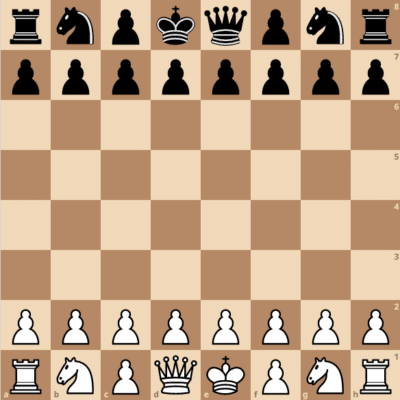
Summary: position of all the pieces
Here’s a summary table showing where each piece goes for both players:
| Piece | Quantity | White | Black |
|---|---|---|---|
| Pawns (♙) | 8 per player | a2 to h2 | a7 to h7 |
| Rooks (♖) | 2 per player | a1, h1 | a8, h8 |
| Knights (♘) | 2 per player | b1, g1 | b8, g8 |
| Bishops (♗) | 2 per player | c1, f1 | c8, f8 |
| Queen (♕) | 1 per player | d1 (white square) | d8 (black square) |
| King (♔) | 1 per player | e1 (black square) | e8 (white square) |
3 rules to remember:
1. White square in the bottom right corner.
2. Queen on her colour.
3. Pawns in front, pieces behind.
1. White square in the bottom right corner.
2. Queen on her colour.
3. Pawns in front, pieces behind.
The FEN notation for the starting position, explained simply
The starting position is written in FEN (Forsyth-Edwards Notation): rnbqkbnr/pppppppp/8/8/8/8/PPPPPPPP/RNBQKBNR w KQkq - 0 1. This short string of characters describes the location of every piece and allows an electronic chess board or a training app to reconstruct the position instantly.
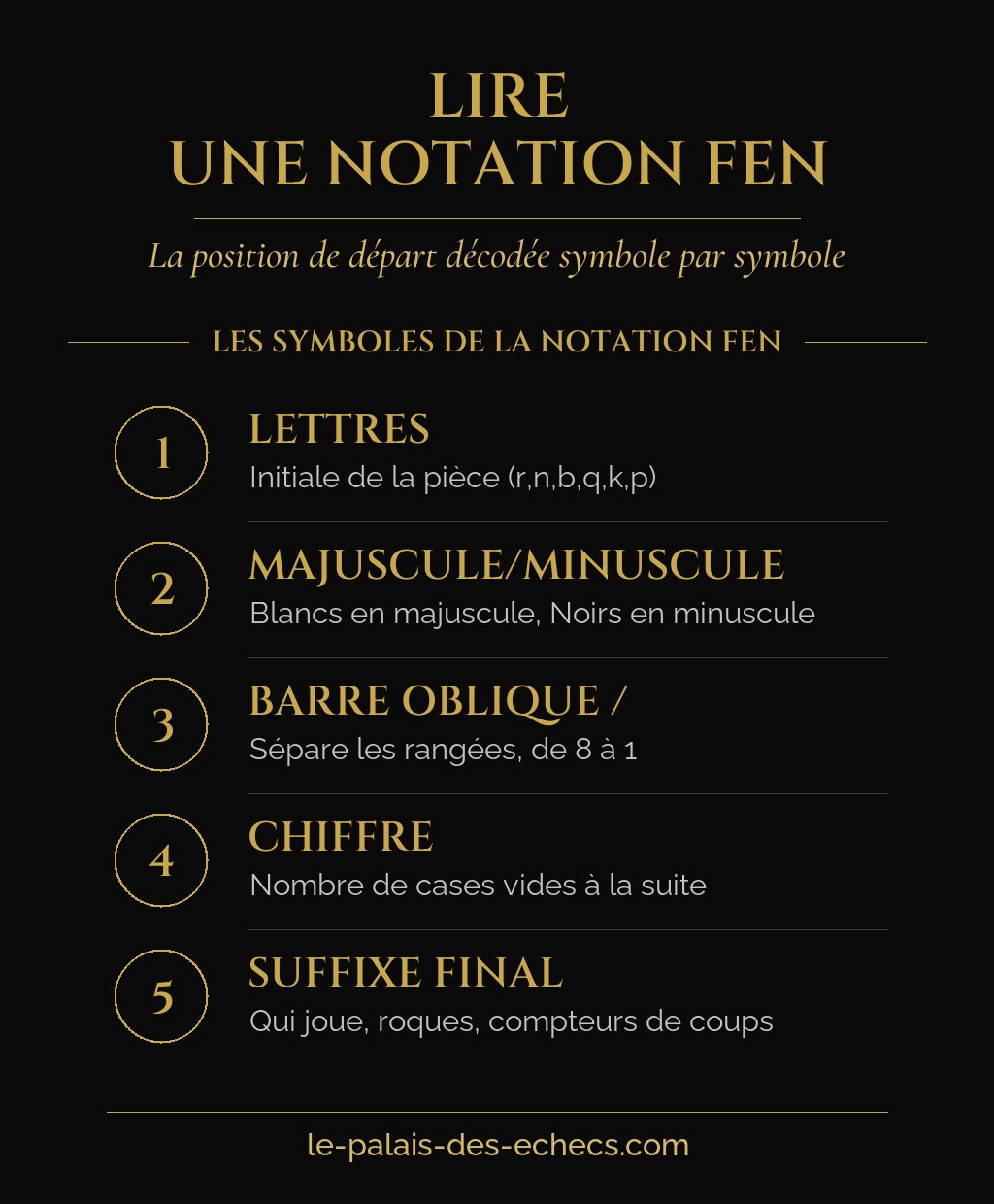
- The letters: each piece has an initial (r = rook, n = knight, b = bishop, q = queen, k = king, p = pawn).
- Upper or lower case: White’s pieces are written in capitals, Black’s in lower case.
- The forward slash “/”: it separates each row, from the 8th (Black’s pieces) to the 1st (White’s pieces).
- The number 8: it indicates eight empty squares in a row, as on rows 3 to 6, which are entirely free at the start.
- “w KQkq – 0 1”: “w” indicates that White plays the first move, “KQkq” that both kingside and queenside castling remain available for both sides, and the final figures count the moves played.
This reading is especially useful with an electronic chess board or a game app: it lets you check at a glance that the position shown does correspond to the official start of the game.
Check your set-up
Before you start playing, get into the habit of checking these points:
- Both sides must be a mirror image of each other — each white piece faces its black equivalent.
- The white queen faces the black queen, and likewise for the kings.
- If your queen and king are swapped, the whole symmetry is thrown off. Check the “queen on her colour” rule.
- White always plays first. Once you’ve checked the set-up, the player with the white pieces opens the game.
The most common set-up mistakes
Swapping the king and queen
This is beginners’ mistake number one. The king and queen go in the centre of the first row, on the d and e files. If you swap them, your whole set-up is wrong. Remember: the queen always goes on the square of her own colour.
Orienting the board incorrectly
If the square in the bottom right corner is black, your board is turned 90° the wrong way. All your pieces will technically be misplaced. Check before you start: bottom-right corner = white square.
Confusing the knight and the bishop
The knight (horse’s head) goes next to the rook, the bishop next to the knight towards the centre. The order from the corner is always: Rook — Knight — Bishop — Queen/King.
Setting up the pieces on a tournament chess board (FIDE standards)
In an official tournament, the initial set-up of the pieces follows exactly the same rules as at home. What changes are the requirements for the equipment itself: the International Chess Federation (FIDE) recommends larger squares for better visibility, Staunton-style pieces with stable proportions, and a chess board heavy enough not to slide during play.
| Criterion | Home chess set | Tournament chess board |
|---|---|---|
| Square size | Variable, depending on the chosen style | Larger, for quick reading of the position |
| Piece style | Free choice: historical, themed, modern… | Staunton, the only style permitted in official tournaments |
| Material | Wood, metal, resin, marble… | Solid wood in the vast majority of tournaments |
| Orientation | Checked by the players themselves | Checked by the arbiter before every round |
To train in conditions close to competition, choose a good-sized solid wood chess board and stable Staunton-style pieces. Our selection of Staunton chess sets brings together models designed for serious use, while solid wood chess boards offer welcome comfort during long training games.
Ready to play? Choose your chess board
Now that you know how to place the pieces, all you need is a beautiful chess board to put it into practice! Discover our selection:
- ♔ Complete chess setsMatching pieces and board, ready to play
- ♖ Chess boardsSolid wood, marble, leather
- ♕ Chess setsFrom the classic Staunton to original designs
- ♘ Folding chess setsPractical for beginners and travel
For more, take a look at our complete guide to the rules of chess, covering how each piece moves, special moves, and the most frequently asked questions.
Frequently asked questions
What is castling, kingside or queenside?
Castling is a special move that brings the king closer to the corner and moves the rook next to him. There’s kingside castling, on the king’s side (e and h files), and queenside castling, on the queen’s side (e and a files). It’s only possible if the king and rook involved haven’t yet moved and the squares between them are free.
What happens to a pawn that reaches the far end of the board?
When a pawn reaches the opponent’s back row (the 8th for White, the 1st for Black), it’s immediately promoted: the player replaces it with a queen, rook, bishop or knight, of their choosing, regardless of how many pieces are already on the board.
Can a pawn move backwards or capture behind it?
No. A pawn only ever moves straight ahead, never backwards, and only captures diagonally, one square forward. It’s the only piece that can never return towards its own starting row.
Should square a1 be white or black?
Square a1 is always a dark square, whichever side you’re on. It’s square h1, opposite it, that must be light: that’s the one to spot in the bottom right corner to orient your chess board correctly.

Top 7 board games that will (really) boost your intelligence!
We all know it, entertainment isn’t just a source of fun, it can also be [...]
Traditional Wooden Games: The Complete Guide
Traditional wooden games are enjoying a remarkable revival. In a world of screens and disposable [...]
Magnus Carlsen: the king of chess — biography and achievements
Magnus Carlsen, born on 30 November 1990 in Tønsberg, Norway, is regarded by many as [...]