



Buying Guides, Chess, News, Non classé
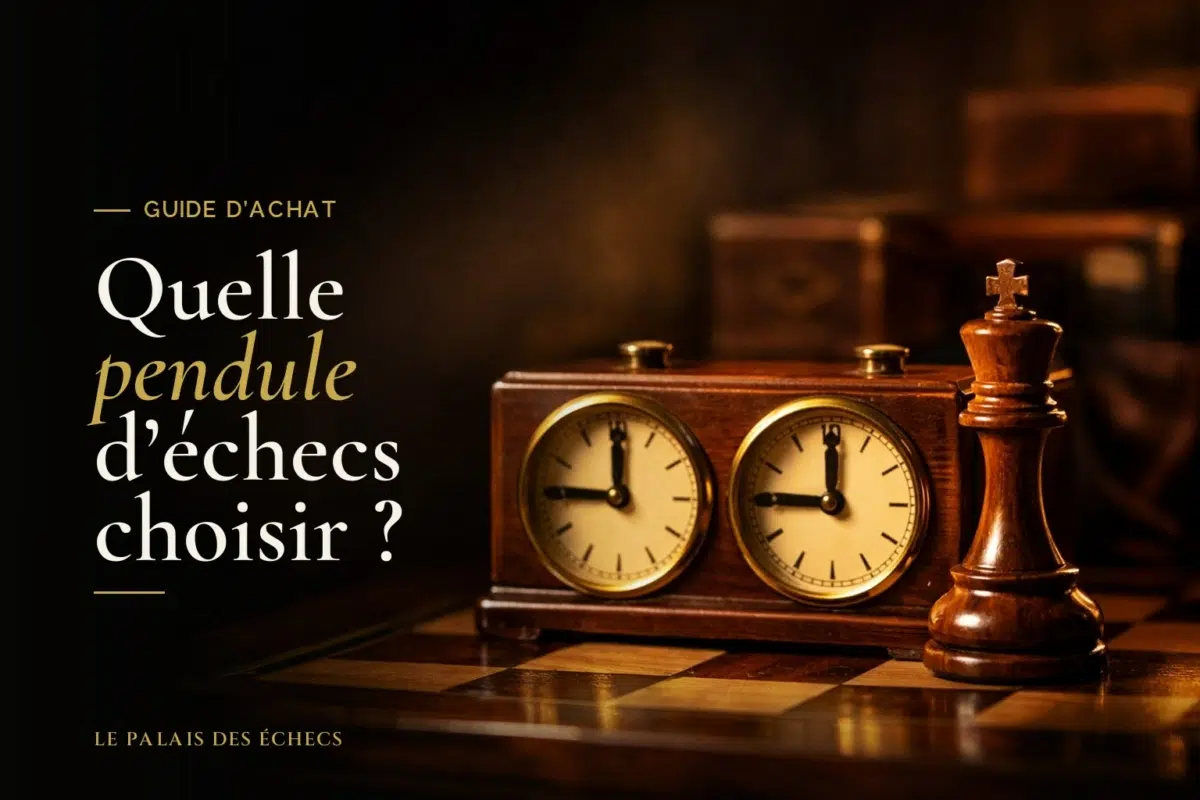
Which chess clock should you choose? Digital clock guide
09
Aug
Aug
The chess clock (also called a chess timer or timer) is an essential instrument for any official game. It guarantees fair play by limiting each player’s thinking time. Whether you’re playing a 3-minute blitz or a 2-hour classical game, understanding time controls and choosing the right clock will make all the difference to your play.
Why use a chess clock?
Without a time limit, a player in a losing position could think indefinitely. The clock solves this problem by giving each player an identical time allowance. When a player makes their move, they press their clock button, which stops their own clock and starts their opponent’s. A player who runs out of time loses the game on time.
Official time controls
| Time control | Time per player | Character | Use |
|---|---|---|---|
| Bullet | 1 to 2 minutes | Ultra-fast, pure reflexes | Mainly online |
| Blitz | 3 to 5 minutes | Fast, intuitive | Clubs, online, tournaments |
| Rapid | 15 to 60 minutes | Moderate thinking | FIDE rapid tournaments |
| Classical | 60 to 120+ minutes | In-depth thinking | Official championships |
FIDE regulations: In classical time controls, the standard is 90 minutes for the first 40 moves, then 30 minutes for the rest of the game, with a 30-second increment per move from the very first move.
The increment: a safeguard against time trouble
The increment (or addition) is a time bonus added after each move played. For example, in a “3+2” time control, each player starts with 3 minutes and receives an extra 2 seconds after every move. This system, introduced by Bobby Fischer (hence the name “Fischer increment”), stops games being decided purely by speed of execution towards the end.
Advice for beginners: For your first club games, choose the 15+10 time control (15 minutes plus a 10-second increment). It gives you enough time to think without the game running on too long. It’s the ideal time control for improving your game.
Digital vs analogue clocks
Digital clock
- Precise second-by-second display
- Automatic increment handling
- Multiple programmable time controls
- Essential for modern tournaments
- Budget: €25 to €80
Analogue clock
- Classic, elegant look
- No batteries needed (mechanical)
- No increment handling
- Suited to friendly, decorative play only
- Budget: €40 to €150
FIDE approval: which models should you choose?
For official tournaments, the clock must be FIDE-approved. The benchmark models are the DGT 2010 (the most widely used in international tournaments), the DGT 3000 (larger screen) and the Leap KK9908 (affordable option). These clocks all handle Fischer and Bronstein time controls, as well as multi-period controls.
Budget and recommendations
| Use | Recommended model | Guide price |
|---|---|---|
| Beginner / friendly play | Smartphone app | Free |
| Club / training | Leap KK9908 | €25 – €35 |
| Official tournaments | DGT 2010 | €50 – €65 |
| Premium | DGT 3000 | €70 – €90 |
“Time is the most underestimated factor in chess. Managing your clock means managing the pressure.”
Viswanathan Anand, World Champion 2007-2013
Viswanathan Anand, World Champion 2007-2013

Printable chess board
Need a chess board in a hurry? Print your own! Whether it’s for a quick [...]
Giant Outdoor Chess Sets: XXL Chess for Your Garden
Giant outdoor chess sets transform a garden, terrace or park into a spectacular playing space. [...]
The Isle of Lewis Chess Pieces: History, Mystery and Collection
Recreate the 12th century by playing with the Isle of Lewis chess set. This article [...]