




Board Games, Chess, News, Non classé
What are the rules of draughts?
26
Oct
Oct
Draughts is played on a board where each piece moves diagonally on the dark squares, suitable from age 6. Capturing is compulsory whenever possible, and a piece reaching the last row becomes a king, the most powerful piece in the game. This page details all the rules, from simple moves to what the king can do, with the differences between French and English draughts.
Updated 30 October 2026: Reworded the title and summary to better match searches for the rules of draughts.
In short: the rules of draughts
- 100-square board (10×10) in France, 64-square board (8×8) in England
- 20 pieces per player (12 in English draughts)
- Pieces move diagonally one square on the dark squares
- Capturing is compulsory: jump over an opponent’s piece to capture it
- A piece reaching the last row is promoted to king
- The king moves several squares diagonally, forwards and backwards
- The player who captures all the opponent’s pieces or blocks them wins
Introducing draughts
Draughts is a two-player board game played on a chequered board with alternating light and dark squares. Known as checkers in English-speaking countries, it belongs to the great family of abstract strategy games, alongside chess or backgammon. Discover also our backgammon rules to explore another great strategy game classic.0
The principle is simple: two armies of pieces face off on a board, and the aim is to capture all the opponent’s pieces or immobilise them. Despite this apparent simplicity, classic draughts holds considerable tactical depth, which has given rise to international competitions and a wealth of strategic literature. To better understand what sets this game apart from chess, see our comparison draughts vs chess.
The board and the pieces
There are two main board formats depending on tradition:
| Variant | Board | Pieces/player | Played in |
|---|---|---|---|
| French/international draughts | 100 squares (10×10) | 20 pieces | France, Netherlands, Africa, international competitions |
| English draughts (Checkers) | 64 squares (8×8) | 12 pieces | England, United States, Canada |
| Russian draughts | 64 squares (8×8) | 12 pieces | Russia, Eastern Europe |
| Turkish draughts | 64 squares (8×8) | 16 pieces | Turkey, Middle East |
The board is made up of alternating light and dark squares. All the action takes place exclusively on the dark squares: pieces never move onto the light squares. Pieces are usually black and white (or black and red, depending on tradition).
How to set up the board?
To play draughts, start by positioning the board between the two players so that each player has a dark square at the bottom left. This is the same orientation as in chess.
Each player then places their pieces on the dark squares of the rows closest to them:
French draughts (100 squares): each player arranges their 20 pieces on the dark squares of the first 4 rows on their side. The two centre rows remain empty at the start of the game.
English draughts (64 squares): each player arranges their 12 pieces on the dark squares of the first 3 rows on their side. The two centre rows remain empty.
The player with the white (or light) pieces starts the game. Players then take turns, one move at a time.
Movement rules
Simple moves
A piece moves one square diagonally, forwards only. The piece always stays on the dark squares. It cannot move backwards (unlike the king, as we’ll see below). Nor can it move in a straight line or sideways.
Capturing
To capture an opponent’s piece, your piece must jump over an enemy piece placed diagonally in front of it, provided the square behind that piece is free. The captured piece is removed from the board.
Fundamental rule: capturing is compulsory in draughts. If you are in a position to capture an opponent’s piece, you must do so. You cannot choose to play another move instead. This is one of the rules of draughts most often overlooked by beginners.
Multiple captures
If, after capturing a piece, your piece finds itself able to capture another, you must continue capturing within the same turn. It is thus possible to eliminate two, three, four pieces or more in a single spectacular move. This is one of the most exciting moments in a game of draughts.
Under the majority capture rule (in French draughts), if several captures are possible, the player must make the one that captures the greatest number of pieces. This rule does not apply in English draughts, where the player is free to choose their capture.
The king: promotion and movement
How to get a king?
When a piece reaches the last row on the opponent’s side of the board, it is promoted to king. This promotion is shown by stacking a second piece of the same colour on top. The king is the most powerful piece in the game — rather like the queen in chess.
How the king moves
French draughts
The king moves as many squares as it likes diagonally, forwards and backwards. It can also capture from a distance: it jumps over an enemy piece even if there are empty squares between them.
English draughts
The king can move diagonally one square at a time, but has the advantage of being able to move backwards. It’s a more limited version, but the principle remains the same: reach the far side of the opponent’s board.
The king is a considerable advantage: it can cross the board in a single move, capture pieces from a distance and change direction during multiple captures. Getting a king before your opponent often gives a decisive advantage.
Special rules to know
⚠ Compulsory capture
If you can capture, you must capture. If you forget, your opponent may be able to remove your erring piece under some house rules — although this rule tends to have disappeared from competition play in favour of a simple reminder.
⚖ Majority capture
In French draughts, if several captures are possible, you must choose the one that takes the most pieces. King and regular piece count for the same value in this calculation.
♞ Immediate promotion?
In French draughts, if a piece reaches the last row during a multiple capture, it is promoted to king but ends its turn. It does not continue capturing as a king within the same move.
🏆 End of the game
The game ends when a player has captured all the opponent’s pieces, or when the opponent can no longer move. Some games may also end by mutual agreement to a draw.
Variants of draughts
Draughts comes in several variants around the world. Here are the three most widely played:
| Variant | Board | King | Majority capture | Specific feature |
|---|---|---|---|---|
| French/international draughts | 10×10 | Long range | Yes | World standard in competition |
| English draughts (Checkers) | 8×8 | 1 square, can move back | No | The most widely played in the English-speaking world |
| Russian draughts | 8×8 | Long range | No | A piece promoted mid-capture continues the move as a king |
Classic draughts as played in France and in international competitions is the 100-square version (10×10) with 20 pieces per player, a long-range king and compulsory majority capture.
What about Canadian draughts?
Canadian draughts is played on a 12×12 board, the largest of all draughts variants, with 30 pieces per player. Born from the meeting of French and English rules, it remains very popular in Quebec and retains the principle of compulsory capture common to all variants.
| Variant | Board | Pieces per player | Compulsory capture |
|---|---|---|---|
| French/international draughts | 10×10 | 20 | Yes, majority |
| English draughts (checkers) | 8×8 | 12 | Yes, player’s choice |
| Canadian draughts | 12×12 | 30 | Yes, majority |
Strategies for beginners
Now that you’ve mastered the rules of draughts, here are a few tips to improve your game:
1. Control the centre
Pieces in the centre of the board control more diagonals and are harder to capture. Avoid advancing your pieces along the edges, where they are less useful.
2. Advance as a group
Isolated pieces are vulnerable. Advance in formation, protecting the rear of your pieces. A diagonal chain of pieces is almost impossible to break through.
3. Aim for promotion
Getting a king before your opponent is often decisive. Look for breakthroughs towards the last row, especially if you can sacrifice one piece to promote another.
4. Set traps
Learn to create multiple capture situations. By offering a “sacrificed” piece, you can force your opponent to capture and position yourself for a far more advantageous counter-capture.
Expert tip: Draughts is an excellent introduction to strategy games for children. If your child has mastered draughts, they’re ready to move on to chess — a game that develops thinking, anticipation and concentration even further. Our travel sets often include both games.
Delphine D., writer for Le Palais des Échecs, a French shop specialising since 2008 in wooden chess sets and chess boards. Our guides are based on our customers’ questions, the official FIDE rules and the products we sell and measure ourselves. They are reviewed and updated regularly. The editorial team
Ready to Play Draughts?
Discover our collection of wooden draughts sets, 3-in-1 sets (chess + draughts + backgammon) and travel sets. European manufacturing, free delivery.
See our Draughts SetsFrequently asked questions
Who can capture the king in draughts?
A simple piece can capture an opponent’s king exactly as it would capture a regular piece, as soon as it can jump over it and land on a free square. The king has no special protection against capture.
Can you still remove a piece for a missed capture in competition draughts?
No. This old house rule has disappeared from official competitions: the referee simply points out the error and enforces the compulsory capture, without removing any piece from the board.
Is draughts played with more than two players?
No, draughts is strictly a two-player game. There is no official variant for three or more players.
What’s the difference between a “counter” and a “piece” in draughts?
The words “piece” and “counter” refer to the same basic piece in draughts. “Counter” is mostly used commercially for turned wooden pieces, while “piece” is the term used in the official rules.
Expressions and popular culture from draughts
Draughts has given rise to expressions still used in everyday French, a sign of how deeply rooted it is in popular culture. The French phrase « souffler n’est pas jouer » (“blowing isn’t playing”) is the best-known example.
This expression comes from an old custom: when a player forgot a compulsory capture, the opponent could “blow”, that is, remove the erring piece from the board as a penalty, without it counting as a move played. It has passed into everyday language as a reminder that you should play by the rules rather than find a way round the obstacle. Draughts also remains a classic family board game, often passed down through generations alongside backgammon sets and chess sets.
How to choose the right wooden draughts set?
A good wooden draughts set is chosen first on the wood species and the size of the pieces, then on the board format depending on intended use, at home or while travelling. A well cared-for solid wood set will last for generations without losing its appeal.
- The wood species: beech, boxwood, maple or walnut each bring a different colour and density, for a set that feels pleasant to handle and sits stably on the board.
- The size of the pieces: pieces that are too small are hard to pick up; check the diameter and height given on the product page.
- The board format: a folding board is easy to carry, while a storage box protects the pieces between games.
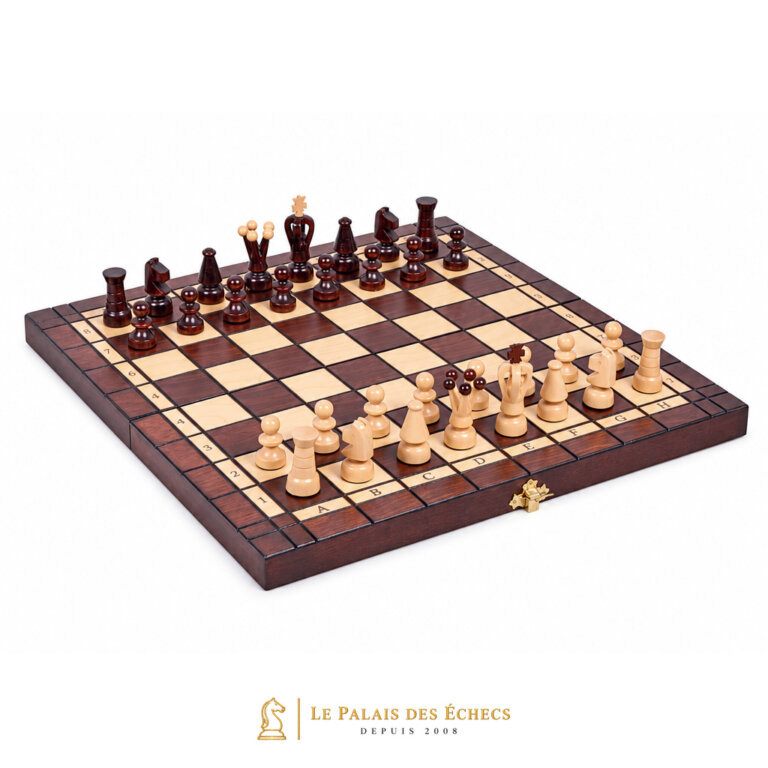
This folding wooden chess and draughts set combines a beech wood chess board with pieces and counters in hornbeam wood, in a board that folds into a storage box: enjoy both games with a single board.
To explore other models, browse the Draughts category or, to move on to chess, our wooden chess sets.
Draughts or chess: which game to choose?
Draughts is quicker to pick up and suits children from age 6, while chess requires a longer learning curve but offers greater strategic depth, driven by six pieces with different ways of moving. The two games complement each other well, and many families start with draughts before moving on to chess.
| Criterion | Draughts | Chess |
|---|---|---|
| Recommended age | From 6 | From 6-7, full mastery later |
| Number of different pieces | 1 (the king comes from promotion) | 6 |
| Central rule | Compulsory capture | Checkmate, no compulsory capture |
| Length of a game | Shorter | Longer |
To go further, discover our chess sets if you’re ready to take the plunge.

Chess Puzzle No. 312: Can you spot Black’s forced mate in three moves?
Black must deliver mate in three moves after Rxa6. An expert-level chess puzzle to solve [...]
Chess Puzzle No. 296: A black pawn races to promote: can White stop it in time?
Rook endgame: a black pawn races to promote. Work out White's reply on today's interactive [...]
Stalemate in chess: definition, rules and how to avoid or trigger it
Stalemate in chess turns a dominant position into a simple draw. Discover its official definition, [...]