




Backgammon, Board Games, Buying Guides, News, Non classé
Backgammon rules: how to play, set-up and wooden board buying guide
26
Jul
Jul
Backgammon rules fit on a single page: each player has 15 checkers that move across 24 points according to the numbers shown on two dice, before being borne off the board. Whoever bears off all their checkers first wins the game, with a single, double (gammon) or triple (backgammon) win depending on the lead taken over the opponent. The starting set-up, always the same, follows the 2-5-3-5 pattern on each side. This guide covers the set-up, how a game unfolds, the variants and the criteria for choosing a suitable wooden board.
Updated on 10 October 2026 · By Delphine D., Le Palais des Échecs editorial team
The essentials
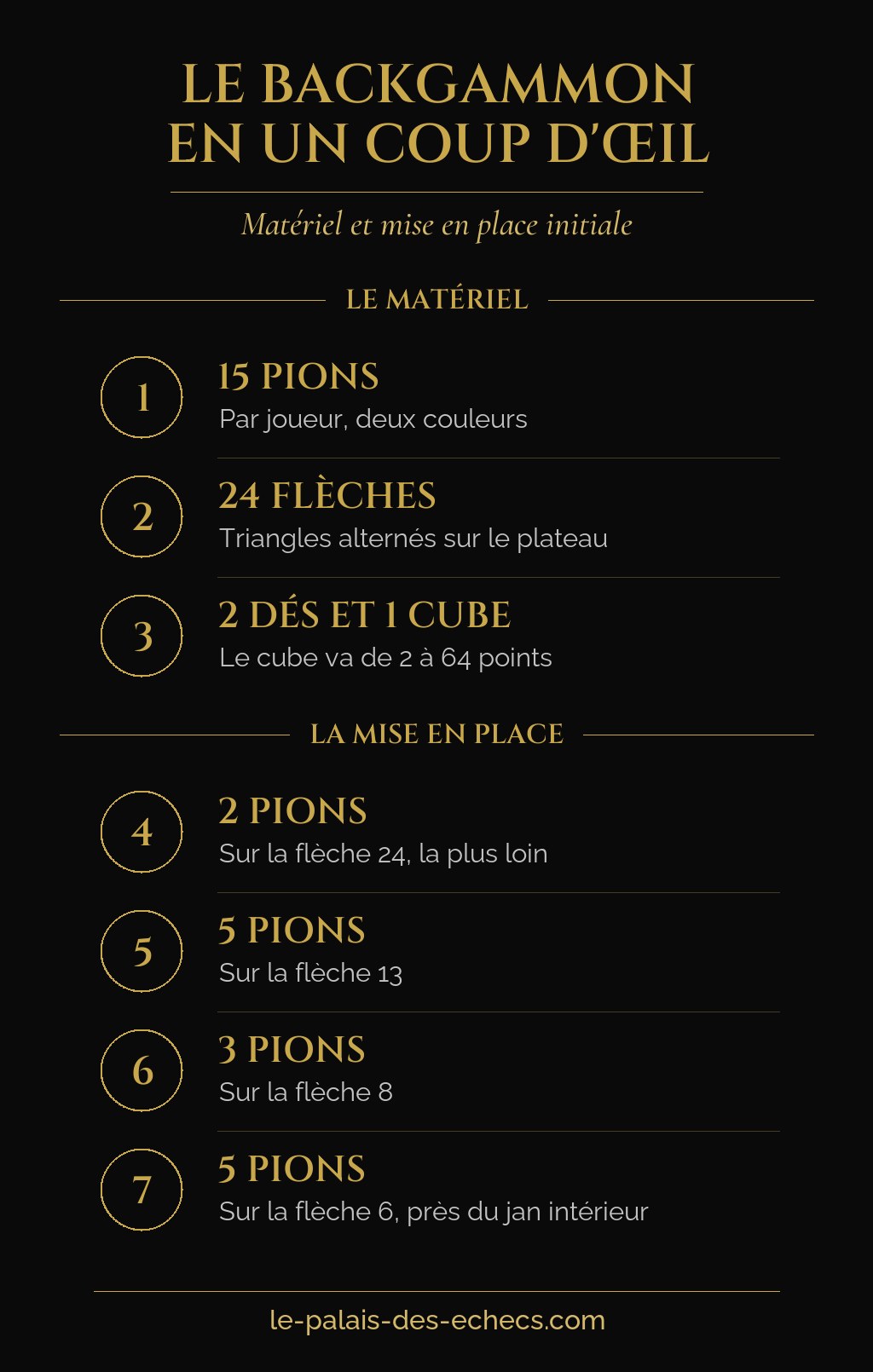
• Equipment: 15 checkers per player, 2 dice, 1 doubling cube, 24 points spread across 4 quadrants.
• Starting set-up: 2 checkers on point 24, 5 on point 13, 3 on point 8, 5 on point 6 (the 2-5-3-5 pattern), identical for both players.
• Movement: you move your checkers towards your home board according to the two dice; a double is played four times.
• Winning: single if the opponent has already borne off a checker, gammon (double) or backgammon (triple) otherwise.
• Doubling cube: it multiplies the stake from 2 to 64 points.
• To play: choose a wooden board based on the wood and the format, fixed or foldable for travel.
What is backgammon? Origins and the principle of the game
Backgammon is a two-player board game that combines strategy and the chance of dice rolls. Each player moves their 15 checkers across a board of 24 points, aiming to bear them off before their opponent. Its origins go back to dice and race games played since Antiquity; it is generally considered a distant descendant of tric-trac. Unlike the rules of chess, where chance never comes into play, backgammon combines calculation with dice rolls from the very first move.
Who invented backgammon?
There is no single inventor: the game developed gradually from ancient dice and race games, before settling into its current form. The doubling cube is a more recent invention, which appeared in the United States in the early 20th century to raise the stakes between experienced players.
The equipment: board, checkers, dice and points
A backgammon set consists of a board, 15 checkers per player, two dice and a doubling cube. The board is divided into 24 points (triangles), arranged in four quadrants of six points each.
The quadrants and the home board
Each player has their own home board, where they must gather all their checkers before bearing them off, and their outer board, located opposite. The points are numbered from 1 to 24 starting from each player’s home board, in opposite directions for each player.
The doubling cube
The doubling cube is a six-sided die marked 2, 4, 8, 16, 32 and 64. It is not used to play a move: it allows a player to offer to double the value of the game, which the opponent either accepts or declines by conceding the leg.
Discover our wooden backgammon boards, supplied with checkers, dice and doubling cube. Between games, checkers and dice can be tucked away in a storage box.
Set-up: how to place the checkers in backgammon
The starting set-up is always the same: each player positions 2 checkers on their point 24, 5 checkers on point 13, 3 checkers on point 8 and 5 checkers on point 6, following what is known as the 2-5-3-5 pattern. This arrangement, symmetrical for both sides, never changes, regardless of the players’ level.
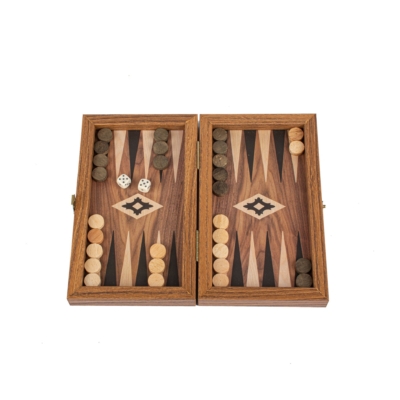
Even a roll-up travel backgammon set follows this standard set-up: only the size of the points and the portability of the board change.
How a game unfolds: movement and hitting rules
Each player rolls their two dice and moves their checkers the indicated number of points, going from their outer board towards their home board. In the case of a double (for example 4-4), the player plays that number four times.
How do you hit an opponent’s checker?
A point occupied by a single opponent’s checker (an isolated checker, or “blot”) can be hit: simply bring one of your own checkers onto it to send the opponent’s checker to the bar. As soon as a point has two or more checkers of the same colour, it is closed and no one can land on it.
Rule to remember: a checker sent to the bar must re-enter via the opponent’s home board before it can move anywhere else on the board. As long as a checker remains on the bar, no other move is allowed.
How does a checker come back from the bar?
It must enter the opponent’s home board, on the point corresponding to one of the two dice rolled. If both corresponding points are closed, the player forfeits their turn and cannot play either die.
Bearing off: the bear-off, the gammon and the backgammon
A player can only begin bearing off checkers from the board once all 15 of their checkers are gathered in their home board. Each die then allows the checker on the corresponding point to be borne off; the first player to bear off all their checkers wins the game.
| Type of win | Condition | Value |
|---|---|---|
| Single | The opponent has already borne off at least one checker | 1x the cube value |
| Gammon | The opponent has not borne off any checker | 2x the cube value |
| Backgammon | The opponent has not borne off any checker and still has a checker on the bar or in your home board | 3x the cube value |
The cube’s value at the end of the game determines the final stake: a gammon doubles the score, a backgammon triples it.
Backgammon variants around the world
Backgammon is played, under slightly different names and rules, in many countries. Three variants are particularly widespread.
Tavla, the Turkish version
Tavla is the name given to backgammon in Turkey and in parts of the Balkans and the Middle East. The movement and hitting rules are, broadly speaking, identical to those of classic backgammon.
Acey-deucey
In this variant, popularised in the United States, checkers are not placed at the start of the game: they enter play gradually. A roll of 1 and 2 (the “acey-deucey”) also grants an extra turn with a double of the player’s choice.
Nardy, or narde
Widespread in Russia and the Middle East, narde gathers all of a player’s checkers on a single starting point, and they must travel the full length of the board before coming home. Depending on the variant, hitting opponent’s checkers does not exist.
Like the rules of draughts or dominoes, these variants reflect the place traditional board games hold in many cultures.
5 simple strategies to improve quickly
Beyond the rules, a few principles are enough to make noticeable progress.
Control the key points
Point 5 and point 7 (the bar-point) are the most useful to occupy early: they slow the opponent’s progress and secure your checkers.
Limit isolated checkers
A single checker on a point is a potential hit. Pair your checkers up as soon as possible, especially in the firing range.
Build a prime
Several consecutive points held form a prime: an opponent’s checker stuck on the bar may be unable to re-enter at all.
Count the pips
Add up the remaining points each checker must travel: this shows who is ahead and whether to favour racing or blocking.
The cube, a fifth lever of play: in theory, it remains profitable to accept a double as long as your chances of winning the game exceed around 25%. Below that, it is better to decline and lose the single point rather than risk a gammon or backgammon.
How to choose your wooden backgammon board: buying guide
Three criteria are enough to choose a backgammon board: the type of wood, the format (fixed or foldable) and the size of the points, which must remain comfortable enough to place checkers without overlapping them.
Which wood should you choose?
Walnut, with its warm brown tone, and wenge, almost black, are among the most commonly used woods for backgammon boards, in laminated or solid wood depending on the model. As with our chess sets, the type of wood directly affects the feel and durability of the board.
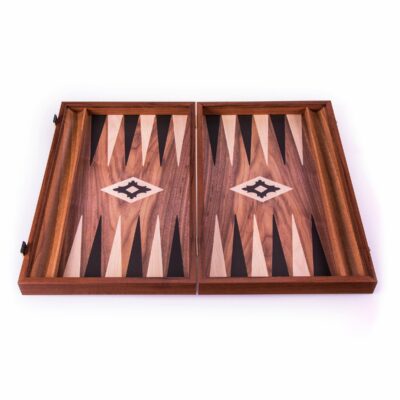
This laminated wood board, with a walnut effect, is fitted with side trays for holding checkers and dice during play. It is available in three sizes, from a compact format to a table-sized format, with a hand-finished touch.
A more compact version in laminated walnut wood, available in four sizes, from 20 x 12 cm to 48 x 26 cm, to suit the space available as well as the number of players at the table.
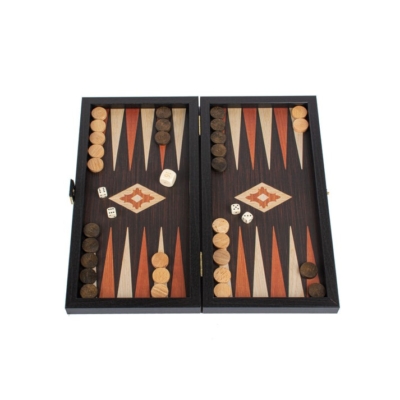
For a more striking contrast, this laminated wenge wood board, almost black, is available in three sizes, from 30 x 17 cm to 48 x 26 cm, with a hand-finished touch.
Fixed, foldable or travel board?
A fixed board, often larger, suits a dedicated games table at home. To take your backgammon with you when travelling, a roll-up travel backgammon set is a better choice, as it fits easily into luggage.
If you are looking for a collector’s board to match a chess board in the same wood, our Luxury Collection brings together chess sets in fine wood within the same price range, as do our wooden chess sets. A handsome wooden backgammon board also makes a much-appreciated gift, for Christmas or any other occasion. For further details, our complete backgammon board buying guide covers the finishes and sizes available.
Frequently asked questions
Who invented backgammon?
There is no single inventor: the game developed gradually from ancient dice and race games. The doubling cube, more recent, appeared in the United States in the early 20th century.
How do you set up the checkers in backgammon?
Each player places 2 checkers on their point 24, 5 on point 13, 3 on point 8 and 5 on point 6, following the 2-5-3-5 pattern. This set-up is identical for both players and never varies.
How do you win at backgammon?
You must bear off all your checkers before your opponent. The win is single if the opponent has already borne off a checker, gammon (double) if they have borne off none, and backgammon (triple) if they have borne off none and still have a checker on the bar or in the winner’s home board.
How do you play Tavla?
Tavla is the Turkish name for backgammon: the equipment, the starting set-up and the movement and hitting rules are, broadly speaking, identical to those of classic backgammon.
Are there backgammon rules available as a PDF?
Yes, several federations and publishers offer official rules that can be downloaded as a PDF, covering set-up, movement and scoring. This guide covers all these rules in detail, directly online.
What is the doubling cube for?
It allows a player to offer to double the stake, from 2 up to 64 points. The opponent either accepts and continues the game at this new value, or declines and immediately concedes the single point.
Find your backgammon board
Walnut, wenge and laminated wood: discover our wooden backgammon boards, with free delivery within mainland France and same-day dispatch for any order placed before midday on working days.
Backgammon boardsTravel backgammon setsLuxury sets
Top 7: the world’s most bling-bling chess sets
Chess, with its origins tracing back to the ancient Indian game of Chaturanga, has become [...]
Chess Puzzle No. 288: Does the black king really look safe on g5?
Mate in 2: the black king looks safe on g5, but a precise combination changes [...]
What are the rules of draughts?
Draughts is played on a board where each piece moves diagonally on the dark squares, [...]