



Chess, Learn Chess, News, Non classé
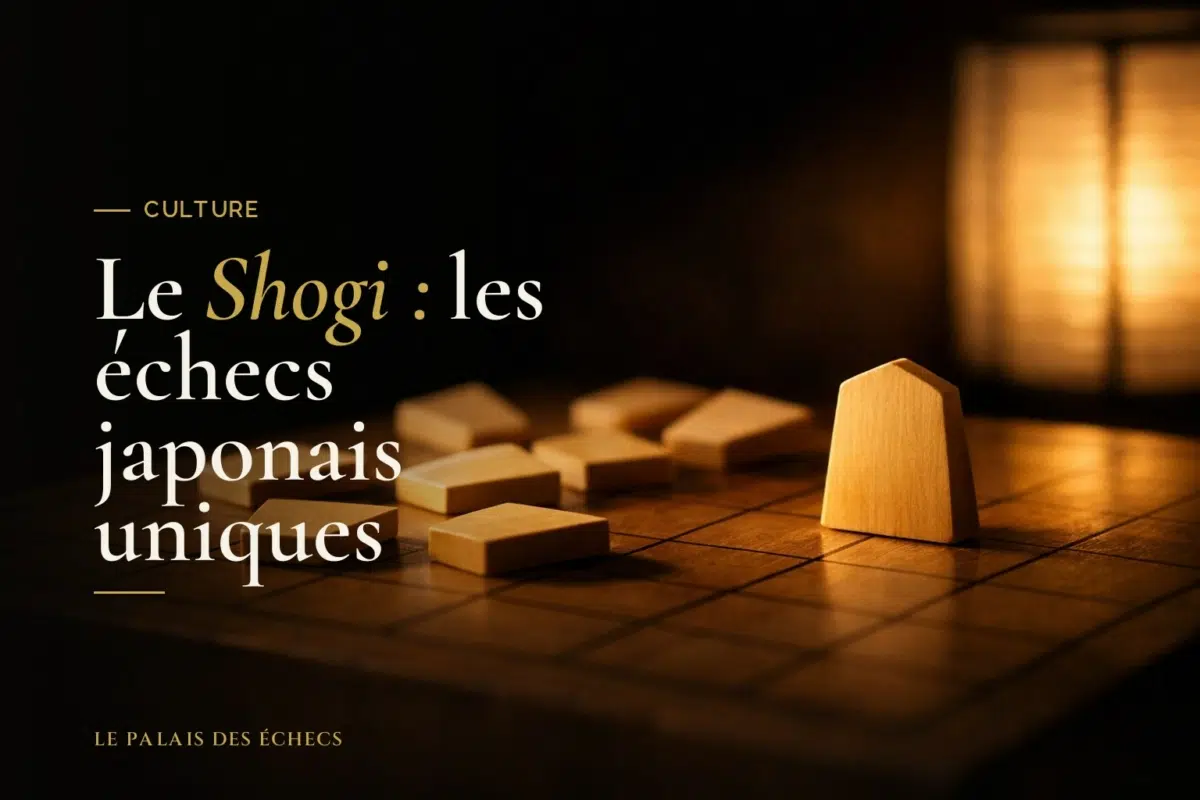
Shogi: discover Japanese chess and its unique rules
05
Jan
Jan
Shogi, or Japanese chess, is a fascinating strategy game played by millions of people in Japan. Its unique feature — the ability to bring captured pieces back into play — makes it the most dynamic of all games in the chess family. Here’s how to learn to play Shogi step by step.
The history of Shogi
Like Western chess and Xiangqi (Chinese chess), Shogi descends from the Indian chaturanga. It is thought to have arrived in Japan during the 6th century via China. The game took its current form during the Edo period (1603-1868), when the best players were sponsored by the shogunate and competed in official matches. Today, professional Shogi in Japan is as prestigious as chess is in Europe, with its own titles and ceremonies. To find out more about the evolution of these games, see our article on the history of chess.
The board and the pieces
Shogi is played on a board of 9 columns x 9 rows (81 squares). The pieces are flat pentagonal wooden pieces, all the same colour — it is their orientation (point facing the opponent) that shows which side they belong to. Each player has 20 pieces:
| Piece | Number | Movement | Promotes to |
|---|---|---|---|
| King (Gyoku/Ou) | 1 | 1 square in any direction | — |
| Rook (Hisha) | 1 | Unlimited straight lines | Dragon king (+ 1 diagonal square) |
| Bishop (Kaku) | 1 | Unlimited diagonals | Dragon horse (+ 1 orthogonal square) |
| Gold general (Kin) | 2 | 1 square: forward, sideways, forward diagonals, backward | — |
| Silver general (Gin) | 2 | 1 square: forward and diagonals | Gold general |
| Knight (Keima) | 2 | L-shaped jump (forward only) | Gold general |
| Lance (Kyosha) | 2 | Unlimited forward (never backward) | Gold general |
| Pawn (Fuhyo) | 9 | 1 square forward | Gold general (Tokin) |
Shogi’s unique rule: dropping pieces
This is THE feature that makes Shogi so special and so different from Western chess. When you capture an opponent’s piece, it changes sides and joins your reserve. On your turn, instead of moving a piece on the board, you can drop a piece from your reserve onto any empty square.
Drop restrictions: A pawn cannot be dropped on a column that already contains one of your unpromoted pawns. A pawn cannot be dropped to deliver immediate checkmate. Pieces are always dropped in their unpromoted form.
This mechanic has profound strategic consequences: in Shogi, the material balance never stops fluctuating. A captured piece always comes back into play, which makes games extremely dynamic and draws almost non-existent (fewer than 1% of professional games).
Promotion
When a piece enters the last three rows of the opponent’s side (the promotion zone), it may (or in some cases must) promote by being turned over. The reverse of the piece shows its new status. Most pieces become gold generals. The two notable exceptions are the rook and the bishop, which become “dragons”, keeping their original movement plus a bonus.
Shogi vs chess: the key differences
| Criteria | Shogi | Western chess |
|---|---|---|
| Board | 9×9 (81 squares) | 8×8 (64 squares) |
| Pieces | 40 (20 per player) | 32 (16 per player) |
| Captured pieces | Join the opponent (drops) | Removed from the game permanently |
| Promotion | Within the last 3 rows | Last row only (pawns) |
| Queen | Does not exist | The most powerful piece |
| Draws | Extremely rare (<1%) | Common at top level (50%+) |
| Complexity | Comparable to chess | 10^120 positions (Shannon) |
To get started: Shogi can be played online on sites such as 81Dojo or Lishogi. If you already know chess, you’ll grasp the logic of the game quickly — it’s the drop rule that will take the most getting used to. Also explore Xiangqi to complete your tour of the world’s chess games. Discover our chess sets for the Western version.
“In Shogi, no piece ever truly dies. It simply changes sides and comes back to fight.”
Discover Chess from Around the World
Chess, Shogi, Xiangqi — explore the strategic variants of the great chess family.
Chess Sets Other Games
Chess in schools: the last hope against France’s educational decline?
By a chess enthusiast, observer of the educational world. Education is constantly evolving, always seeking [...]
Why and how to learn to play chess
Learning chess means opening a door to a world of strategy, creativity and intellectual challenge. [...]
How to Choose Your Backgammon Board: A Buying Guide
We offer a wide range of backgammon boards to choose from. How do you choose [...]