



Chess, Learn Chess, News, Non classé
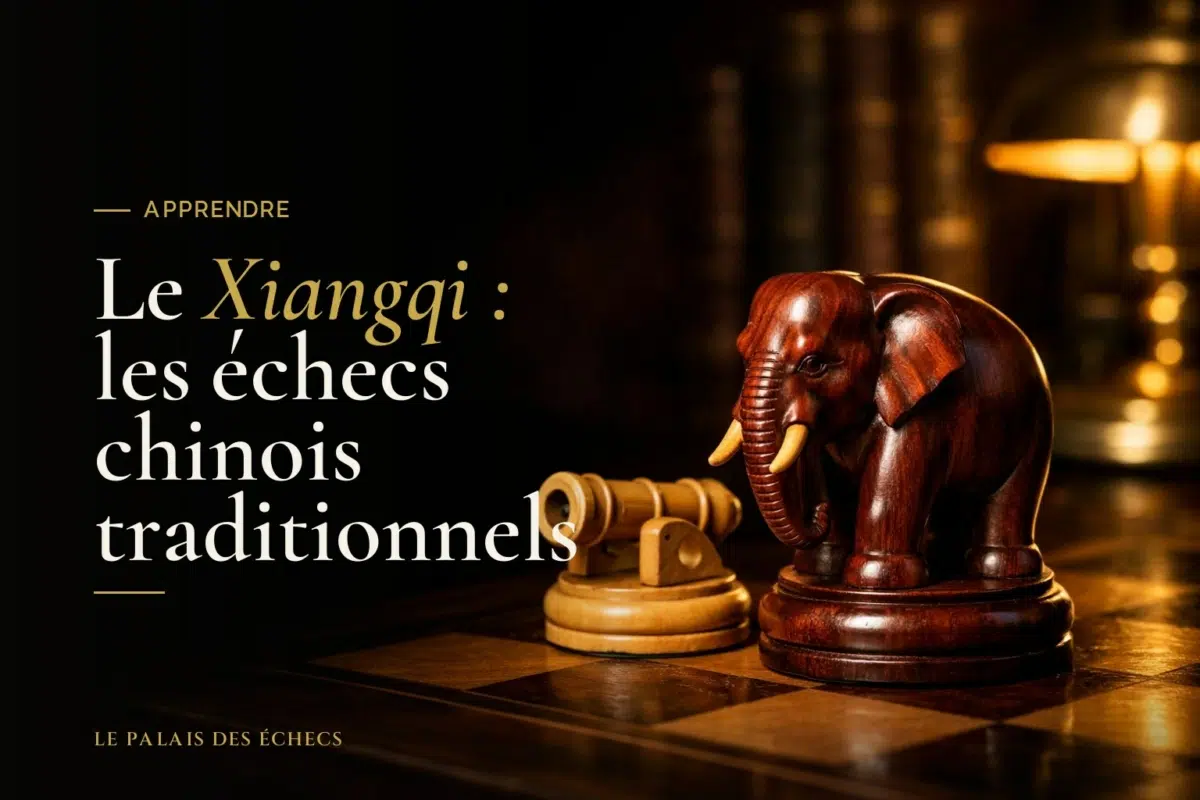
Xiangqi: discovering the traditional Chinese chess game
16
Nov
Nov
Xiangqi is the Chinese chess game, played by hundreds of millions of players across China and South-East Asia. With its central river, its imperial palace and its cannons that jump to capture, it offers a strategic experience radically different from Western chess.
An ancient Chinese game
Xiangqi (pronounced “shiang-chi”) literally means “elephant game”. Like Western chess, it descends from the Indian Chaturanga of the 6th century, but evolved separately for over a millennium in China. Today, this Chinese game of chess is the most widely played board game in the world by number of players — it’s estimated that over 500 million people play it regularly in Asia.
The board and the river
The Chinese chess board is fundamentally different from the Western chessboard:
| Criterion | Xiangqi (Chinese chess) | Western chess |
|---|---|---|
| Board | 9 columns x 10 rows (90 intersections) | 8 x 8 squares (64 squares) |
| Piece placement | On the intersections of the lines | On the squares |
| River | Yes: divides the board into two camps | No |
| Palace | Yes: a 3×3 zone where the general and his guards are confined | No |
| Pieces per player | 16 (1 general, 2 guards, 2 elephants, 2 horses, 2 chariots, 2 cannons, 5 soldiers) | 16 (1 king, 1 queen, 2 rooks, 2 bishops, 2 knights, 8 pawns) |
The river is the most original element of Xiangqi. This horizontal band across the centre of the board separates the two camps and affects the movement of several pieces: elephants cannot cross it, while soldiers gain mobility once they’ve crossed it.
The Xiangqi pieces
♔ The General (Jiang/Shuai)
Equivalent to the king. Moves one intersection horizontally or vertically, but is confined to the palace (3×3 zone). Two generals may never face each other on the same column with no piece between them (the “flying general” rule).
♕ The Guards (Shi)
Protect the general. Move one intersection diagonally, but remain confined to the palace. A rough equivalent of the bishop, but very limited.
🐘 The Elephants (Xiang)
Move 2 intersections diagonally (forming a diamond shape). Cannot cross the river and are blocked if a piece occupies the intermediate intersection. Purely defensive pieces.
♞ The Horses (Ma)
Similar to the Western knight: moves in an L-shape. But in Xiangqi, the horse can be blocked if a piece occupies the adjacent square in the direction of movement. Weaker than the Western knight.
♖ The Chariots (Ju)
Identical to the Western rook: unlimited horizontal and vertical movement. The most powerful piece in Xiangqi, just as the rook is a major piece in chess.
💥 The Cannons (Pao)
A piece unique to Xiangqi, with no Western equivalent. Moves like a chariot (horizontally/vertically) but to capture, must jump over exactly one piece (friendly or enemy) between itself and its target. A fascinating mechanism found in no other chess game.
Asian chess vs Western chess
Xiangqi and Western chess share a common ancestor but offer very different experiences:
⚔ Xiangqi: more aggressive
The river, the general’s confinement to the palace and the absence of a queen make Xiangqi more tactical and aggressive. Checkmates arrive faster, sacrifices are more frequent, and endgames are very different.
♔ Chess: more strategic
The all-powerful queen, the absence of a river and castling give Western chess a more positional and strategic character. Games are generally longer and long-term plans matter more.
Asian chess is enjoying a resurgence of interest in the West thanks to online platforms that allow you to play against opponents from around the world. If you’ve mastered Western chess, Xiangqi will feel both familiar and surprising — an excellent way to broaden your strategic horizons. To discover another Asian chess game, take a look at our guide to Japanese Shogi.
Discover our Strategy Games
Chess, backgammon, draughts, dominoes: all in solid wood, made in Europe.
Chess sets Other games
The 11 best chess players of all time
Who is the best chess player in the world? Ask any chess enthusiast and you'll [...]
The English Opening in chess: the basics to master it
The English Opening (1.c4 (also known as the c4 opening)) is a sophisticated flank opening, [...]
Scholar’s Mate in chess: how to play it and stop it in 4 moves
Scholar’s Mate is the fastest and most famous checkmate in chess. In just 4 moves, [...]